My caramel has a habit of going from golden to burnt while I reach for the cream, and my fried chicken used to come out either greasy or dark outside and raw in the middle. Both are temperature problems, which is exactly what precision induction cooktops promise to fix. But a burner that shows 5-degree steps on its screen doesn’t always hold that temperature in the pan.
So in October I tested five temperature-controlled burners for home kitchens on our kitchen counter. Each one held 2 quarts of frying oil at 350°F for an hour while a probe thermometer logged the real temperature every 30 seconds, and the probe models held a pot of water at 140°F for sous vide-style eggs. Then I made fried chicken, caramel, tempered chocolate and soft-boiled eggs on each.
The Breville Control Freak Home is the most precise burner I’ve cooked on. It sets the temperature in 1-degree steps from 77°F to 482°F and held my frying oil within about 3 degrees of the setting for an hour. It costs about $1,500, though. For most people, the NuWave Diamond with probe gives probe-controlled cooking for a fraction of the price, and the NuWave Precision Gold is the best precision burner without a probe.
Wondering whether the Breville is worth it? Read my Breville Control Freak review. For everyday boiling and sautéing, a regular portable induction burner does the job for much less. If exact temperatures are what you’re after, keep reading.
My rankings at a glance
| Rank | Cooktop | Best for | Steps | Oil swing at 350°F | Water swing at 140°F | My rating |
|---|---|---|---|---|---|---|
| 1 | Breville Control Freak Home | Most precise | 1°F | about 3°F | about 1°F | 9.2 |
| 2 | NuWave Diamond with Probe | Best value with a probe | 5°F | about 12°F | about 3°F | 8.1 |
| 3 | NuWave Precision Gold | Best without a probe | 5°F | about 14°F | No probe | 7.8 |
| 4 | NuWave Upgraded Cooktop with Digital Probe | Best probe model for searing | 5°F | about 13°F | about 4°F | 7.7 |
| 5 | NuWave Precision 10.25 inches | Best compact precision burner | 5°F | about 16°F | No probe | 7.3 |
| Pro | Breville Control Freak (original) | Commercial kitchens | 1°F | Not tested | Not tested | — |
The oil swing shows how far 2 quarts of oil moved above and below 350°F over one hour, read by a probe thermometer every 30 seconds. Smaller is better. Ratings are out of 10.
Precision induction cooktop reviews
Here’s how each precision burner did in my kitchen, most precise first.
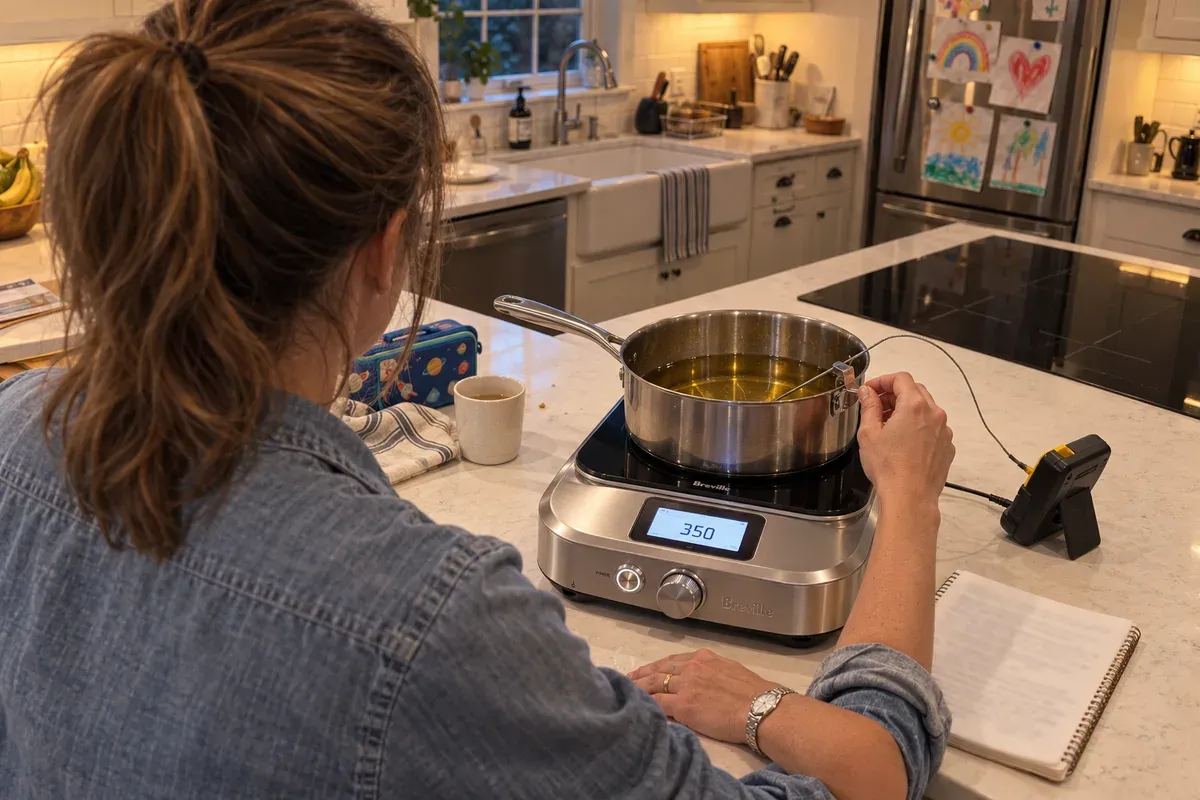
1. Most precise: Breville Control Freak Home
Quick facts: Temperature: 77–482°F in 1°F steps (405 settings) · Sensors: Dual sensors under the glass plus a precision temperature probe · Power: 1,800 watts, 120 volts · Controls: Touchscreen with 4 cooking modes and a control knob · Size: 12.2 × 16.9 × 4.1 inches; about 15.4 pounds · List price: $1,499.95 on Breville’s site
My results: Oil held about 3°F up or down; water about 1°F up or down. My rating: 9.2 out of 10.
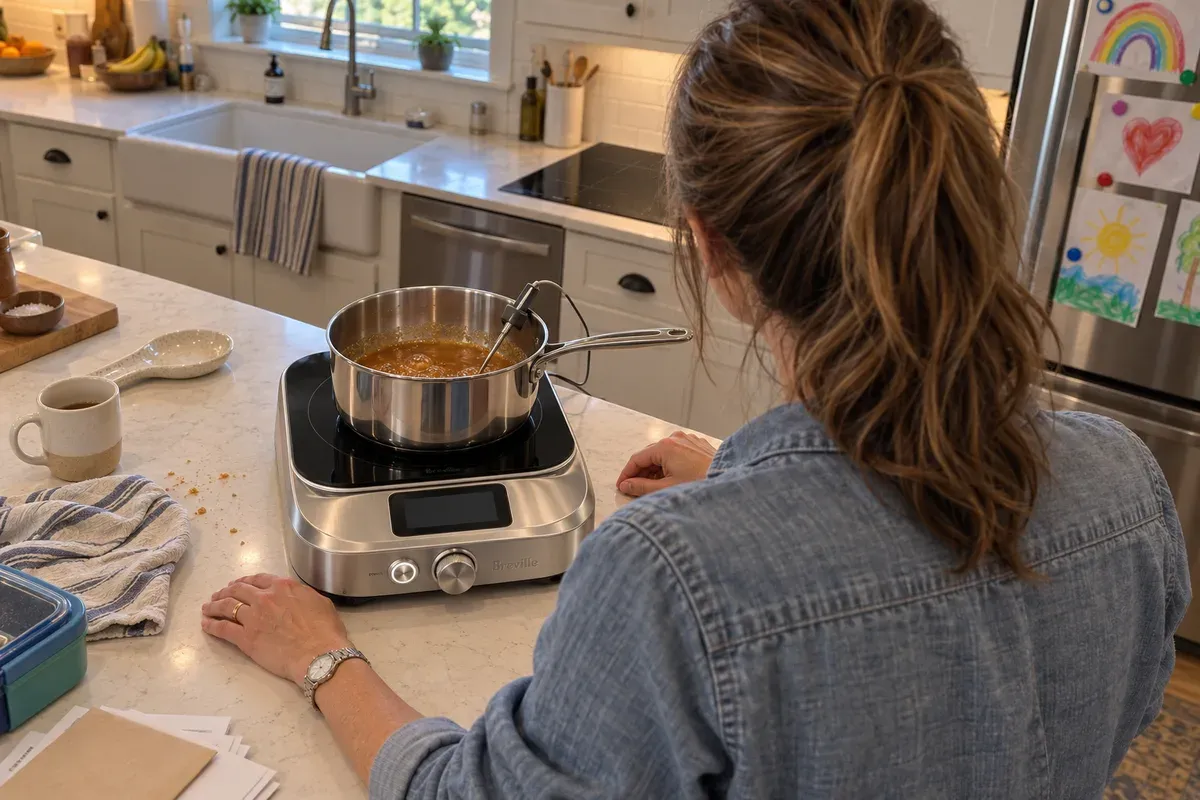
This is the burner chefs talk about, in a smaller home version. Its sensors and probe let it hold a temperature in a way no other burner here could: my caramel went from pale to perfect amber without the usual frantic stirring, and fried chicken oil barely moved when I added cold chicken. The touchscreen has modes for ingredients and techniques, plus custom presets.
It’s expensive, big and heavy, and it does one zone. Per The Rational Kitchen’s Control Freak spec comparison, the Home version drops the original’s Universal Serial Bus (USB) port and commercial listing, has a thinner steel housing, and costs a little less. Want the full story? Read my Breville Control Freak vs Control Freak Home comparison.
What I liked
- It sets temperatures in 1-degree steps and actually holds them.
- It uses both a probe and sensors under the glass.
- Its touchscreen modes are easy to use.
What I didn’t like
- It costs about $1,500.
- It’s large and heavy for a single zone.
My verdict: Buy it if you fry, make candy or temper chocolate often and want the temperature to stay exactly where you set it. Skip it if you mostly boil and sauté.
2. Best value with a probe: NuWave Diamond with Probe
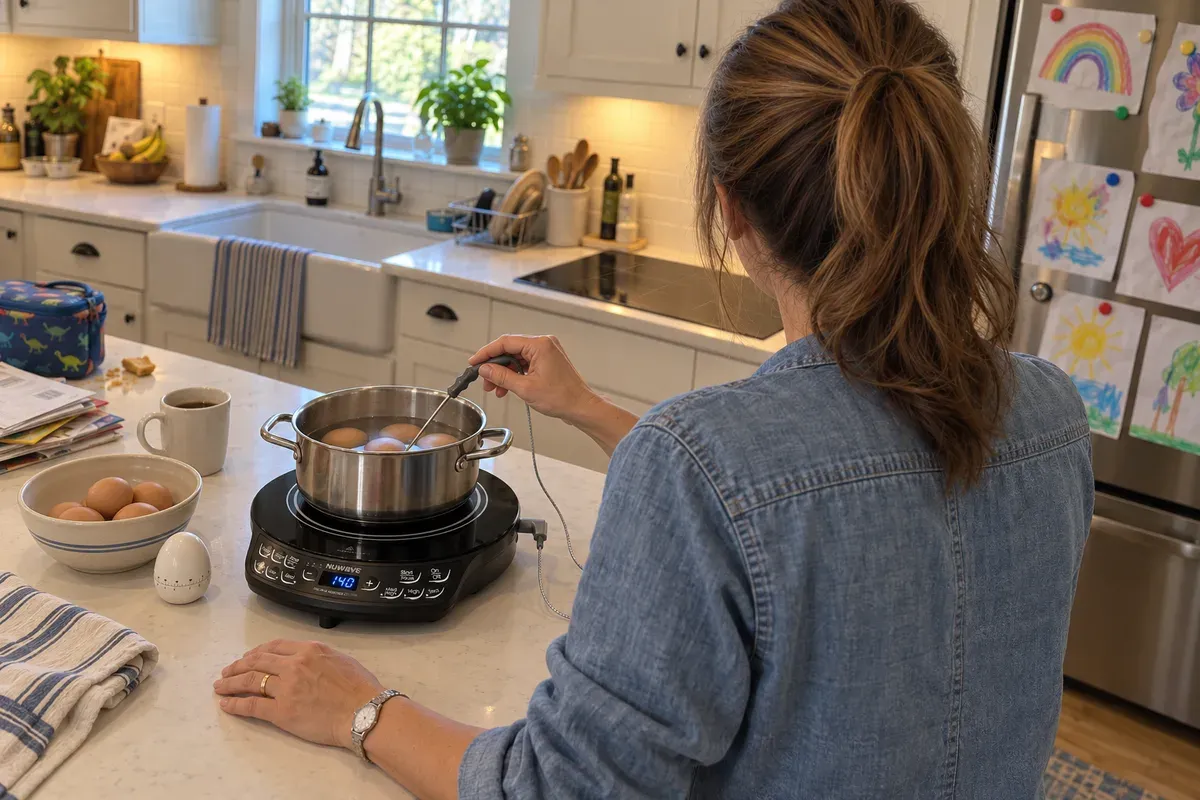
Quick facts: Temperature: 100–500°F in 5°F steps (91 settings); 5 presets · Probe: Digital probe controls liquids up to 480°F and reads internal temperatures up to 212°F · Programs: Pasta, soup/stock, deep fry, rice · Power: 1,400 watts, 120 volts · Size: About 11.9 × 10.3 × 2.3 inches
My results: Oil held about 12°F up or down; water about 3°F up or down. My rating: 8.1 out of 10.
The probe is what makes this work: in water and soups, it held 140°F within a few degrees for two hours, good enough for sous vide-style eggs. In oil, without the probe in the pot, it swung more. At 1,400 watts it’s slower to heat a big pot of oil than an 1,800 watts burner. Owners mention fan noise and price.
What I liked
- It offers probe control for a fraction of the Breville’s price.
- Its automatic programs are handy.
What I didn’t like
- At 1,400 watts, it’s slower with big pots.
- Its temperature swung more in oil.
My verdict: Buy it if you want probe-controlled cooking for a fraction of the Breville’s price. Skip it if you deep-fry often and want a tight oil temperature.
3. Best without a probe: NuWave Precision Gold
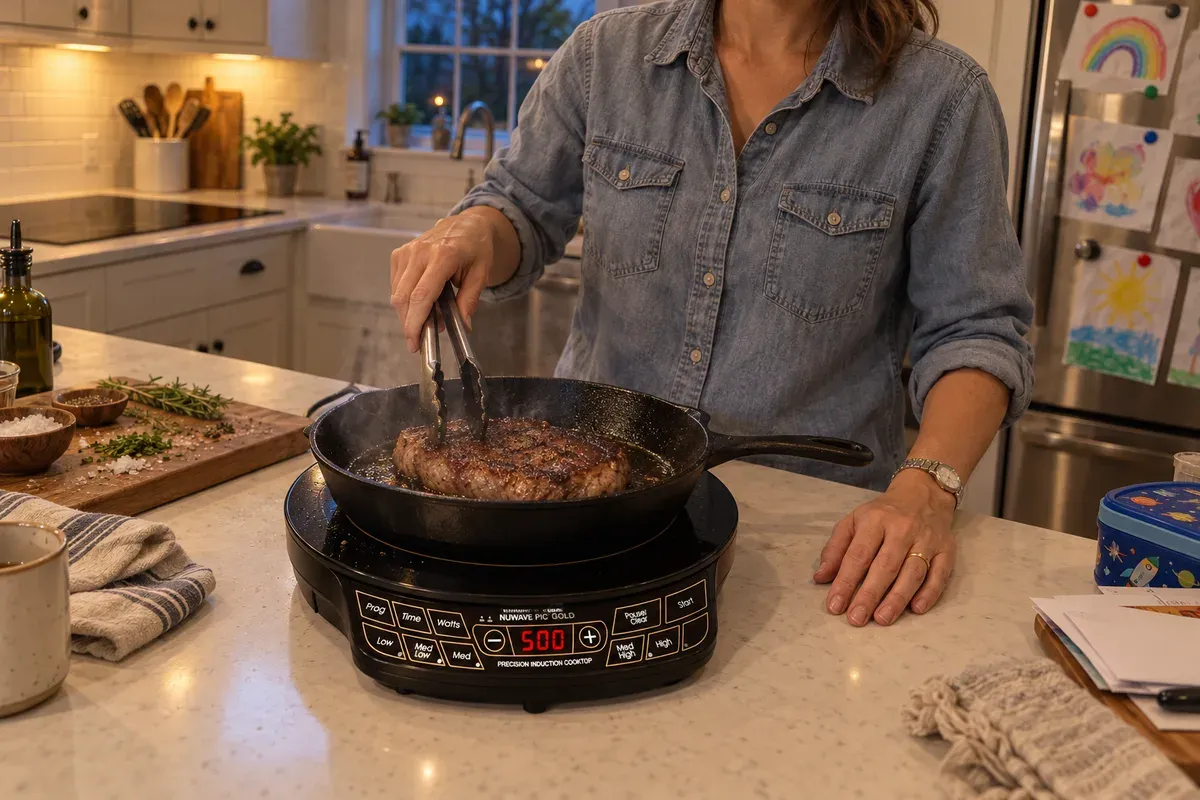
Quick facts: Temperature: 100–575°F in 5°F steps; 6 presets · Coil: 8 inches · Power: 1,500 watts, 120 volts · Size: 12.4 × 13.8 × 2.3 inches; 6.5 pounds · Safety: Shuts off when the timer ends; won’t start without cookware
My results: Oil held about 14°F up or down. My rating: 7.8 out of 10.
The 8-inch coil heats a 10-inch skillet more evenly than NuWave’s smaller models, and owners say it holds a set temperature for hours. It made a great steak sear at 500°F. Some owners report failures after about six months, so keep your receipt.
What I liked
- Its 8-inch coil is large.
- It goes up to 575°F for searing.
What I didn’t like
- It has no probe.
- Reports on its long-term reliability are mixed.
My verdict: Buy it if you want a big coil and high searing heat without paying for a probe. Skip it if you need the temperature to hold within a few degrees.
4. Best probe model for searing: NuWave Upgraded Cooktop with Digital Probe
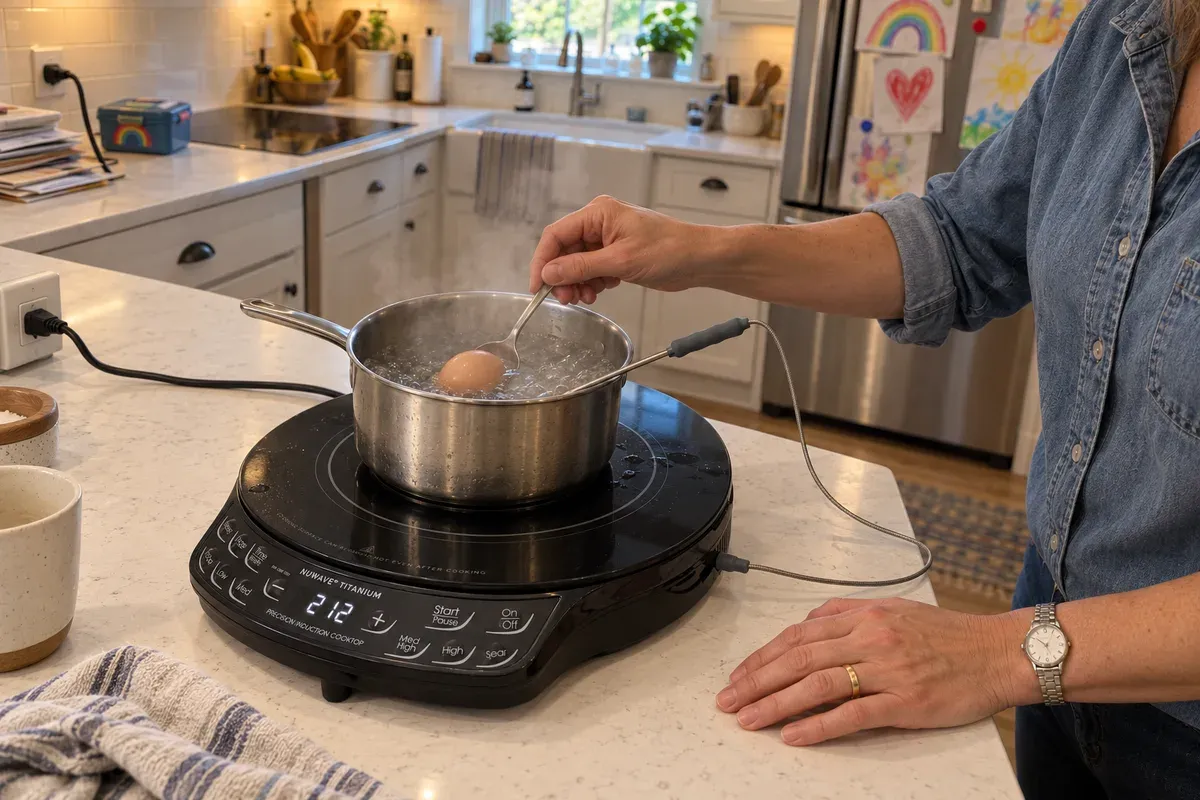
Quick facts: Temperature: 50–575°F in 5°F steps (106 settings); presets 100/200/300/400/575°F · Probe: Patented digital temperature probe · Power: 1,800 watts · Display: Cool-white digital display · Size: 12.3 × 14 × 2.6 inches
My results: Oil held about 13°F up or down; water about 4°F up or down. My rating: 7.7 out of 10.
This combines a probe with a full 1,800 watts and a 575°F top setting, so it can both hold a gentle temperature and sear hard. Eggs were excellent; owners mention a loud fan, and I agree.
What I liked
- It combines a probe with a full 1,800 watts.
- Its range is wide, from 50°F to 575°F.
What I didn’t like
- Its fan is loud.
My verdict: Buy it if you want a probe and full 1,800-watt power for searing. Skip it if a loud fan bothers you.
5. Best compact precision burner: NuWave Precision 10.25 inches
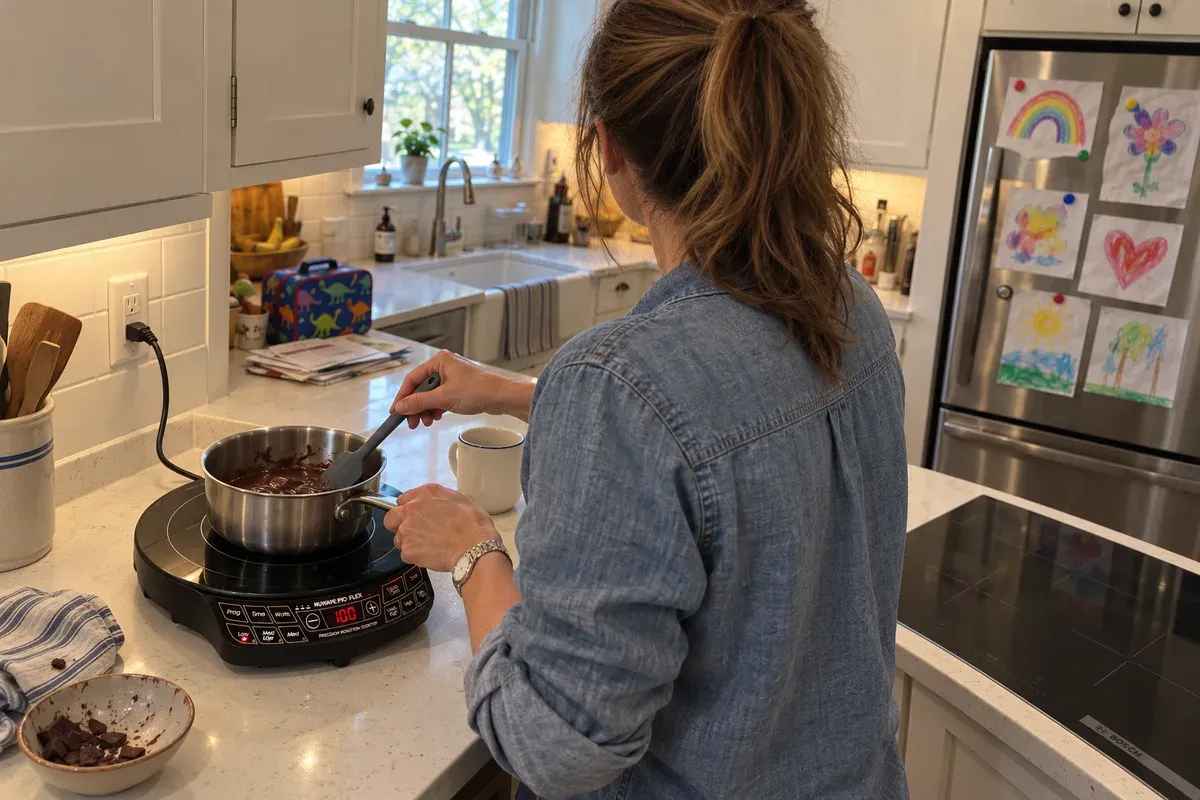
Quick facts: Temperature: 100–500°F in 5°F steps (81 settings) · Power: 1,400 watts, 120 volts · Size: 10.3 × 11.8 × 2.3 inches; 4 pounds · Glass: Shatter-proof ceramic glass
My results: Oil held about 16°F up or down. My rating: 7.3 out of 10.
Small and light, with the same 5-degree controls. Great for melting chocolate or keeping sauces warm in a tiny kitchen. It swung the most in oil, so I wouldn’t deep fry on it.
For more, see my guide to the best small induction cooktops.
What I liked
- It’s compact and light.
- It sets temperatures in 5-degree steps.
What I didn’t like
- It was the least precise in oil.
- It tops out at 1,400 watts.
My verdict: Buy it if you want a light, compact burner with temperature steps. Skip it if precise frying is the main reason you’re buying.
For commercial kitchens: Breville Control Freak (original)
Quick facts: Temperature: 77–482°F in 1°F steps · Extras: USB port for recipe programs, 72-hour timer, carrying case · Listings: Underwriters Laboratories (UL)/IEC and NSF commercial; IPX3 water protection · Size: 13.7 × 18.5 × 4.3 inches; about 16.2 pounds · Price: About $1,500
I didn’t test the original, commercial-rated Control Freak, so it isn’t ranked. It shares the Home version’s temperature control but adds a sturdier housing, a USB port and an NSF listing for restaurants. For a home kitchen, the Home model is the better buy.
My verdict: Buy it if you cook for paying customers and need the commercial listings, USB recipe programs and 72-hour timer. Skip it if you cook at home; the Home version does the same job.
Others I considered
- Hestan Cue: an app-guided induction burner that talks to sensor-equipped pans.
- Duxtop 9600LS: excellent burner with 20 temperature levels, but it doesn’t hold an exact temperature as well. See my portable guide.
What “precision” really means on an induction cooktop
Most portable burners are told “deliver this much power.” A temperature-controlled burner instead reads a sensor and adjusts power to hit a number. There are three kinds of sensor:
- Sensor under the glass: reads the bottom of the pan through the glass. Simple, but slow to react and affected by pan thickness. Most NuWave burners work this way.
- Plug-in probe: a thermometer that sits in the food or liquid, so the burner controls what you actually care about. The NuWave Diamond and Breville both have one.
- Pan sensors plus fast electronics: the Breville combines dual sensors under the glass with its probe, which is why it holds so tightly.
A burner can display 5-degree steps and still swing 15 degrees in the pan, because many cheaper units hold low and medium temperatures by switching the power on and off. That’s exactly what I saw on the NuWave models without a probe.
How to choose a precision induction cooktop
Probe or no probe
A probe controls the food or liquid directly, which is what you want for frying, candy, sous vide-style cooking and soups. Without one, the burner guesses from the pan bottom.
Steps vs real accuracy
Small steps on the display don’t guarantee a steady pan. Look for independent tests, and check with your own thermometer.
Power
1,800 watts heats big pots of oil faster; 1,400 watts models are fine for smaller batches.
Price
The Breville is in a class of its own, at a price to match. NuWave’s probe models get you most of the benefit for everyday cooking.
New to temperature modes? See how to use an induction cooktop. Your pans must be magnetic, so check my guide to what cookware works on induction.
FAQ
What is the most precise induction cooktop?
In my tests, the Breville Control Freak Home was the most precise, holding frying oil within a few degrees of its setting. It sets temperatures in 1°F steps from 77 to 482°F.
Is the Breville Control Freak worth it?
For cooks who fry, make candy or need exact temperatures often, yes. For everyday cooking, a NuWave probe model gets you most of the benefit for much less.
How accurate are NuWave induction cooktops?
They set temperatures in 5°F steps, but without a probe the real pan temperature can swing more than that. Using the probe in liquids improves accuracy a lot.
Can you deep fry on an induction cooktop?
Yes. A temperature-controlled burner, ideally with a probe, makes it easier to keep oil at the right temperature. Never leave hot oil unattended.
Can you sous vide on an induction cooktop?
With a probe-controlled burner, you can hold water at a low set temperature for sous vide-style cooking. A dedicated immersion circulator is still more precise for long cooks.
What is the difference between power level and temperature mode?
Power level sets how much energy goes into the pan. Temperature mode uses a sensor to hold a set temperature and adjusts power automatically.