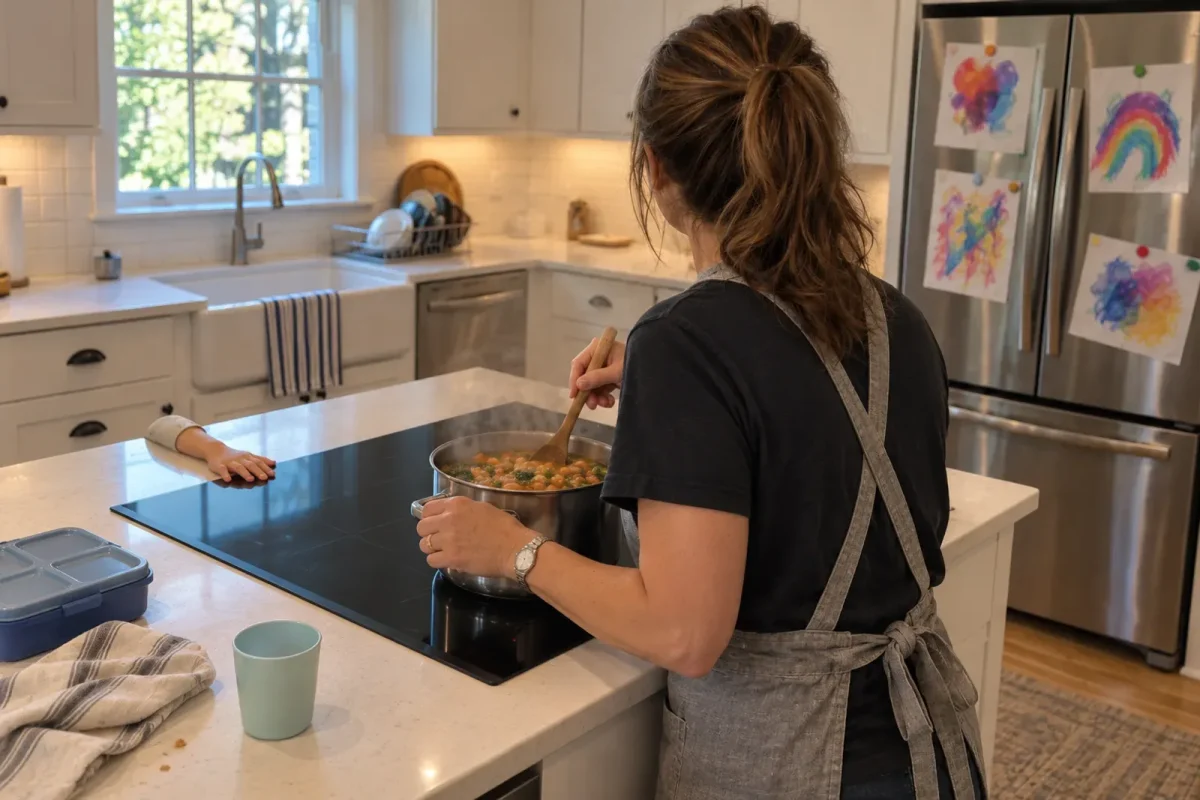
Yes, induction cooking is safe for most people, and in several ways it’s safer than gas or radiant electric: there’s no open flame, no combustion gases, and a zone won’t heat without a magnetic pan on it. The magnetic field is low-frequency, drops off within a few inches, and health agencies don’t expect harm at normal cooking distances. Two groups should take extra care. The first is people with a pacemaker or an implantable cardioverter-defibrillator (ICD), who should follow their device maker’s distance advice (Medtronic says 24 inches). The second is families with small children, because the glass still gets hot from the pan.
I’m a mom of four and have cooked on induction for nine years. Safety was the main reason I chose it. I’m not a doctor or a physicist, so this guide is built on what health agencies and heart-device makers publish, plus the surface-temperature checks I do on every cooktop I test.
Induction safety at a glance
- The electromagnetic field (EMF) is a low-frequency magnetic field, about 20 to 100 kilohertz, that weakens quickly with distance, according to Germany’s Federal Office for Radiation Protection (BfS).
- Pacemakers and ICDs: Medtronic advises keeping 24 inches between an induction cooktop and the device; ask your doctor.
- The glass gets hot from the pan, so watch the residual-heat “H” light.
- There’s no flame, and zones won’t heat without a magnetic pan.
- Nothing burns, so there’s no nitrogen dioxide from burning gas.
- During pregnancy, the BfS says no extra precautions are needed beyond normal use.
Is induction cooking radiation (EMF) harmful?
Induction cooktops create an electromagnetic field (EMF), but it’s not the kind of radiation in X-rays. It’s a low-frequency magnetic field, typically around 20 to 100 kilohertz (kHz), that heats the pan by creating currents in its magnetic base. Most of the energy goes into the pan; a small “stray field” leaks around it and fades quickly with distance.
Germany’s Federal Office for Radiation Protection (BfS) says that when an induction hob is used as the manual directs, stray fields are low and usually stay below the international reference value of 27 microtesla (µT) set by the International Commission on Non-Ionizing Radiation Protection (ICNIRP). It expects no health effects because these fields couple only weakly with the body. The BfS notes that fields can rise close to the cooktop under unfavorable conditions, such as an unsuitable or off-center pan, and recommends:
- Use pans of the right size and material, with a flat base.
- Cover the cooking zone completely with the pan.
- Keep about 5 to 10 centimeters (2 to 4 inches) between your body and the front edge or an active zone.
A study of domestic and professional induction cooktops found the same pattern: exposure depends heavily on pan placement and distance. In short, a well-sized, centered pan is the simplest way to keep stray fields low. To learn more about how the field works, read How Does an Induction Stove Work?
Induction cooktops and pacemakers
This is the one group that should be cautious. Strong magnetic fields can interfere with implanted heart devices such as pacemakers and implantable cardioverter-defibrillators (ICDs).
- Medtronic lists induction cooktops among products that produce large electromagnetic fields and advises keeping 24 inches (about 61 cm) between the cooktop and the heart device.
- Harvard Health Publishing advises a distance of 12 to 24 inches for anyone with an implanted heart device, and suggests checking the device maker’s brochure.
- The BfS advises people with active implants to ask their doctor whether household appliances like induction hobs could affect them.
- Your cooktop’s own manual usually includes a pacemaker warning.
Practical steps: ask your cardiologist, use the back zones so the device stays farther away, don’t lean over an active zone, and don’t rest your chest against the counter while cooking. If your doctor advises against it, a radiant electric cooktop has no strong magnetic field.
Is induction cooking safe during pregnancy?
The BfS says the same advice applies to pregnant women as to everyone else, and no additional measures are needed: use the right pans, cover the zone, and keep a normal distance. If you have concerns, ask your doctor or midwife.
Burns: does an induction cooktop get hot?
The glass doesn’t heat itself, but it does get hot from the pan sitting on it, especially after long cooking or when a pan boils dry. It cools faster than radiant electric. In my tests, the glass next to a boiling pot read 118°F; under a cast-iron skillet after searing it read 260°F; a radiant electric zone read 410°F.
- Most cooktops show an “H” or residual-heat light until the glass cools.
- The pan handle and pan itself get just as hot as on any stove.
- An empty zone with no pan stays cool, so a hand on it won’t burn.
Fire safety
There’s no open flame to catch a towel, sleeve or paper, and no gas to leave on unlit. Induction zones stop heating when the pan is lifted, and most cooktops have overheat protection and an automatic shut-off after a set time. Oil can still overheat and catch fire in the pan, so never leave hot oil unattended. Keep a lid nearby to smother a pan fire, and never put water on a grease fire.
Indoor air quality
Gas burners release nitrogen dioxide (NO2) and other combustion pollutants. A 2024 Stanford study estimated typical gas and propane stove use raises average yearly NO2 exposure by about 4 parts per billion. Induction burns nothing, so those combustion pollutants are gone. Cooking itself still produces smoke and grease particles, so use a range hood that vents outside. For more, read Induction vs Gas.
Safety features for families
| Feature | What it does | Why it matters |
|---|---|---|
| Pan detection | Zone only heats with a magnetic pan on it | Hands, towels and toys on an empty zone won’t heat |
| Child lock / control lock | Locks the touch controls | Curious kids can’t switch it on |
| Residual-heat indicator | Shows “H” while glass is hot | Warns before you touch |
| Auto shut-off | Turns zones off after a time limit | Backup if you forget |
| Overheat protection | Cuts power if a pan gets too hot | Helps with boiled-dry pans |
| Safety listing (UL or ETL, two independent U.S. testing labs) | Tested to US electrical safety standards | Look for the mark on any cooktop you buy |
I keep the child lock on whenever the cooktop is off; my youngest learned to tap the power button at age three.
My induction safety habits
- Lock the controls when not cooking.
- Turn pan handles toward the back.
- Use the back zones when little kids are around.
- Match the pan to the zone and center it.
- Don’t leave metal utensils, foil or lids on an active zone; they can heat up.
- Lift pans instead of sliding to protect the glass; a cracked cooktop should be switched off at the breaker and not used.
- Use only induction-compatible pans. For more, read What Cookware Works on Induction?
New to induction? Read how to use an induction cooktop and the pros and cons.
FAQ
Is induction cooking safe?
Yes, for most people. It has no flame or combustion gases, the magnetic field fades within a few inches, and zones won’t heat without a pan. People with pacemakers or ICDs should follow their doctor’s and device maker’s advice.
Do induction cooktops give off harmful radiation?
They give off a low-frequency magnetic field, not ionizing radiation. Germany’s BfS expects no health effects at normal distances when you use suitable, centered pans.
Can you use an induction cooktop with a pacemaker?
Many people do, but ask your cardiologist first. Medtronic advises keeping 24 inches between an induction cooktop and the heart device, and Harvard Health advises 12 to 24 inches.
Is induction cooking safe during pregnancy?
Germany’s BfS says pregnant women don’t need extra precautions beyond normal use: suitable pans that cover the zone and a normal distance. Ask your doctor if you’re concerned.
Can you burn yourself on an induction cooktop?
Yes. The glass gets hot from the pan and stays hot for a while after cooking. Watch for the residual-heat light before touching it.
Is induction safer than gas?
In most ways, yes: no open flame, no gas leaks, no combustion pollutants indoors, and a cooler surface. Gas still works in a power outage.