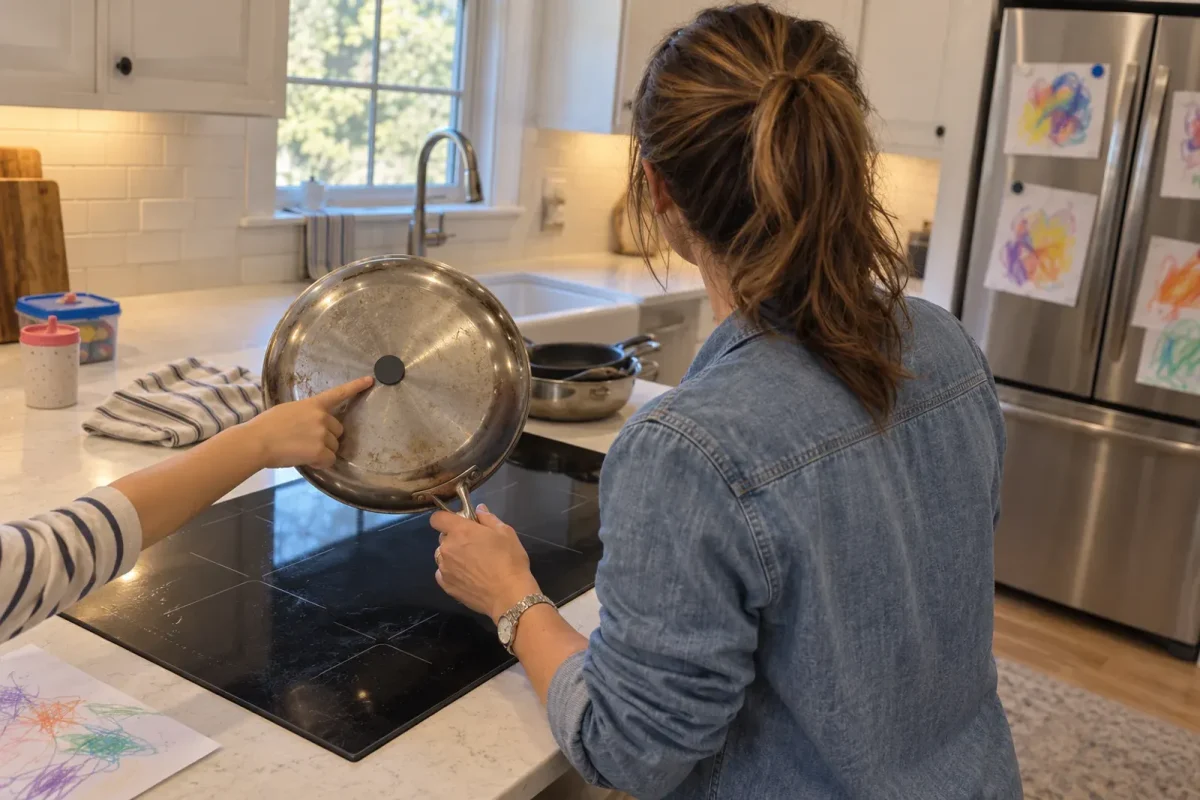
Cookware works on induction if its base is magnetic. Hold a fridge magnet to the bottom of the pan: if it sticks firmly, the pan will work. Cast iron, enameled cast iron, carbon steel and most clad or disc-bottom stainless steel work. Plain aluminum, copper, glass and ceramic don’t, unless they have a magnetic steel plate built into the base.
When I switched to induction nine years ago, I magnet-tested every pan in my kitchen before buying anything new. Seven of my ten pans already worked. For this guide I tested 24 pans from my kitchen and my friends’ kitchens on the same induction cooktop. Here is what works, what doesn’t, and how to check yours in 30 seconds.
What works on induction
| Material | Works on induction? | Notes |
|---|---|---|
| Cast iron | Yes | Heats slowly but evenly once hot; lift, don’t slide |
| Enameled cast iron (e.g. Le Creuset, Staub) | Yes | Smooth enamel base is gentle on glass |
| Carbon steel | Yes | Great for woks and skillets; must be flat-bottomed |
| Clad stainless steel (tri-ply, 5-ply) | Usually | Works if the outer layer is magnetic stainless |
| Disc-bottom stainless steel | Usually | Works if the base disc is magnetic |
| Nonstick and ceramic-coated | Only with a magnetic base | Look for a steel plate or the induction symbol |
| Plain aluminum | No | Needs a magnetic base plate or a converter disc |
| Copper | No | Unless it has a magnetic steel base |
| Glass, stoneware, ceramic pots | No | Only with a converter disc |
Why induction needs magnetic cookware
An induction cooktop heats with a changing magnetic field, not a flame or a hot coil. That field only creates heat inside metals that react strongly to magnets, called ferromagnetic metals, such as iron and many types of steel. Aluminum, copper and glass don’t react enough, so the cooktop either won’t detect them or barely heats them. For more, read How Does an Induction Stove Work?
The magnet test, step by step
- Take any fridge magnet.
- Hold it to the center of the flat bottom of the pan, on the outside.
- If it sticks firmly, the pan will work well. If it sticks weakly, it may work but heat slowly or unevenly. If it doesn’t stick, it won’t work on induction.
- Check near the edge of the base too. On disc-bottom pans the magnetic plate may be smaller than the base, which means only the center will heat.
The induction symbol and what “induction ready” means
“Induction ready,” “induction compatible” and “induction safe” all mean the same thing: the base is magnetic and the pan will work on an induction cooktop. Many brands print a symbol on the base or the box that looks like a coil of wire or a flat spring inside a square. It’s helpful, but the magnet test is the real proof.
What I found testing 24 pans
I put each pan on my Bosch 800 Series on power level 9 with 2 cups of water and timed it to a boil. A magnetic pan with a full-width base was always the fastest.
| Pan | Magnet | Detected? | 2 cups to a boil | Notes |
|---|---|---|---|---|
| Tri-ply stainless 3-quart saucepan | Strong | Yes | 1 min 58 sec | Even boil across the base |
| Lodge 12-inch cast-iron skillet | Strong | Yes | 2 min 40 sec | Slower to heat, very even once hot |
| Enameled cast-iron Dutch oven | Strong | Yes | 2 min 35 sec | No scratches on the glass |
| Carbon-steel flat-bottom wok | Strong | Yes | 2 min 5 sec | Only the flat center heats |
| Disc-bottom stainless stockpot | Medium | Yes | 2 min 20 sec | Disc smaller than base; ring of slower bubbles |
| Nonstick skillet with steel base plate | Medium | Yes | 2 min 12 sec | Fine for eggs |
| 18/10 stainless pot, no magnetic layer | None | No | — | Error symbol flashed |
| Plain aluminum sauté pan | None | No | — | Cooktop didn’t detect it |
| Copper saucier | None | No | — | Cooktop didn’t detect it |
| Glass saucepan | None | No | — | — |
These are 10 of the 24 pans I tested; the rest followed the same pattern.
Material by material
Cast iron
Cast iron works very well on induction because iron is strongly magnetic. Lodge says its cast iron is safe on induction cooktops and recommends preheating slowly and lifting the pan rather than sliding it. Full guide: can you use cast iron on induction?
Enameled cast iron (Le Creuset, Staub)
Enameled cast iron works because there’s iron under the enamel. The smooth enamel base is kind to the glass. My Le Creuset Dutch oven has worked on induction for years.
Carbon steel
Carbon steel works and heats faster than cast iron. Choose flat-bottomed carbon-steel woks and skillets, because a round bottom only touches the glass at one point.
Stainless steel
Stainless steel works only if it’s a magnetic grade. Many pans are made of non-magnetic 18/10 or 18/8 stainless inside, with a magnetic stainless layer on the outside (clad) or a magnetic disc on the bottom. Pans made only of non-magnetic stainless won’t work. Full guide: does stainless steel work on induction?
Nonstick and ceramic-coated
The coating doesn’t matter; the base does. Most modern nonstick pans sold as induction-compatible have a steel plate pressed into an aluminum body.
Aluminum, copper and glass
These don’t work on their own because they aren’t magnetic. Some copper and aluminum pans have a magnetic steel base added; the magnet test will tell you.
Pan size and shape matter too
- A flat base matters because induction heats only where the pan touches the glass. A warped or round base heats unevenly.
- Size matters too. Most zones need a minimum pan diameter to detect the pan, often around 4 to 5 inches; check your cooktop’s manual. A pan much bigger than the zone heats only in the middle.
- Weight affects cooking: very thin pans heat fast but scorch easily, while heavier bases spread heat more evenly.
Can induction cookware go on gas or electric stoves?
Yes. Induction-ready pans work on gas, radiant electric and coil electric stoves too. The magnetic base is only needed for induction. That makes induction-compatible pans a safe buy even before you switch.
What to do with pans that don’t work
- You can use a converter disc: a magnetic steel plate that goes on the cooktop and your pan sits on top. It works but is slower and less efficient; in my test, 2 cups took 4 minutes and 10 seconds on a disc vs 1 minute and 58 seconds in a tri-ply pan. For more, read Induction Converter Discs.
- Keep them for the oven or a portable gas burner.
- Replace slowly, starting with the two or three pans you use every day.
FAQ
What pans work on an induction cooktop?
Pans with a magnetic base: cast iron, enameled cast iron, carbon steel, and most clad or disc-bottom stainless steel. If a magnet sticks firmly to the bottom, it will work.
Do you need special pans for induction?
You need magnetic pans, but they don’t have to be special. Many pans you already own probably work; test them with a fridge magnet before buying new ones.
What does induction ready mean?
It means the pan has a magnetic base and will work on an induction cooktop. It’s the same as “induction compatible” or “induction safe.”
Does aluminum work on induction?
Plain aluminum doesn’t, because it isn’t magnetic. Aluminum pans with a steel plate in the base do work.
Does copper work on induction?
Not on its own. Copper pans only work if they have a magnetic steel base added.
Can you use induction cookware on a gas stove?
Yes. Induction-ready cookware works on gas, radiant electric and coil electric stoves as well.
Does Le Creuset work on induction?
Yes. Le Creuset enameled cast iron has an iron core, so it’s magnetic and works on induction.