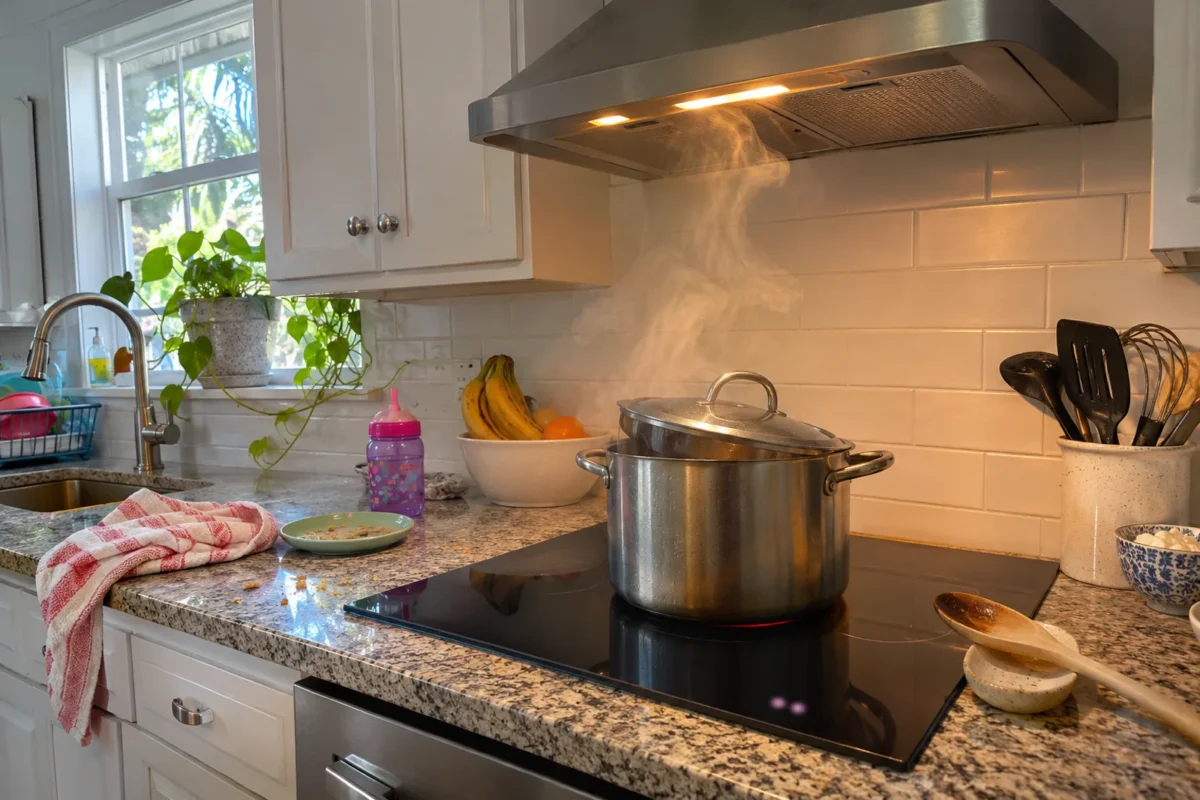
You don’t strictly need a range hood with an induction cooktop, because induction burns no gas, but you should still have one. The food itself makes smoke, grease, steam and fine particles no matter what you cook on. For most homes, a ducted hood at least as wide as the cooktop, moving about 300 to 500 cubic feet of air per minute, is plenty for induction. That’s less than a gas cooktop needs, and staying at 400 or under usually means no makeup air system.
When we switched from gas, I assumed the hood mattered less, and in one way it does: no more burner exhaust. Then I seared steaks on the new cooktop with the fan off, and the smoke alarm told me otherwise. Testing cooktops all year in a Tampa kitchen, I’ve learned that steam is the other big one. Induction boils water so fast that a pot of pasta puts out a cloud of steam in minutes. This guide covers what size of hood you need, where to hang it, and the code rules that change with induction.
Range hood for induction at a glance
- A hood isn’t required by the model U.S. residential code, but cooking still makes smoke, grease and fine particles.
- Airflow: about 100 cubic feet per minute for every 10 inches of cooktop width, so roughly 300 for a 30-inch cooktop and 360 for a 36-inch. Go higher for searing, stir-frying or an island.
- Width: at least as wide as the cooktop; 3 to 6 inches wider on each side for an island hood.
- Height: follow both the hood’s and the cooktop’s guides and use the larger number. Some cooktop guides ask for 30 inches.
- Above 400 cubic feet per minute, some homes need makeup air.
- Ducted to the outside works best; recirculating still helps.
Do you need a range hood with induction at all?
With gas, a hood does two jobs: it removes the burner’s combustion gases, like nitrogen dioxide, and it removes cooking fumes. Induction gets rid of the first job completely. The second job stays, because the pollution from cooking comes from the food and the oil in the pan.
Researchers at the University of California, Berkeley and Lawrence Berkeley National Laboratory cooked the same meals on gas and on induction. Induction produced no detectable nitrogen oxides and fewer ultrafine particles than gas, but the cooking itself still made fine particles, possibly even more of the slightly larger kind that comes from browning food, and filtered range hoods substantially cut what people breathed in. In plain terms: induction makes kitchen air cleaner, and a hood still makes it cleaner again.
The model U.S. residential code doesn’t require a kitchen hood at all, so the choice is yours, but the National Kitchen and Bath Association’s planning guidelines recommend ventilation of at least 150 cubic feet per minute for every cooking surface. In a humid climate like ours, a hood also keeps steam from settling on cabinets and windows.
How much airflow induction needs
Hood power is measured in cubic feet per minute (CFM), the volume of air the fan moves. Gas cooktops need a lot, because the burners add heat and exhaust. Induction needs less.
| Cooktop | Typical cooking | Heavy searing, frying or stir-frying |
|---|---|---|
| 24-inch, wall hood | About 250 to 300 | About 350 to 400 |
| 30-inch, wall hood | About 300 to 400 | About 400 to 500 |
| 36-inch, wall hood | About 360 to 400 | About 450 to 600 |
| 30-inch or 36-inch, island hood | About 450 to 600 | 600 or more |
These ranges follow two common rules: roughly 100 CFM for every 10 inches of cooktop width, and Broan’s guidance that 350 to 500 CFM is often enough for electric and induction. Add more for a long duct run, a high ceiling or an island, where there’s no wall to guide the smoke up.
The number on the box is measured with no duct attached. Long ducts, elbows and a small duct size all cut real airflow. Broan lists the minimum duct as 3 by 10 inches, or a 6-inch round equivalent. Bigger and straighter is better.
The 400 rule and makeup air
This is the code rule that changes with induction, and it can save you real money. A strong hood pushes a lot of air out of the house, and that air has to come back in from somewhere. In a tight house, it can be pulled back down a gas water heater’s or furnace’s flue, along with the exhaust.
The model International Residential Code handles this in its kitchen exhaust section. Hoods that move more than 400 CFM need a makeup air system when the home has a fuel-burning appliance that vents naturally, like many gas water heaters and furnaces. Makeup air means a duct with a powered damper that opens to let fresh air in whenever the hood runs, and it can add hundreds or thousands of dollars to a remodel.
- If your home is all-electric, the model code’s trigger usually doesn’t apply. Local codes can be stricter, though, so ask your building department.
- If you still have a gas water heater or furnace, a hood rated 400 CFM or less avoids the requirement. With induction, 400 is enough for most 30-inch cooktops.
- If your house is very tight, even a smaller hood may struggle to pull air. Cracking a window while you cook helps.
How wide the hood should be
Smoke rises in a cone, so a hood narrower than the cooktop misses the edges. For a wall hood, match the cooktop width at least: a 30-inch hood over a 30-inch cooktop. If you sear or fry often, a 36-inch hood over a 30-inch cooktop catches noticeably more. For an island hood, go 3 to 6 inches wider than the cooktop on each side, so a 36-inch cooktop gets a 42-inch hood or bigger.
Depth matters too. A hood that reaches over the front zones catches more than a shallow one that only covers the back half.
How high to hang it
This is where you’ll find conflicting numbers, so here’s how to sort them out. Hood makers give a mounting range for their hood. KitchenAid, for example, suggests about 20 to 24 inches above an electric cooktop and says no hood should be more than 36 inches up. But your cooktop has its own installation guide, and some ask for more room.
- Bosch’s specification sheet for its 36-inch 800 Series cooktop lists 30 inches from the cooktop surface to the lower edge of the hood.
- GE asks for at least 30 inches from the countertop to any unprotected surface above its Profile induction cooktops.
Use whichever number is larger. Lower catches more smoke but can block your view of the back pots and bump taller cooks’ heads. Higher looks airier but captures less, so if you hang it at the top of the range, choose a stronger, wider hood. For island hoods, most guidance is about 28 to 36 inches above the cooktop.
Ducted vs recirculating
- Ducted hoods send the air outside. They remove smoke, heat, steam, odors and particles, and they’re the best choice whenever a duct can reach an outside wall or the roof.
- Recirculating (ductless) hoods pull air through a grease filter and a charcoal filter and blow it back into the kitchen. They catch grease and some odor and particles, but not steam or heat. A 2024 Lawrence Berkeley lab study found two filtered recirculating hoods substantially reduced particle exposure, so they’re much better than nothing. Replace the charcoal filters as often as the maker says, usually every few months.
Condos and apartments often can’t duct to the outside, and that’s where induction and a good recirculating hood make a sensible pair: no burner exhaust, and the filters handle the cooking.
Wall, island, downdraft or microwave?
- Wall or under-cabinet hoods are the most effective for the money, because the wall helps guide smoke into the hood.
- Island hoods need more airflow and width because air moves in from every side. See Induction Cooktop in a Kitchen Island for the full island picture.
- Downdraft vents rise from or sit in the counter and pull smoke sideways. They’re quieter to look at and weaker at catching smoke from tall pots, but they make island cooktops possible without a ceiling hood. I tested them in the best induction cooktops with downdraft.
- Over-the-range microwaves with a built-in fan are the weakest option. They’re shallow and low-powered. Check your cooktop’s guide too: GE’s 30-inch overhead clearance rules out many microwave setups.
Hoods that turn on by themselves
Some cooktops can switch the hood on for you and set its speed to match your cooking. Bosch calls it Hood Control: you run a compatible Bosch hood from the cooktop’s controls, set up through the Home Connect app, and on some newer Bosch pairs the hood starts by itself when you turn on a zone. GE’s version is called Chef Connect. Two things to know before you pay for it: it works only with the same brand’s compatible hoods, and you can get most of the benefit for free by switching the hood on before you start cooking.
How to get the most from your hood
- Turn it on before you start, not when the kitchen is already smoky. It sets up the airflow.
- Use the back zones for smoky cooking. Hoods capture much more from the back of the cooktop than from the front, which Lawrence Berkeley lab testing has shown. I put my searing pan at the back right.
- Use lids when you boil. Less steam, and induction boils faster with a lid anyway.
- Leave it running for 10 to 15 minutes after you finish. Many hoods have a delay-off setting that does this for you.
- Clean the grease filters every month or two. Most metal filters go in the dishwasher.
For the rest of the installation picture, read How to Install an Induction Cooktop, and if you’re still choosing a cooktop, start with my guide to choosing an induction cooktop. Air quality is also covered in Is Induction Cooking Safe? and Induction vs Gas.
FAQ
Do you need a range hood with an induction cooktop?
It isn’t required by the model residential code, but it’s strongly recommended. Induction burns no gas, but cooking food still makes smoke, grease, steam and fine particles.
How many CFM do I need for an induction cooktop?
About 100 CFM for every 10 inches of cooktop width, so roughly 300 for a 30-inch and 360 for a 36-inch cooktop. Go up to 400 to 600 for heavy searing, a long duct or an island hood.
How high should a range hood be above an induction cooktop?
Use the larger of the hood maker’s minimum and the cooktop maker’s minimum. Hood makers often say 20 to 24 inches for electric cooktops, but some induction cooktop guides, like Bosch’s and GE’s, call for 30 inches.
Do I need makeup air for my range hood?
Under the model code, hoods over 400 CFM need makeup air when the home has a naturally vented fuel-burning appliance, like some gas water heaters. All-electric homes usually don’t, but check your local code.
Is a recirculating hood good enough for induction?
It’s a reasonable choice when you can’t duct outside. Filtered recirculating hoods cut particles and grease, but they don’t remove steam or heat, and the charcoal filters need regular replacing.
Can I use a downdraft vent with an induction cooktop?
Yes. Downdraft vents work well with induction because there are no gas flames to pull sideways, though they capture less from tall pots than an overhead hood.