Nine years ago I bought my first induction cooktop almost blind, from a showroom salesman and a spec sheet. It turned out fine, but I remember how little I could learn about how these cooktops actually cook day to day. When I started this site, this was the guide I wanted to write first: the one I wish I’d had, built on real dinners rather than marketing copy.
So from August to October I swapped 10 built-in induction cooktops, one at a time, into a temporary plywood counter at the end of our kitchen, wired by my electrician to its own 240-volt circuit. I timed boils, watched simmers with a probe thermometer, browned flour to find hot spots, and cooked our family’s normal meals on each one for at least 10 days.
The Bosch 800 Series NIT8061UC is the cooktop I’d recommend to most people. It boiled a quart of water in 2 minutes and 41 seconds, held my soup at the same lazy simmer for half an hour, and its controls were the easiest to live with. If you have a 36-inch opening, get the GE Profile PHP9036DTBB. If you want a strong 30-inch cooktop for less money, the LG CBIH3013BE is the value pick.
This guide covers cooktops built into the counter. If you need one that plugs into a normal outlet, see my portable induction picks. If you’re fitting a specific opening, my 30-inch, 36-inch and 24-inch guides go deeper. New to induction? Start with how induction works. If you’re ready to choose, keep reading.
My rankings at a glance
| Rank | Cooktop | Best for | Size | Boils 1 quart in | Simmer swing | My rating |
|---|---|---|---|---|---|---|
| 1 | Bosch 800 Series NIT8061UC | Best overall | 30 inches | 2 min 41 sec | about 4°F | 8.9 |
| 2 | GE Profile PHP9036DTBB | Best 36-inch | 36 inches | 2 min 35 sec | about 7°F | 8.6 |
| 3 | LG CBIH3013BE | Best value | 30 inches | 2 min 38 sec | about 6°F | 8.3 |
| 4 | Frigidaire Professional PCCI3080AF | Best with knobs | 30 inches | 2 min 22 sec | about 8°F | 8.1 |
| 5 | Samsung CC70F30S2DAA | Best scratch-resistant glass | 30 inches | 2 min 44 sec | about 7°F | 7.9 |
| 6 | Bosch 800 Series NIT8661UC | Most power in a 36-inch | 36 inches | 2 min 39 sec | about 4°F | 7.8 |
| 7 | Thermador Freedom CIT36YWBB | Best for flexible pan placement | 36 inches | 2 min 52 sec | about 5°F | 7.6 |
| 8 | Miele KM 7740 FR | Five separate zones | 36 inches | 2 min 47 sec | about 5°F | 7.4 |
| 9 | Frigidaire Gallery GCCI3067AB | Best budget induction cooktop | 30 inches | 3 min 5 sec | about 9°F | 7.0 |
| Skip | Empava Flex 30-inch | Not recommended | 30 inches | 3 min 31 sec | about 16°F | 5.1 |
Boil times are the middle of three runs with the same quart of tap water on each cooktop’s biggest zone. The simmer swing shows how far a pot drifted above and below a gentle simmer over 30 minutes, so smaller is calmer. Ratings are out of 10.
Induction cooktop reviews: my 9 picks
Here are my nine picks, best first. Every cooktop used the same pans and the same tests, so the numbers line up from one review to the next.
1. Best overall: Bosch 800 Series NIT8061UC (30 inches)
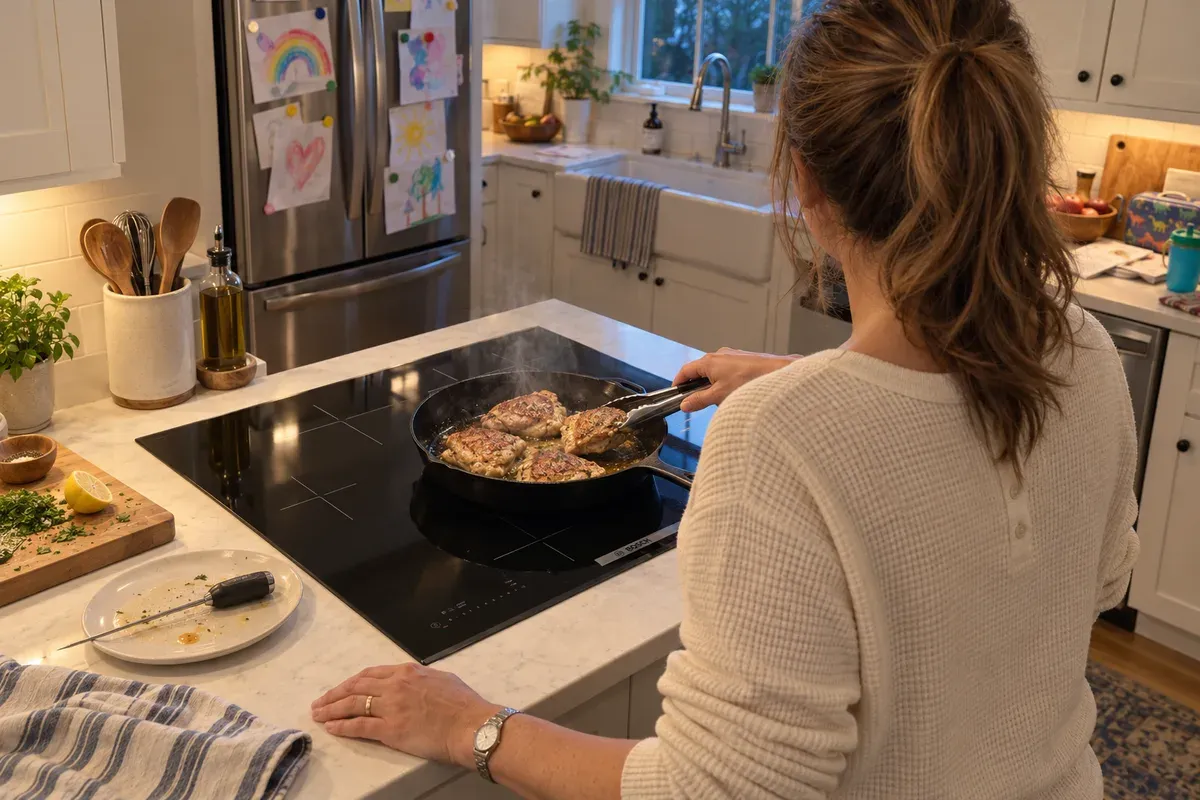
Quick facts: Size / zones: 30-inch class (31 inches overall width), four zones including an 11-inch zone · Power: 17 power levels, SpeedBoost · Extras: AutoChef pan-temperature assistance
My results: 1 quart boiled in 2 minutes and 41 seconds; 6 quarts in 14 minutes and 5 seconds; simmer about 4°F up or down; fan very quiet. My rating: 8.9 out of 10.
Best for: anyone replacing a 30-inch cooktop who wants fine control without paying luxury prices.
The Bosch earned the top spot because it did the everyday things best. Seventeen power levels sound like a spec-sheet number until you’re holding a sauce just below a bubble; in my 30-minute simmer test, my pot stayed at the same lazy simmer the whole time, moving only about 4 degrees up or down, the steadiest of all 10. On boost, the 11-inch zone brought a quart to a boil in 2 minutes and 41 seconds.
AutoChef is the feature that sets it apart. You pick a pan temperature level and the zone works to hold it. Bosch’s own manual says the displayed temperature is approximate, and my probe agreed: the screen showed about 340°F and my kitchen thermometer read 352°F in the oil, close enough for frying. It still made a full skillet of chicken thighs on a Tuesday night easier, because I wasn’t chasing the heat up and down.
The sliders read my fingers fine when they were damp, but a splash of pasta water once paused the cooktop; a quick wipe brought it back.
What I liked
- Its simmer was steady: my soup barely moved in 30 minutes.
- Its 17 power levels give real in-between settings.
- The large 11-inch zone fit my 12-inch cast iron with an even brown ring across about 9 inches of the pan.
- Pause stops every zone at once, which saved a pot of rice when the doorbell rang.
What I didn’t like
- It costs more than the LG, my value pick.
- It has touch controls only, with no knobs.
- It’s called a 30-inch model but measures 31 inches across, so check your opening and trim.
- A splash of water on the controls paused the cooktop once.
My verdict: Buy it if you want the best everyday 30-inch cooktop and will use the fine control. Skip it if you need knobs (see the Frigidaire) or want to save money (see the LG).
For more, see my guide to Bosch induction cooktops.
2. Best 36-inch: GE Profile PHP9036DTBB
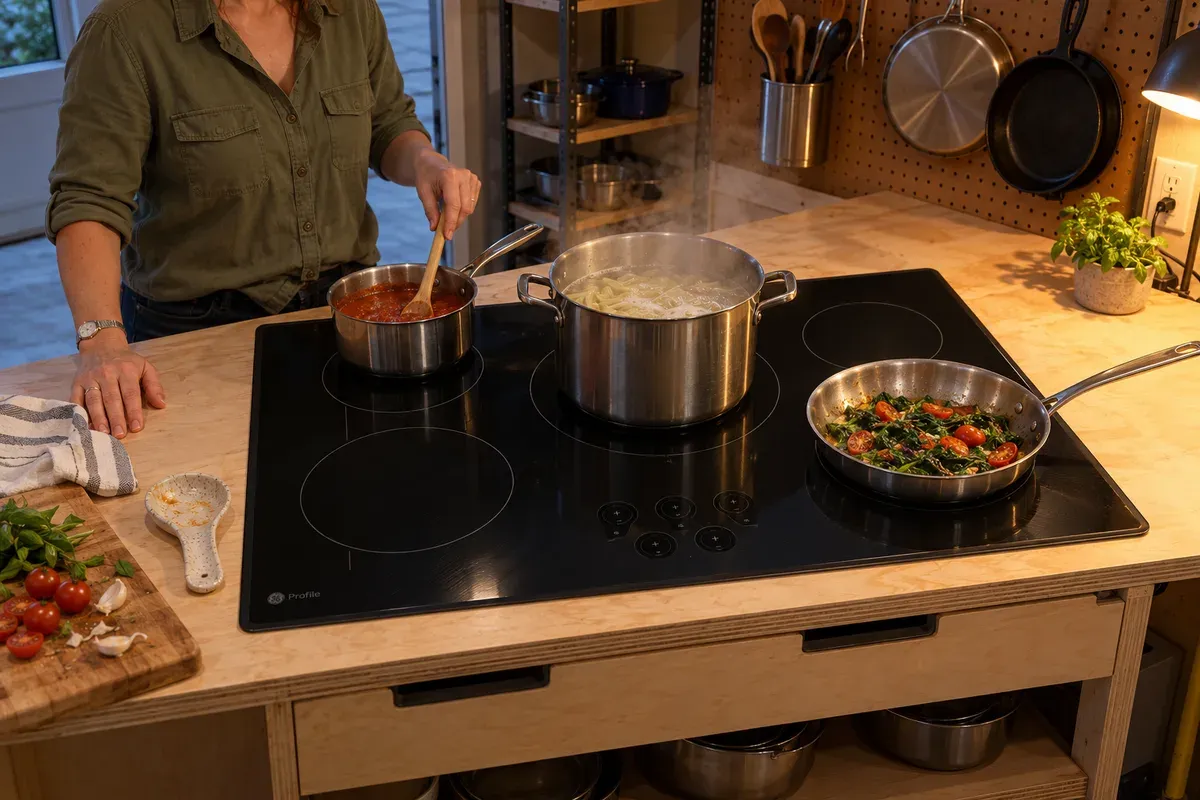
Quick facts: Size / zones: 36-inch (36 1/8 inches overall), five elements: 11-inch center 3,700 watts, 8-inch 3,200 watts, two 7-inch 2,500 watts, 6-inch 1,800 watts · Power: Boost on all elements; 11 heat settings; left pair links as SyncBurners · Extras: Keep-warm and melt settings, Wi-Fi with the SmartHQ app, control lock, timer · Circuit: 208/240 volts, 50 amps recommended breaker; 33-inch cutout width
My results: 1 quart boiled in 2 minutes and 35 seconds; 6 quarts in 12 minutes and 20 seconds; simmer about 7°F up or down; fan quiet. My rating: 8.6 out of 10.
Best for: bigger families and anyone with a 36-inch opening who wants power and a griddle-friendly layout.
If I had a 36-inch opening, this is the one I’d install. The 3,700-watt, 11-inch center element is the reason: my 6-quart stockpot came to a boil in 12 minutes and 20 seconds, the fastest of the four 36-inch cooktops. On pasta night I could run the pot, a sauce and a skillet at once without crowding.
The two left elements link as SyncBurners, so a long griddle runs at one setting. My pancake test showed even browning across the middle, slightly darker over the front coil. With only 11 heat settings, it’s coarser than the Bosch’s 17; at the low end I noticed that it pulsed every few seconds on the lowest setting, so I used setting 2 for gentle simmering.
The melt setting turned a stick of butter liquid without a single splatter.
What I liked
- Its big center element boiled 6 quarts in 12 minutes and 20 seconds.
- Its SyncBurners link for a griddle.
- Melt and keep-warm settings are handy for butter, chocolate and holding dinner.
- The melt setting softened butter with no splatter.
What I didn’t like
- It needs a 50-amp circuit, more than some 36-inch models.
- It has only 11 heat settings.
- On the lowest setting it switches on and off, so my soup drifted between still and small bubbles, about 7 degrees up or down.
My verdict: Buy it if you cook big meals on a 36-inch cooktop. Skip it if your panel can’t take another 50-amp circuit; check the Bosch NIT8661UC (40 amps).
For more, see my guide to GE Profile induction cooktops.
3. Best value: LG CBIH3013BE (30 inches)
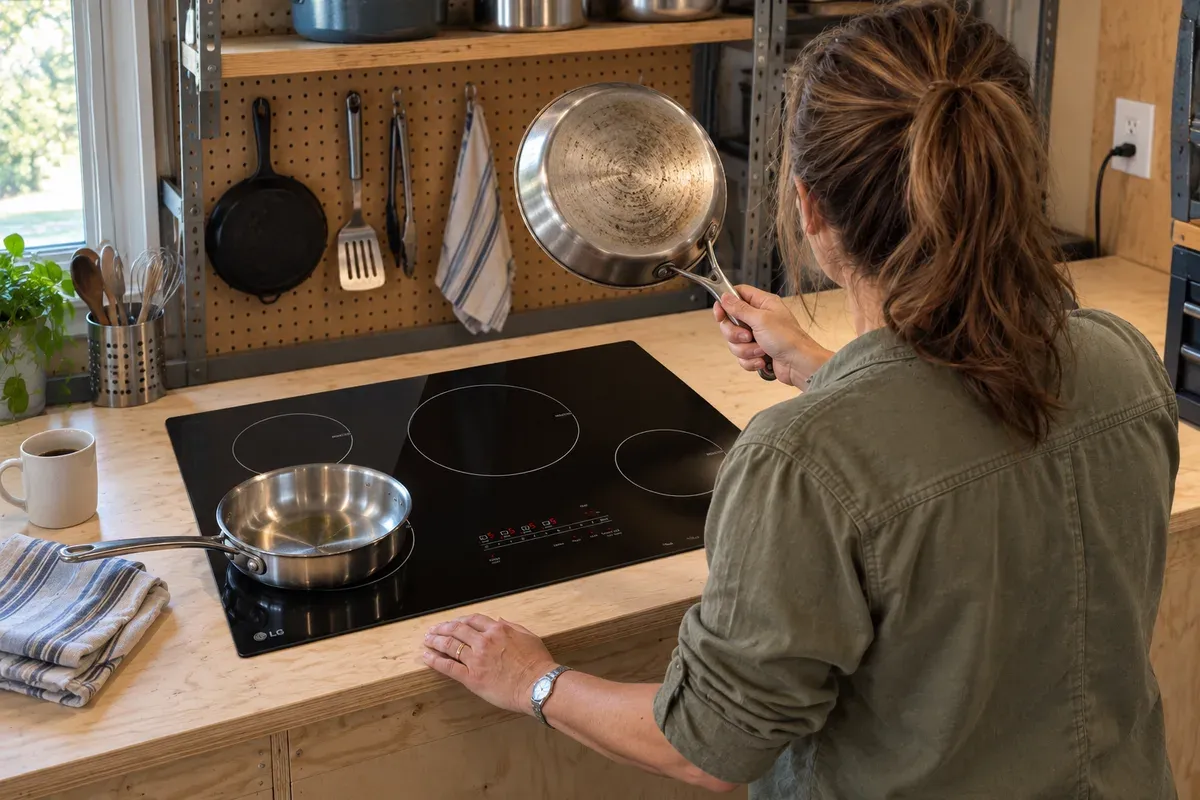
Quick facts: Size / zones: 30 inches, four fixed elements, no bridge listed · Power: Main element up to 4.3 kilowatts on boost · Extras: Dedicated simmer settings, cookware-compatibility indicator, pause key, timer, Wi-Fi (LG ThinQ app)
My results: 1 quart boiled in 2 minutes and 38 seconds; 6 quarts in 13 minutes and 50 seconds; simmer about 6°F up or down; fan quiet. My rating: 8.3 out of 10.
Best for: a straightforward 30-inch replacement on a tighter budget.
The LG gives you most of what matters for less. Its 4.3 kilowatts boost element boiled my quart in 2 minutes and 38 seconds, just three seconds behind the Bosch. The money saved can go toward the electrician or a couple of new pans.
The cookware indicator was more useful than I expected. It flagged my old aluminum-base sauté pan as not compatible, which explained years of uneven searing. It doesn’t tell you whether a pan heats evenly, though; my flour test on the main zone showed a solid 8-inch brown circle with paler edges.
There’s no bridge, so it isn’t the pick for a long griddle. Across two zones my griddle browned in two separate patches with a pale strip in the middle.
What I liked
- Its boost element is strong for the price.
- It has dedicated simmer settings, a pause button and a timer.
- Its cookware indicator helps when you’re switching from gas.
- The fan is quiet; I could easily talk over it.
What I didn’t like
- It has no bridge for a griddle.
- It has touch controls only.
- Its simmer wandered a little more than the Bosch’s, about 6 degrees up and down.
My verdict: Buy it if you want a capable 30-inch cooktop and the best price per feature. Skip it if you want knobs or a bridge.
For more, see my guide to LG induction cooktops.
4. Best with knobs: Frigidaire Professional PCCI3080AF (30 inches)
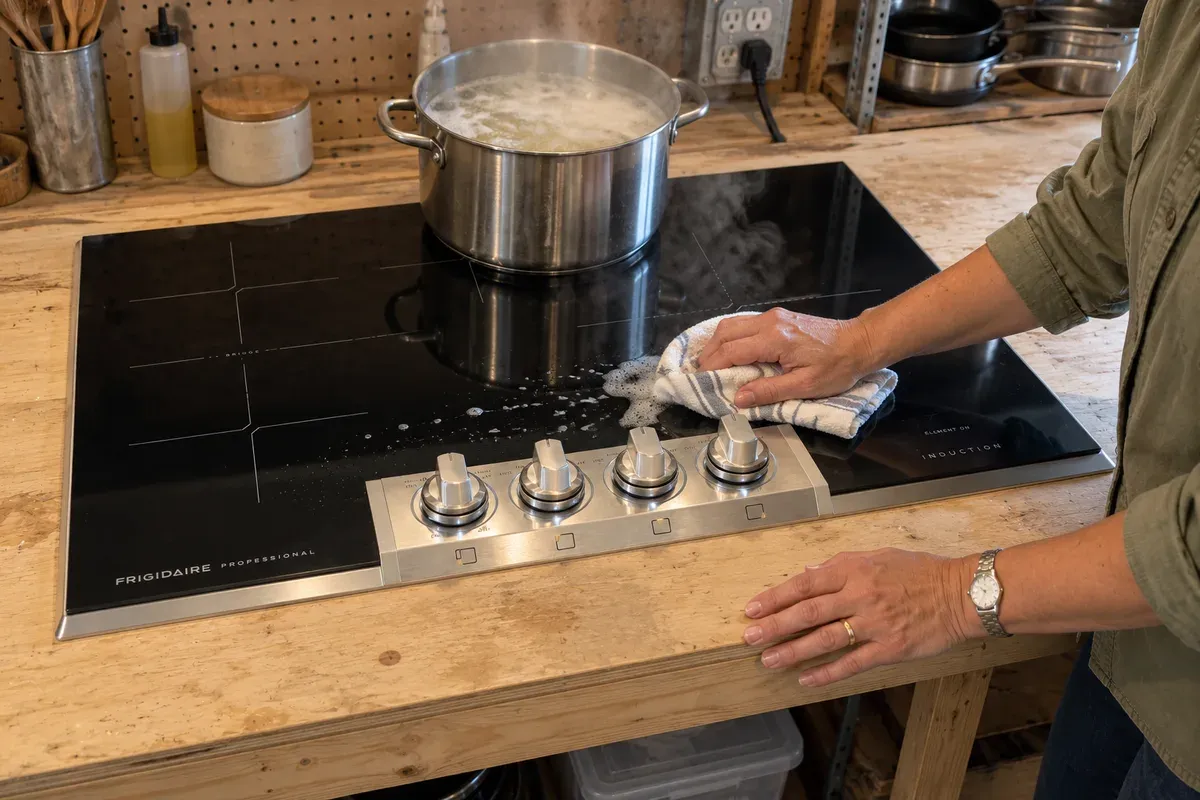
Quick facts: Size / zones: 30 inches, four zones including a two-element bridge on the left · Power: 11-inch main element: 3,600 watts, up to 5,200 watts on boost · Extras: Backlit knobs with residual-heat indication
My results: 1 quart boiled in 2 minutes and 22 seconds; 6 quarts in 13 minutes and 10 seconds; simmer about 8°F up or down; fan quiet. My rating: 8.1 out of 10.
Best for: cooks who want to turn a knob, and griddle lovers.
This is the one I’d hand to someone coming from gas who hates touch panels. You reach for a knob and turn it, and the backlight shows what’s on. On boost, the 5,200-watt main element boiled my quart in 2 minutes and 22 seconds, the fastest quart of all 10.
The bridge links the two left zones for a griddle. My pancakes came out even end to end, with slightly darker spots over the coils. The trade-off is cleaning: I had to wipe around four knobs after a boiled-over pot of pasta water, which a flat touch panel avoids.
What I liked
- Its real knobs are easy to use with wet or greasy hands.
- It has a bridge for a griddle.
- Its main element is very powerful on boost.
- It had the fastest 1-quart boil in my test: 2 minutes and 22 seconds.
What I didn’t like
- There are more edges to clean around.
- It still has only four zones on a 30-inch top.
- The fan was the loudest of the name brands, about like a bathroom fan.
My verdict: Buy it if knobs or a griddle matter to you. Skip it if you want the easiest wipe-clean glass.
For more, see my guide to induction cooktops with knobs.
5. Best scratch-resistant glass: Samsung CC70F30S2DAA (30 inches)
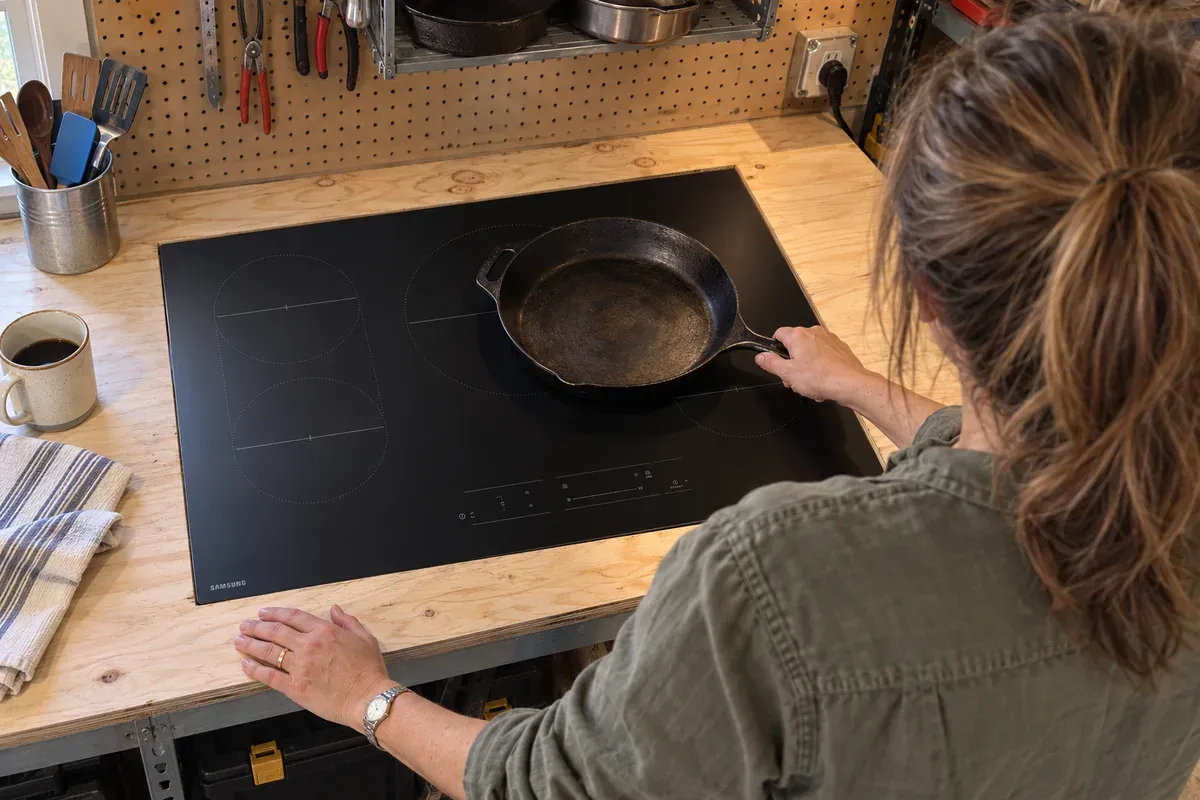
Quick facts: Size / zones: 30 inches, four burners including a Sync Burner · Power: 4.3 kilowatts Power Burner · Extras: Anti-Scratch Matte Glass, Wi-Fi with SmartThings, ENERGY STAR certified
My results: 1 quart boiled in 2 minutes and 44 seconds; 6 quarts in 14 minutes and 30 seconds; simmer about 7°F up or down; fan very quiet. My rating: 7.9 out of 10.
Best for: busy kitchens where cast iron gets slid around, and anyone who hates fingerprints on glossy glass.
Samsung’s matte glass is the reason this one is on my list. After 6 weeks of my cast-iron skillet on it, the surface showed no visible scratches, while the glossy GE showed two fine marks in the same spot. It also hid fingerprints and water spots better than the Bosch NIT8061UC.
The 4.3 kilowatts Power Burner boiled a quart in 2 minutes and 44 seconds, and the Sync Burner let me run a griddle at one setting, with evenly golden pancakes edge to edge, with one slightly pale corner.
What I liked
- The matte glass resists scratches and smudges.
- Its Sync Burner handles a griddle.
- It was the quietest of the 10; I could hear the TV over the fan.
What I didn’t like
- It has touch controls only.
- On the lowest setting my soup crept from still to small bubbles and back, about 7 degrees up or down.
My verdict: Buy it if you want a low-maintenance surface. Skip it if you need the finest simmer steps.
For more, see my guide to Samsung induction cooktops.
6. Most power in a 36-inch: Bosch 800 Series NIT8661UC
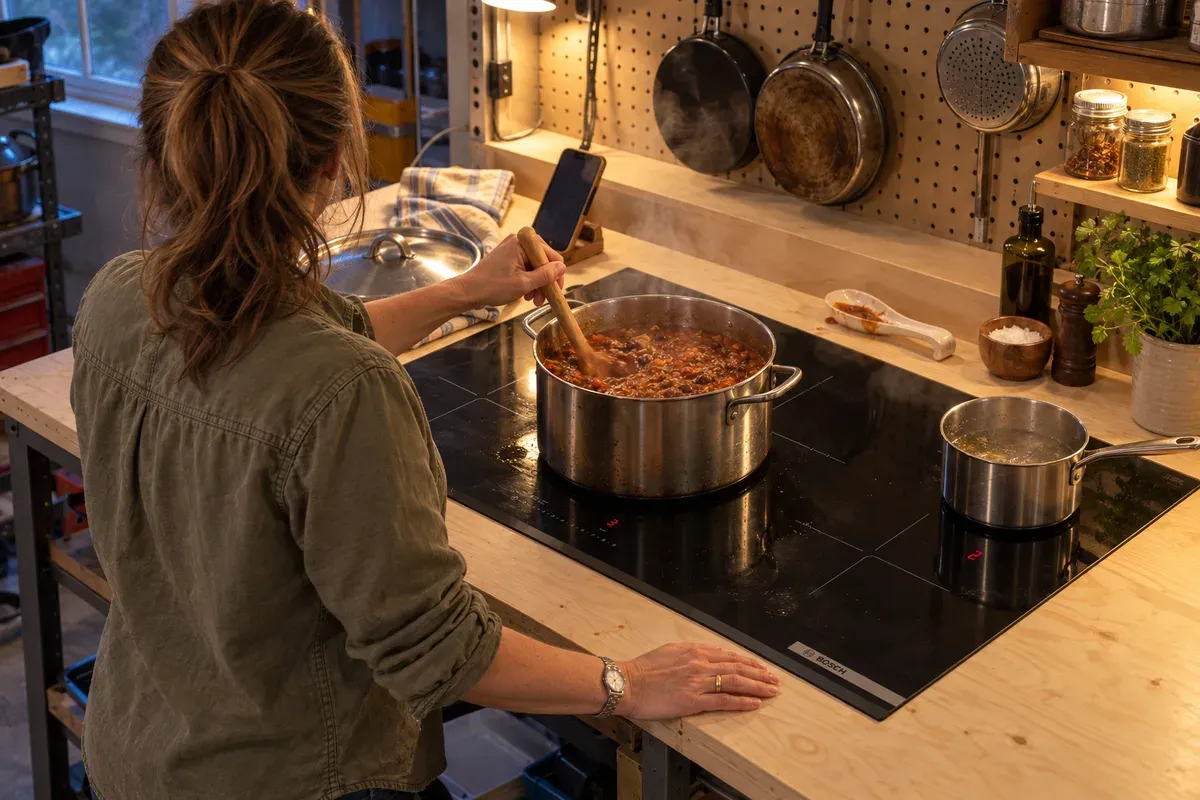
Quick facts: Size / zones: 36-inch class (37 inches overall, 34 7/8-inch cutout), five elements including a 9/11/13-inch triple-ring center · Power: Boost on all five; center and front-right up to 3,600 watts; 17 power levels · Extras: Home Connect Wi-Fi, favorite button, pause, child lock · Circuit: 208/240 volts, 40 amps breaker
My results: 1 quart boiled in 2 minutes and 39 seconds; 6 quarts in 13 minutes and 5 seconds; simmer about 4°F up or down; fan quiet. My rating: 7.8 out of 10.
Best for: 36-inch kitchens that want boost on every element and a 40-amp circuit.
The triple-ring center adjusts to a 9-, 11- or 13-inch pan, so my big stockpot and small saucepan both got the right-sized heat. In my 6-quart test it took 13 minutes and 5 seconds. Its simmer was just as steady as the 30-inch Bosch’s: my chili didn’t budge for half an hour.
It ranked below the GE because it boiled 6 quarts 45 seconds slower than the GE, has no linked zones for my griddle, and costs more. On the plus side, it needs only a 40-amp circuit.
What I liked
- Every element has a boost setting.
- Its triple-ring center fits pans from 9 to 13 inches.
- It needs a 40-amp circuit, not 50.
- It tied with the 30-inch Bosch for the steadiest simmer.
What I didn’t like
- It has no bridge for a griddle.
- It’s 37 inches wide overall, so check the space.
- There’s no way to link zones for a griddle.
My verdict: Buy it if you want boost on every element and a gentle simmer on a 40-amp circuit. Skip it if you griddle often, since it has no bridge.
7. Best for flexible pan placement: 36-inch Thermador Freedom CIT36YWBB
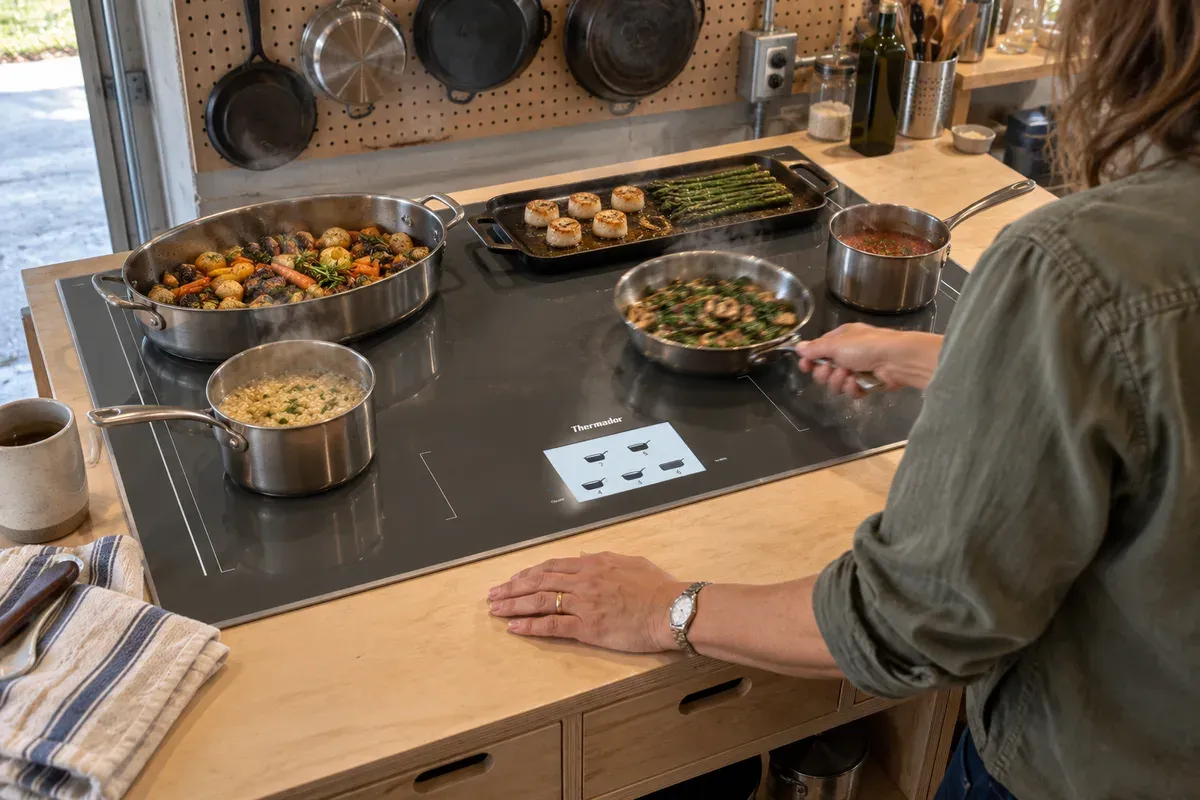
Quick facts: Size / zones: 36-inch class (37 inches overall), full-surface induction, up to six pans within placement limits · Controls: Central touchscreen; settings follow a pan when you move it
My results: 1 quart boiled in 2 minutes and 52 seconds; 6 quarts in 14 minutes and 40 seconds; simmer about 5°F up or down; fan quiet. My rating: 7.6 out of 10.
Best for: serious home cooks with odd-shaped pans and a luxury budget.
The Freedom has no marked circles: you set a pan anywhere and it finds it. I cooked with five pans at once, including an oval roasting pan and a long griddle, and when I slid a pan across, its setting followed every time but once, when I lifted the pan instead of sliding it. Thermador’s manual warns that pans set too close together can be read as one; I saw that happen when my two small saucepans were read as one pan when their bases sat about an inch apart.
It’s ranked seventh because its boil times were mid-pack and the touchscreen took longer to learn, at roughly twice the price of the GE. For most families, a five-zone cooktop does the same job for far less.
What I liked
- You can place pans almost anywhere.
- Its settings move with the pan.
- It handled five pans at once, including an oval roaster.
What I didn’t like
- It has the highest price in this test.
- The touchscreen took me about a week to learn.
- Placement and power limits still apply.
My verdict: Buy it if you want to place pans anywhere and move them while cooking. Skip it if price matters; it’s the most expensive cooktop I tested.
8. Five separate zones: 36-inch Miele KM 7740 FR
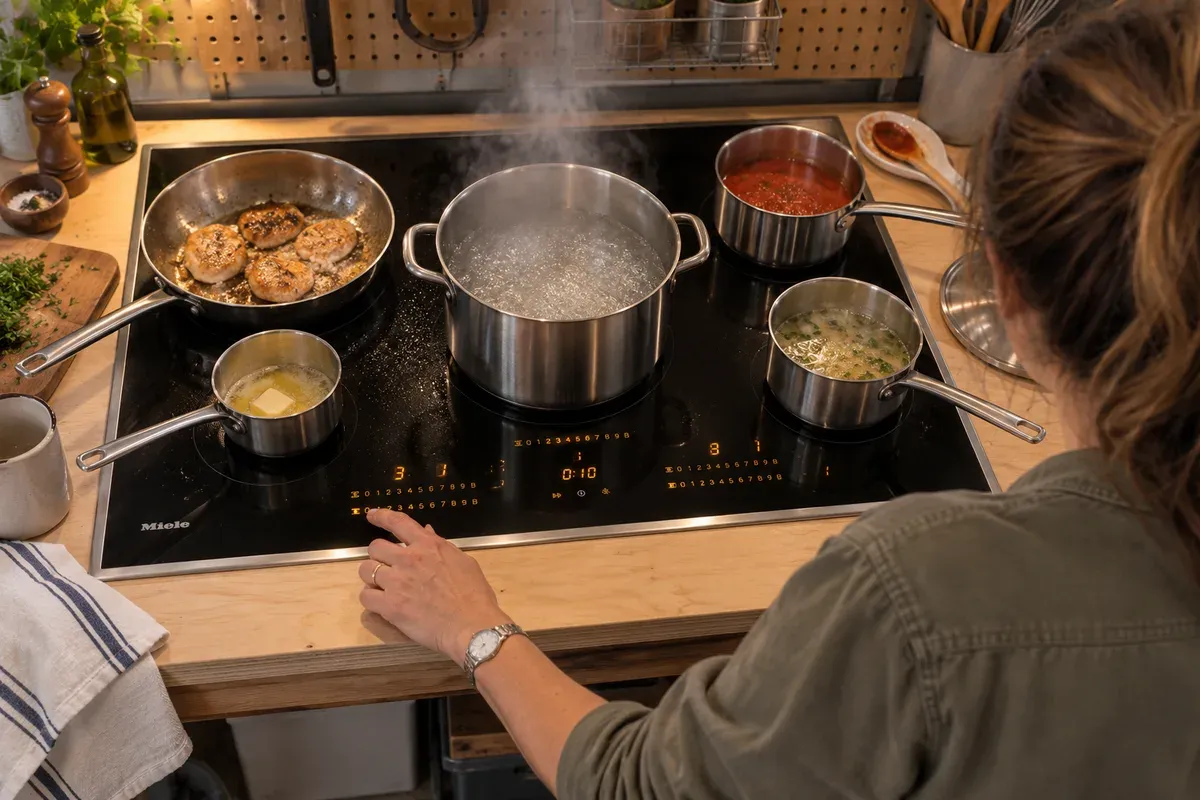
Quick facts: Size / zones: 36 inches, five individual zones, about 11-inch center zone, stainless frame · Controls: SmartSelect numerical controls; TwinBooster; hood communication
My results: 1 quart boiled in 2 minutes and 47 seconds; 6 quarts in 14 minutes and 15 seconds; simmer about 5°F up or down; fan very quiet. My rating: 7.4 out of 10.
Best for: cooks who juggle several pans and like direct number controls.
Miele’s SmartSelect lets you tap a number for each zone instead of sliding, which I found faster with wet hands. Five separate zones meant I could run a stockpot, two saucepans, a skillet and a small butter warmer at once, though five large pans did not fit once handles were counted.
It lands eighth because its 6-quart boil trailed the GE by nearly two minutes and it costs more than the Bosch, and because of the reliability data below. Wirecutter rates this model highly, so if you’re set on Miele, buy from a dealer with good local service.
What I liked
- Its number controls are direct and quick.
- It has five separate zones.
- Its simmer was steady; my tomato sauce stayed put without stirring.
What I didn’t like
- You pay a premium price for a fixed-zone layout.
- Five large pans didn’t fit once I counted the handles.
My verdict: Buy it if you like pressing a number for each setting and want five separate zones. Skip it if you’d rather pay less for a similar layout.
9. Best budget induction cooktop: Frigidaire Gallery GCCI3067AB (30 inches)
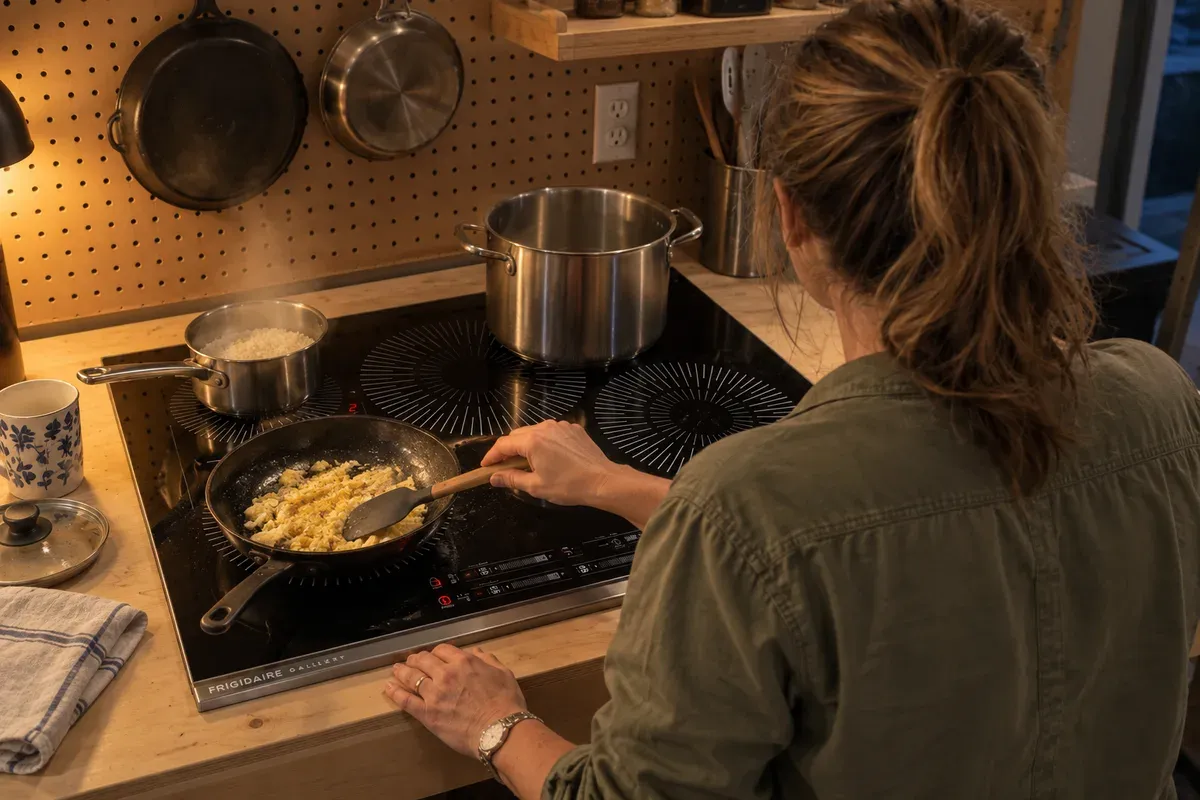
Quick facts: Size / zones: 30-inch (30 5/8 inches overall), four elements: two 8-inch at 2,300 watts (3,600 watts boost), two 7-inch at 1,800 watts (2,600 watts boost) · Extras: Left bridge element, auto pan detect, front touch controls, ENERGY STAR, Americans with Disabilities Act (ADA) compliant · Circuit: 240 volts, 30 amps minimum; cutout 28 1/2 inches–29 7/8 inches wide
My results: 1 quart boiled in 3 minutes and 5 seconds; 6 quarts in 15 minutes and 40 seconds; simmer about 9°F up or down; fan quiet. My rating: 7.0 out of 10.
Best for: the most affordable switch to a name-brand built-in; if you want a cheap induction cooktop that still comes from a brand with US service,, especially if your panel only has room for a 30-amp circuit.
The Gallery gets you induction, a bridge and boost on every element on a 30-amp circuit, which can save an electrical upgrade in older homes. Without an 11-inch zone, my 12-inch skillet browned only in the center 7 inches in the flour test.
It handled weeknight eggs, rice and pasta without trouble, but it was the slowest name brand to boil a big pot of pasta water (15 minutes and 40 seconds), and its simmer wandered more than any other name brand, which is why it sits ninth.
What I liked
- It needs only a 30-amp circuit.
- You get a bridge and boost at an entry-level price.
- It handled everyday meals without fuss.
What I didn’t like
- Its largest element is only 8 inches.
- It had the slowest name-brand 6-quart boil: 15 minutes and 40 seconds.
My verdict: Buy it if you want a name-brand cooktop on a budget, or your house only has a 30-amp circuit. Skip it if you often cook with a 12-inch skillet or big stockpots.
The one I’d skip
Empava is the best-known budget induction brand on Amazon, which is why I tested its Flex 30-inch four-burner model. It was the only one of the 10 that failed my standard, because it couldn’t hold a gentle simmer: the burner kept switching fully on and off and scorched my rice twice. It was the slowest in every boil test; a big pot of pasta water took over 18 minutes. On its lowest setting the burner kept switching fully on and off, so my rice went from boiling hard to sitting still, and it scorched twice. The fan was also the loudest, about like a hair dryer on low.
If your budget can’t stretch to a name brand, I’d rather you buy the Frigidaire Gallery or a good portable induction burner until it can.
Also worth a look (not tested by me)
- 36-inch Bosch Benchmark NITP669SUC: the top of Bosch’s induction range, a step above the 800 Series models I tested. I haven’t tested it.
- Wolf induction cooktops: luxury option for Wolf/Sub-Zero kitchens. I haven’t tested one; see Wolf induction cooktops.
- Impulse Labs: a cooktop with a built-in battery for extra power, often recommended in the r/inductioncooking community. I haven’t tested it.
How induction cooktops work (the short version)
An induction cooktop heats the pan, not the glass. Under the glass-ceramic top sits a copper coil. When you turn a zone on, alternating current through the coil makes a fast-changing magnetic field, which sets up small electric currents (eddy currents) in the base of a magnetic pan, and the pan itself gets hot.
That explains most of what I noticed while testing:
- Speed: heat starts in the pan, so water boils fast, especially on power boost.
- Pan detection: a zone won’t heat unless it senses a suitable pan, and it shuts off when you lift the pan away.
- Residual heat: the glass only warms from the hot pan, but it can still burn you, which is why every model shows a residual-heat light.
- Pulsing at low heat: some cooktops hold a low setting by switching the power on and off, which is why a simmer can drift.
- Power sharing: neighboring zones often share power, so boosting one can turn down the one next to it.
- Cookware: only magnetic (ferromagnetic) pans work: cast iron, carbon steel and most clad stainless steel.
For more, see my guide to how induction cooking works, what an induction cooktop is and whether induction cooking is safe.
30-inch or 36-inch?
Choose a 30-inch cooktop unless you regularly cook with four or more pans at once or already have a 36-inch opening. In my tests, the 30-inch models handled a normal family dinner of a pasta pot, a saucepan and a skillet of chicken without crowding.
| Choose 30 inches when… | Choose a 36-inch cooktop when… |
|---|---|
| You’re replacing an existing 30-inch cooktop | The kitchen already has a 36-inch opening, or you’re remodeling anyway |
| Four zones cover your normal meals | You often run four or five pans, or a big stockpot plus a griddle |
| Counter prep space is tight | Extra cooking space matters more than counter space |
| Your panel can only take a 30- or 40-amp circuit | You can add the circuit the model needs (up to 50 amps in my test group) |
Compare the shortlists in my best 30-inch induction cooktops and best 36-inch induction cooktops guides. For condos and small kitchens, see 24-inch models.
How to choose a built-in induction cooktop
Measure the cutout first
Size labels are categories, not exact measurements. In my test group, the Bosch NIT8061UC is a “30-inch” cooktop that measures 31 inches across, and the Bosch NIT8661UC and Thermador are “36-inch” models at 37 inches. Measure your opening, then check the cutout in the installation guide for the exact model before you order.
Check your electrical panel
Built-in induction cooktops run on a dedicated 208/240-volt circuit. In my test group the requirement ran from 30 amps (Frigidaire Gallery) to 50 amps (36-inch GE Profile). Don’t add up boost wattages to size a breaker; follow the model’s manual and have a licensed electrician confirm it. For more, see my guide to what circuit an induction cooktop needs.
Pick the features you’ll actually use
- Power boost: a short burst of extra wattage on one element for fast boiling. Most of the models I tested have it on at least one element.
- Bridge or sync zones: two zones linked for a griddle (Frigidaire, GE, Samsung). See flex-zone and full-surface cooktops.
- Fine power levels: Bosch offers 17 power levels, GE 11 heat settings. In my simmer test, the Bosch kept my soup steadier at low heat than the GE did.
- Controls: sliders, number pads, touchscreen or knobs. Try them in a showroom with wet fingers.
Check your pans with a magnet
If a magnet sticks firmly to the flat base, the pan will work. My cast iron, carbon steel wok and tri-ply stainless all worked; an old aluminum sauté pan and my copper saucier did not. See what cookware works on induction.
Plan for ventilation
No flame doesn’t mean no smoke or grease. Keep a hood that vents outside if you can; the U.S. Department of Energy explains why kitchen exhaust still matters. For islands, see downdraft induction cooktops.
What is the best induction cooktop brand?
Bosch is the brand I’d start with: its 30-inch model won my test, and Bosch’s Benchmark line had the lowest first-year service rate in Yale Appliance’s 2026 data. After that, pick by need: GE Profile for 36-inch power, LG for value, Frigidaire for knobs, Thermador for flexible placement.
You can also read my brand guides: Bosch · GE Profile · LG · Frigidaire · Samsung · Miele · Thermador
Installation and cost
Budget for more than the cooktop. Get one quote that separates the appliance, delivery and haul-away, the electrician (and permit, where needed), any countertop or cabinet changes, installation labor, and new pans or a hood. If you’re switching from gas, add capping the gas line. In my area, the electrician charged $650 for the 240 volts circuit, including the permit. For more, see my guide to how to install an induction cooktop and what an induction cooktop costs.
FAQ
What is the best induction cooktop?
In my testing, the Bosch 800 Series NIT8061UC was the best all-round 30-inch built-in induction cooktop, and the GE Profile PHP9036DTBB was my pick for a 36-inch opening. The LG CBIH3013BE is the value choice.
What is the most reliable induction cooktop brand?
In Yale Appliance’s 2026 service-call data, Bosch’s Benchmark line, SKS and Gaggenau had the fewest first-year service calls, and Miele had the most among listed brands. Home testing can’t measure long-term reliability, so I report that data separately.
Do I need a special circuit for an induction cooktop?
Yes. Built-in models need a dedicated 208/240-volt circuit; the ones I tested called for 30 to 50 amps. Check your model’s installation guide and have a licensed electrician confirm it.
Will my pans work on an induction cooktop?
If a magnet sticks firmly to the flat base, yes. Cast iron, carbon steel, enameled cast iron and most clad stainless work; plain aluminum, copper and glass don’t.
Is a 36-inch induction cooktop worth it?
Only if you often cook with four or more pans or already have a 36-inch opening. A good 30-inch cooktop handles most family meals and costs less to buy and install.
Are induction cooktops noisy?
A little. Every induction cooktop has a fan that runs while you cook. In my tests the loudest sounded like a hair dryer on low and the quietest was easy to talk over. Some pans hum or buzz on high power; it usually stops when you turn the heat down.
Does the glass stay cool?
No. The pan heats the glass under it, so the surface can burn you after cooking. Watch the residual-heat indicator before touching or wiping.
Can I install a built-in induction cooktop myself?
The cutout and drop-in are DIY-friendly for some people, but the 240-volt circuit should be done by a licensed electrician. Follow the model’s installation guide.