Our family of six spends most summer weekends in a travel trailer, and for years I cooked on the propane stove inside it, with the windows open and the cabin getting hotter by the minute. When our propane ran out halfway through a long weekend, I decided to find out whether induction could take over, and whether our battery and inverter could actually handle it.
So I tested seven induction cooktops on our trailer’s 2,000-watt inverter, its 200 amp-hour lithium iron phosphate (LiFePO4) battery and 30-amp campground hookups. A plug-in watt meter showed how much power each one really pulled, and our battery monitor showed what each meal cost us. I cooked eggs and bacon, one-pot pasta and chili for six over two long weekends in October, and every cooktop rode 400 miles of washboard roads in a cabinet.
The NuWave PIC Flex is the one that lives in our trailer now. It’s light, and you can cap it at 600 or 900 watts, so it runs on a smaller inverter or a busy 30-amp hookup without tripping anything. If you have shore power or a big battery bank and want home-kitchen speed, the Duxtop 8100MC boiled a quart in 4 minutes and 45 seconds. If you’re building a kitchen into a rig, the Dometic 2-burner drop-in is made for it.
Want the full power math? Read my guide to running induction on RV, solar or battery power. For cooking at home, see my portable induction picks, and for a tiny kitchen, my small induction cooktop guide. If you’re shopping for the road, keep reading.
My rankings at a glance
| Rank | Cooktop | Best for | Most it pulled | Boils 1 quart in | Battery per quart | My rating |
|---|---|---|---|---|---|---|
| 1 | NuWave PIC Flex | Best overall for RVs | 1,310 watts | 6 min 10 sec | about 12 amp-hours | 8.4 |
| 2 | Duxtop 8100MC | Best with full power | 1,790 watts | 4 min 45 sec | about 13 amp-hours | 8.2 |
| 3 | Dometic 2-Burner Drop-In Induction Cooktop | Best built-in for an RV kitchen | 1,430 watts | 5 min 50 sec | about 13 amp-hours | 8.0 |
| 4 | NuWave Diamond with Probe | Best for precise cooking on the road | 1,390 watts | 5 min 55 sec | about 13 amp-hours | 7.9 |
| 5 | Duxtop 8600BI | Best drop-in single burner | 1,780 watts | 4 min 50 sec | about 13 amp-hours | 7.6 |
| 6 | Mini 700W Induction Burner | Best for tiny inverters and van life | 690 watts | 12 min 40 sec | about 15 amp-hours | 7.0 |
| Skip | 500W mini | Not recommended | 495 watts | Didn’t boil in 20 min | — | 4.8 |
Power draw was read with a plug-in watt meter, and battery use from our trailer’s battery monitor, including inverter losses. Boil times are the middle of three runs. Ratings are out of 10.
RV and camping induction cooktop reviews
Here’s how each cooktop did in our trailer, best first.
1. Best overall for RVs: NuWave PIC Flex
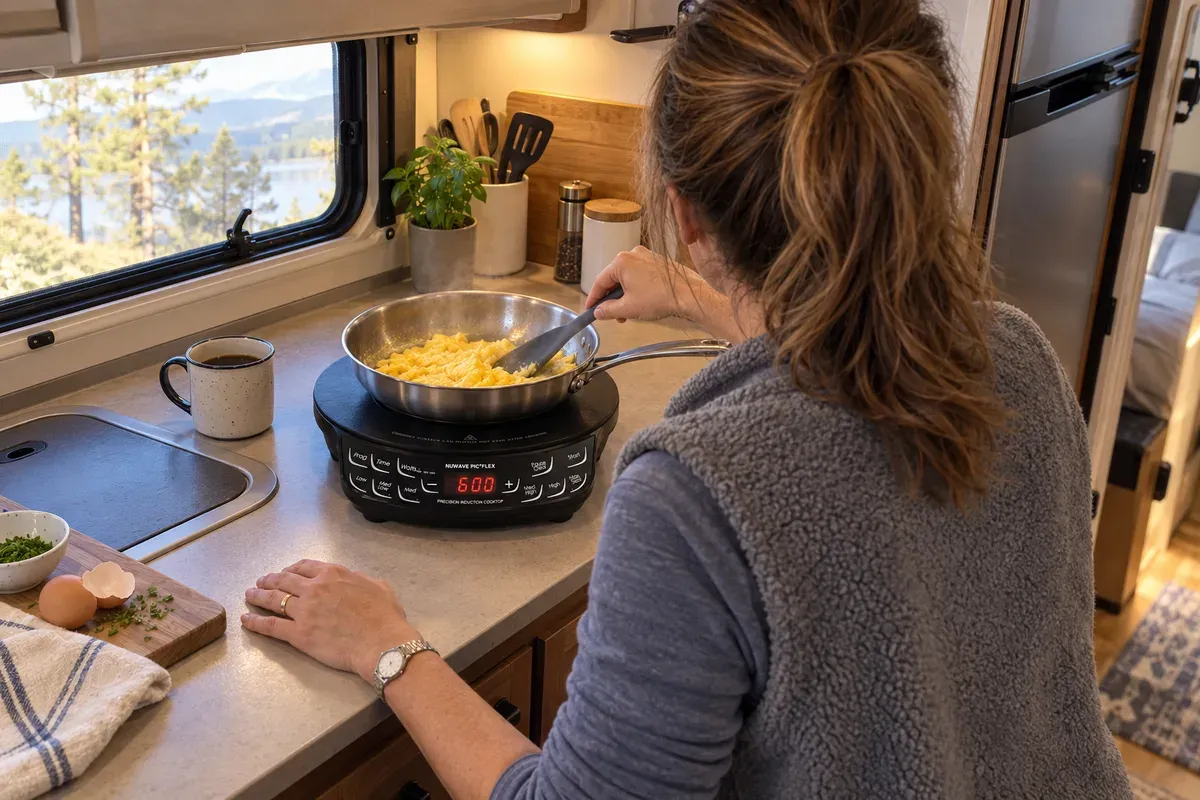
Quick facts: Power: 600, 900 or 1,300 watts settings (the current Amazon listing shows 1,400 watts; confirm on the box) · Temperature: 100–500°F in 5°F steps; 6 presets · Coil: 6.5 inches · Size: About 12 × 10 × 2 inches · Glass: Shatter-resistant ceramic glass
My results: Maximum draw 1,310 watts; 1 quart in 6 minutes and 10 seconds; about 12 amp-hours per quart. My rating: 8.4 out of 10.
The Flex wins for RVs because you can cap its power. On the 600 watts setting it ran happily off our inverter while the fridge and water pump were running, and on a friend’s smaller 1,000 watts inverter. It’s light, round-cornered and slips into a cabinet. Wirecutter calls it a travel pick, too.
The small 6.5-inch coil is the trade-off: my 10-inch skillet browned only in the middle. For family-size meals, use smaller pans.
What I liked
- You can cap its wattage for weak power supplies.
- It’s light and compact.
- It sets temperatures in 5-degree steps.
What I didn’t like
- Its coil is small.
- It’s slow even at full power.
My verdict: Buy it if you camp on a smaller inverter or busy hookups and want one light burner. Skip it if you have plenty of power and want speed.
2. Best with full power: Duxtop 8100MC
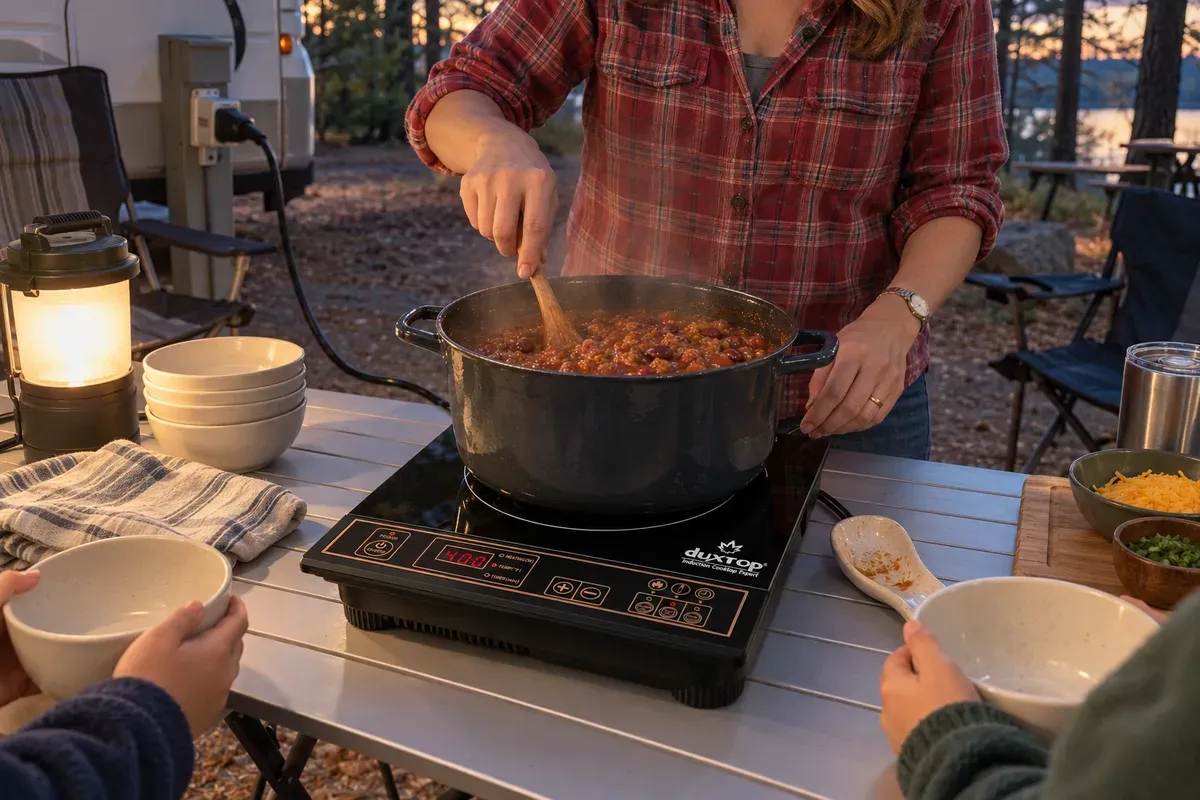
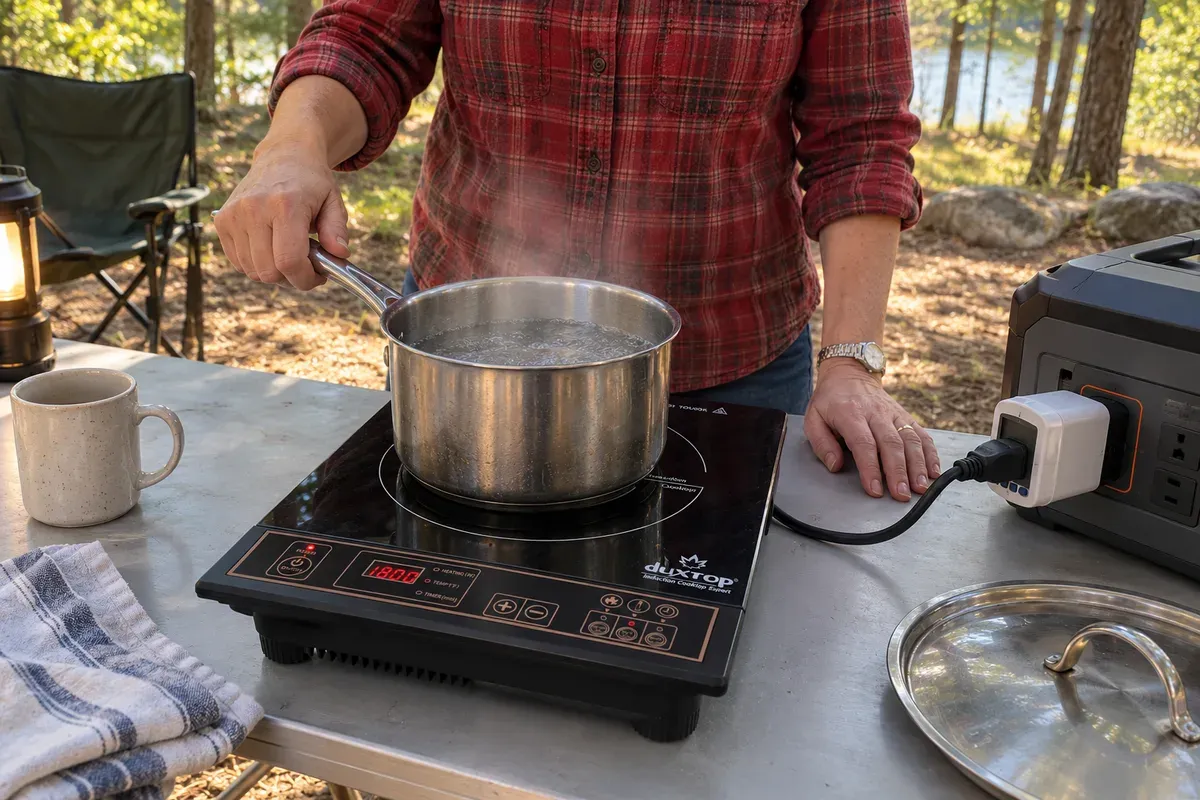
Quick facts: Power: 1,800 watts; 15 power levels from 200 to 1,800 watts · Temperature: 15 settings, 140–460°F · Timer: Up to 170 minutes · Size: 13 × 11.5 × 2.5 inches · Safety: Auto pan detection; low/high-voltage warning; Intertek ETL (ETL) approved
My results: Maximum draw 1,790 watts; 1 quart in 4 minutes and 45 seconds; about 13 amp-hours per quart. My rating: 8.2 out of 10.
The 8100MC is one of the most-reviewed induction burners on Amazon, and it’s the one I’d take when we have shore power. Its 200 watts lowest level is useful off-grid for keeping food warm without draining the battery. It boiled water almost as fast as my home cooktop’s smaller zones.
Duxtop warns that clad pans can make a high-pitched sound, and my tri-ply pan did whine on high; my cast iron didn’t.
What I liked
- It cooks at a full 1,800 watts.
- Its lowest level is just 200 watts.
- Its raised buttons are simple to use.
What I didn’t like
- It needs a 2,000-watt inverter at full power.
- Clad cookware whines on it.
My verdict: Buy it if you have shore power or a 2,000-watt inverter and want home-kitchen speed. Skip it if your inverter is smaller.
3. Best built-in for an RV kitchen: Dometic 2-Burner Drop-In Induction Cooktop
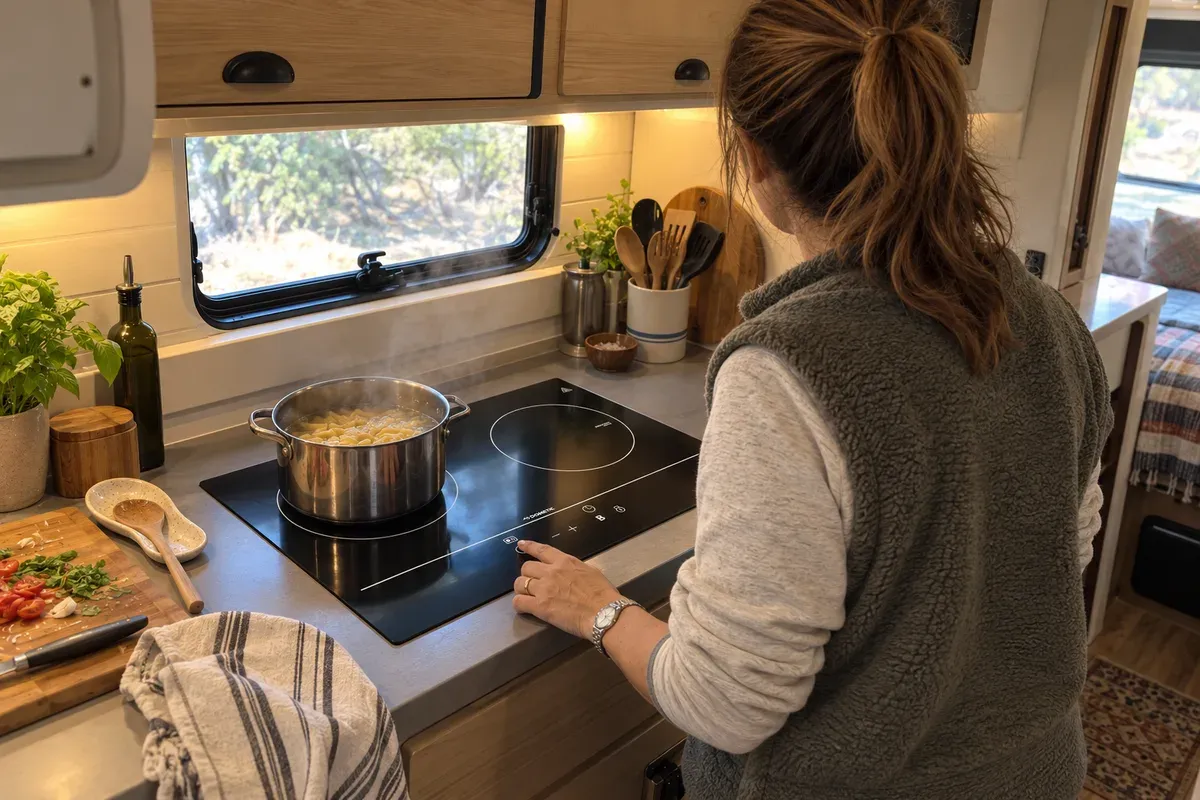
Quick facts: Power: 1,440 watts maximum, 120 volts · Controls: Knobs; 10 power settings; on-indicator light for each burner · Temperature: 150–450°F · Timer: Up to 150 minutes; child lock · Installation: Drop-in
My results: Maximum draw 1,430 watts; 1 quart in 5 minutes and 50 seconds. My rating: 8.0 out of 10.
Dometic is a major recreational vehicle (RV) appliance maker, and this is a drop-in two-burner designed for RV counters, with knobs that are easy to use while the rig is parked on a slope. Its 1,440 watts maximum is gentler on an inverter than an 1,800 watts burner. My friend runs it off a 2,000 watts inverter every weekend.
It has very few Amazon ratings so far, so check RV forums and the Dometic spec sheet before you buy.
What I liked
- It’s built specifically for RVs.
- It has knobs.
- Its lower maximum draw is easier on an inverter.
What I didn’t like
- It has few owner reviews so far.
- It has to be installed.
My verdict: Buy it if you’re building or upgrading an RV kitchen and want two zones with knobs. Skip it if you’d rather not install anything.
4. Best for precise cooking on the road: NuWave Diamond with Probe
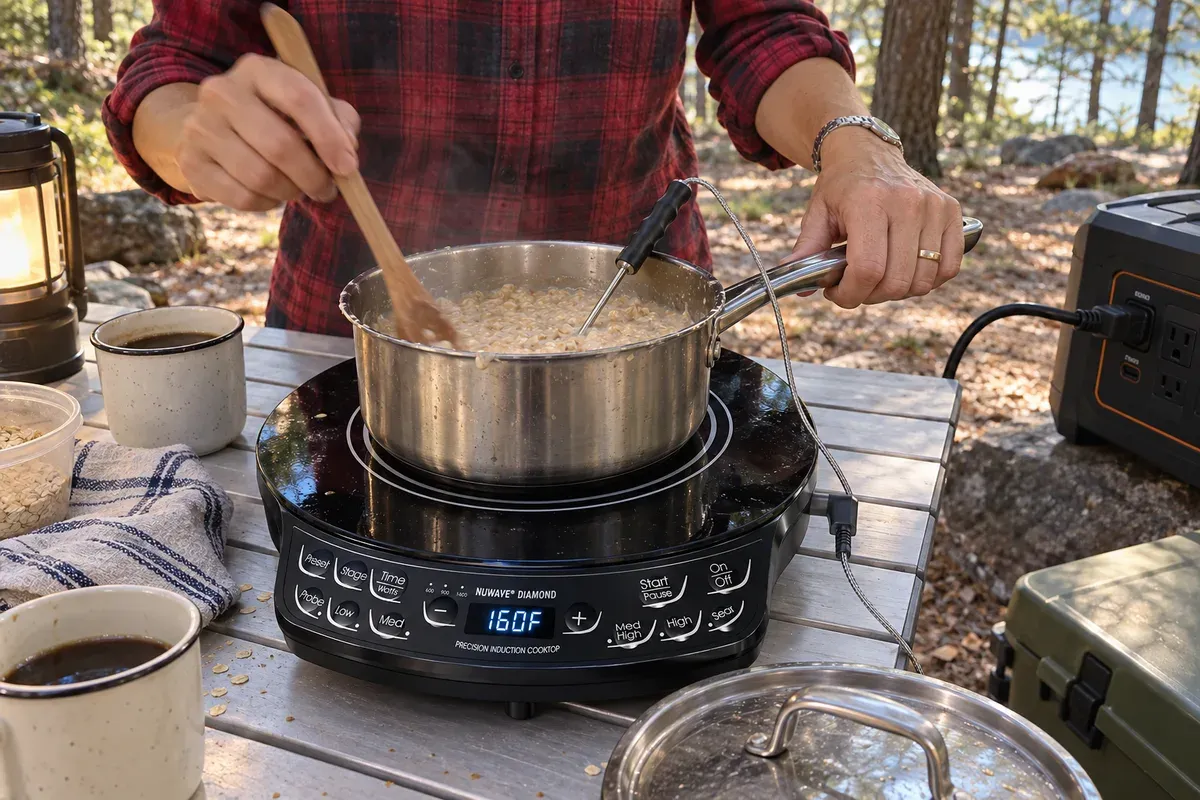
Quick facts: Power: 1,400 watts, 120 volts · Temperature: 100–500°F in 5°F steps; 5 presets · Probe: Digital thermometer probe that controls liquid temperature · Programs: Pasta, soup/stock, deep fry, rice · Size: About 11.9 × 10.3 × 2.3 inches
My results: Maximum draw 1,390 watts; 1 quart in 5 minutes and 55 seconds. My rating: 7.9 out of 10.
The probe is the reason to buy it: drop it into the pot and the burner holds the liquid at your set temperature. Rice and oatmeal didn’t scorch once, which on a camp stove is a small miracle. At 1,400 watts it’s inverter-friendly. Owners mention fan noise and price.
For more, see my guide to the best precision induction cooktops.
What I liked
- Its probe makes hands-off cooking possible.
- At 1,400 watts, it’s easy on an inverter.
What I didn’t like
- Its fan is noticeable in a small cabin.
- It costs more than basic burners.
My verdict: Buy it if you like hands-off cooking with a probe and need a burner that’s easy on your inverter. Skip it if you camp on a tight budget.
5. Best drop-in single burner: Duxtop 8600BI
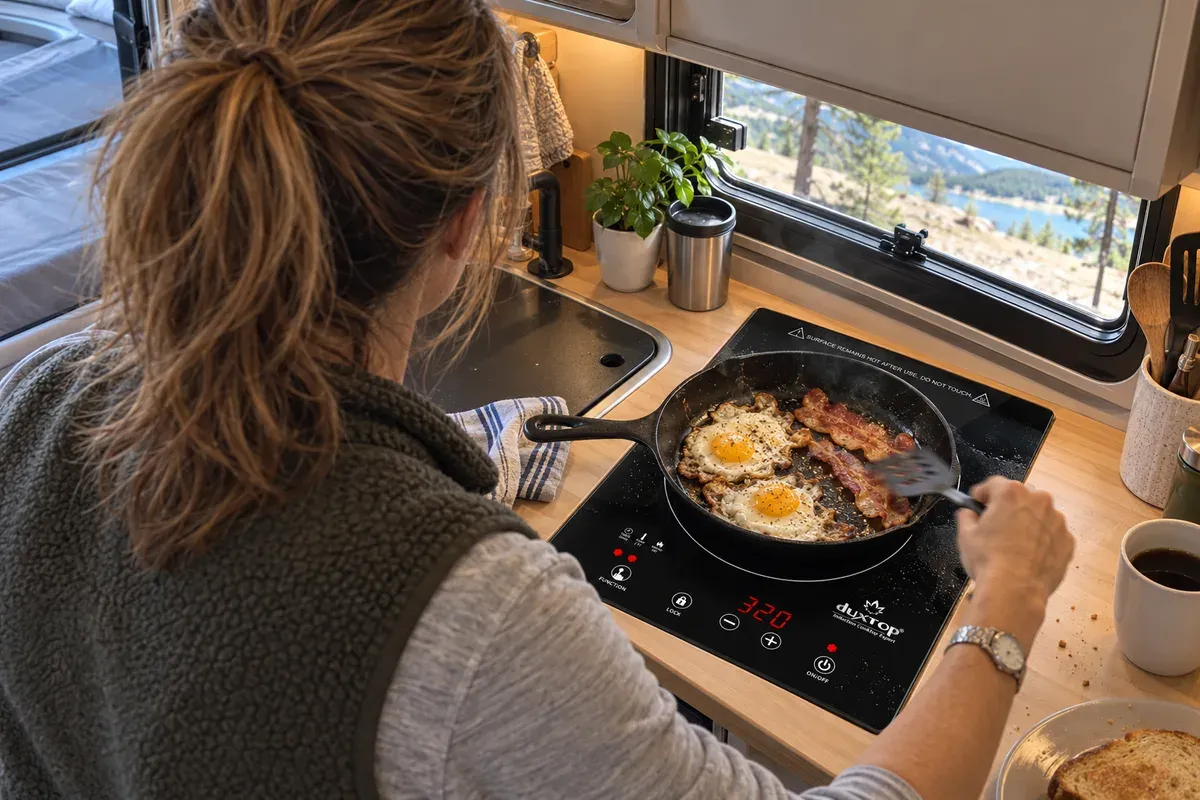
Quick facts: Power: 1,800 watts; 15 power levels from 200 to 1,800 watts · Temperature: 15 settings, 140–460°F · Installation: Built-in (drop-in) or countertop · Size: 14.65 × 11.89 × 3.15 inches; 6.8 pounds · Efficiency: Duxtop states 83% energy efficiency
My results: Maximum draw 1,780 watts; 1 quart in 4 minutes and 50 seconds. My rating: 7.6 out of 10.
Van builders like this one because it can drop into a counter cutout and still plug into a regular outlet. It cooked like the 8100MC. Some owners find it weak at every setting and mention a whine; keep the vents underneath clear in a built-in cabinet.
For more, see my guide to the best 120-volt induction cooktops.
What I liked
- You can drop it into a counter or use it on top.
- Its lowest level is just 200 watts.
What I didn’t like
- It needs airflow under the cutout.
- Some pans whine on it.
My verdict: Buy it if you want a single burner set into your RV counter. Skip it if you can’t leave airflow under the cutout.
6. Best for tiny inverters and van life: Mini 700W Induction Burner
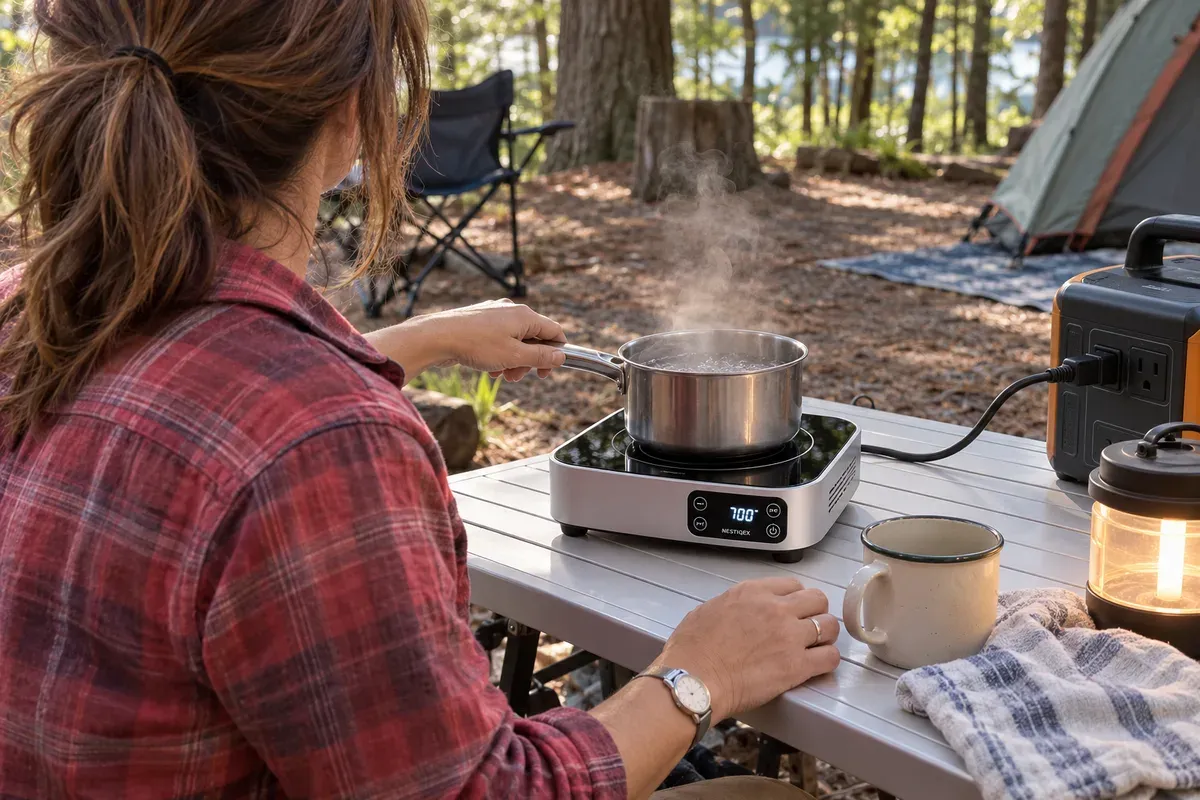
Quick facts: Power: 200–700 watts, 120 volts · Size: About 7 × 7 × 2.7 inches · Low heat: Non-pulse heating, per the maker · Extras: Magnet included to test cookware · Warranty: 365 days, per the listing
My results: Maximum draw 690 watts; 1 quart in 12 minutes and 40 seconds. My rating: 7.0 out of 10.
At 700 watts this runs on almost any inverter, even a small portable power station. It’s for coffee, tea, eggs and one-pot noodles, not family dinners. It made our morning coffee every day of the trip without touching the generator.
What I liked
- It runs on small power stations.
- It’s tiny and light.
What I didn’t like
- It’s slow and only takes small pans.
My verdict: Buy it if you run a small power station or van setup and mostly make coffee and one-pot meals. Skip it if you cook for a family.
The one I’d skip
This palm-sized burner is sold for moka pots, and the maker itself says it’s for small portions and warming only. In my test it never brought a quart of water to a boil in 20 minutes. Owner feedback is also weaker than the 700 watts mini’s. If you need a tiny burner, spend a little more on the 700 watts model.
Inverter, battery and shore-power math (the simple version)
- Inverter size: pick an inverter rated comfortably above the cooktop’s maximum draw. For an 1,800 watts burner, a 2,000 watts pure sine wave inverter is the practical minimum; ours ran the Duxtop at full power with its fan running hard. Induction electronics can misbehave on modified sine wave inverters, so choose pure sine wave.
- Battery use: watts × minutes ÷ 60 = watt-hours. Divide by 12 for amp-hours on a 12-volt system, then add about 10–15% for inverter losses. Example: 1,000 watts for 10 minutes = about 167 Wh, or about 14 amp-hours at 12 volts, roughly 16 amp-hours with losses.
- A day of cooking: our family of six used about 60–80 amp-hours a day for breakfast and dinner, comfortable on a 200 amp-hours lithium bank with some solar.
- Shore power: a 30-amp RV hookup can run a 1,800 watts burner, but not alongside the air conditioner and a microwave. A 50-amp hookup has much more room.
- Generators: a 2,000 watts inverter generator runs a 1,300–1,500 watts burner more comfortably than a full 1,800 watts one.
For worked examples, read my full guide to running induction on RV, solar or battery power. Not sure what your outlets can handle? Electrical requirements.
How to choose an induction cooktop for an RV or camping
Wattage and adjustable caps
Match the cooktop to your weakest power source. A model with a wattage cap (NuWave’s 600/900 watts settings) or a low lowest level (Duxtop’s 200 watts) gives you flexibility.
Portable or drop-in
Portables store away and go outside; drop-ins free up counter space and won’t slide while driving.
Size, weight and storage
Measure the cabinet. Keep the burner padded so the glass doesn’t crack on rough roads.
Cookware
RV pans must be magnetic too. A small cast-iron skillet and a magnetic stainless saucepan cover most camp meals. For more, see my guide to what cookware works on induction.
Ventilation and safety
Induction burns no propane, so there’s no carbon monoxide from cooking, but you still need a vent fan for steam and grease. Never block the burner’s air vents. For more, read is induction cooking safe?
ENERGY STAR says about 85% of induction’s energy reaches the pan, which matters when every amp-hour counts.
FAQ
Can you use an induction cooktop in an RV?
Yes. A 120-volt induction burner runs on shore power or on a battery bank through a pure sine wave inverter. Check that your inverter and wiring can handle its maximum wattage.
What size inverter do I need for an induction cooktop?
Choose an inverter rated above the cooktop’s maximum draw: about 2,000 watts for an 1,800-watt burner, or less for a lower-wattage model or one with a wattage cap.
How long will a battery run an induction cooktop?
Divide watts by battery voltage to get amps, then add 10–15% for inverter losses. An 1,800-watt burner on a 12-volt system draws roughly 165 amps, so a 200 amp-hours lithium battery runs it at full power for about an hour in total.
Can I run an induction cooktop on a 30-amp RV hookup?
Yes, but not at the same time as other big loads like the air conditioner or microwave, or you may trip the pedestal breaker.
Is induction better than propane for camping?
Induction is safer indoors, cooler and easier to clean, but it needs electricity. Propane works anywhere without power. Many RVers use both.
What is the best low-wattage induction cooktop?
In my tests, the NuWave PIC Flex was the best all-round low-wattage choice thanks to its 600, 900 and higher settings. For very small power stations, a 700-watt mini burner works for coffee and simple meals.