To choose an induction cooktop, start with the things you can’t change later: the width and cutout your counter allows, the amps your circuit can supply, and what sits underneath it. Then compare how the zones share power, whether the zone sizes match your pans, and how the controls feel with wet hands. Features like temperature sensors, bridge zones and hood syncing come last, because they only matter once a cooktop fits your kitchen and your wiring.
I’ve now cooked on more than 20 test cooktops, most of them on the plywood test counter in my kitchen, and the mistakes I see friends make are rarely about brand. They’re about a cooktop that’s half an inch too wide for the counter, needs 50 amps on a 30-amp circuit, or won’t let two big pots boil hard at the same time. This is the checklist I go through before I recommend anything, including the details I only learned by living with these cooktops.
The short checklist
- Measure your counter cutout and buy a cooktop whose cutout range covers it.
- Check the breaker the cooktop needs (30, 40 or 50 amps) against your circuit.
- Find out which zones share power, so your two busiest pans aren’t on the same pair.
- Match the zone sizes to the pans you actually own, measured across the flat base.
- Check what can go below it: a drawer, a wall oven, or nothing.
- Try the controls with a wet finger, and decide if you want knobs instead.
1. Does it fit your counter?
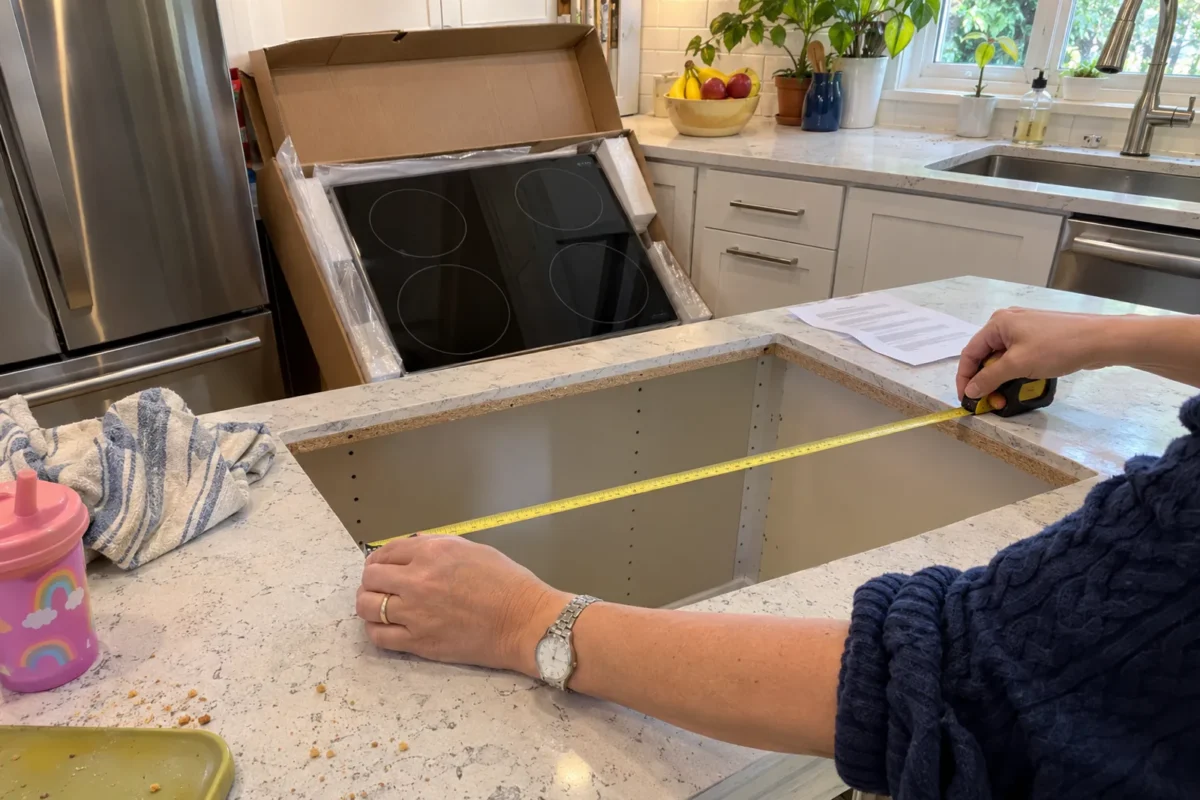
Induction cooktops come in three main widths: 24, 30 and 36 inches. The width on the box is only a name, though. What matters is the hole in your counter, and cooktops of the same width use different cutouts. A 30-inch Bosch 800 Series needs a cutout 28 7/8 inches wide, while a 30-inch GE Profile needs 28 1/2 to 28 5/8 inches. If you’re replacing a cooktop, measure the hole you already have and only shortlist cooktops whose cutout range covers it.
If you’re building a new kitchen, you have more freedom, but stone counters can’t easily be recut later. We paid $150 to widen our granite by half an inch when we first switched. My full measuring guide and a table of real cutouts is in Induction Cooktop Sizes and Cutout Dimensions.
2. Does it fit your wiring?
Built-in induction cooktops need their own 208/240-volt circuit, and the breaker size is not tied to the width. On my test counter, two 30-inch cooktops that looked almost identical needed 30 amps and 50 amps. The 30-inch Bosch 800 Series NIT8061UC needs 30 amps, the 30-inch GE Profile PHP9030 needs 40 amps, and the 36-inch GE Profile PHP9036 needs 50 amps, according to their spec sheets.
Look at the breaker for your current cooktop before you shop. If it’s 30 amps, a 30-amp cooktop is a simple swap, while a 50-amp model means new, thicker wire. If your home has 208-volt service, as many apartments and condos do, the cooktop will work but with less top power. GE lists the PHP9030 at 7.4 kilowatts on 240 volts and 6.4 kilowatts on 208 volts. The details are in my guide to induction cooktop electrical requirements.
3. What goes underneath it?
This is the check almost nobody does in the store. An induction cooktop has electronics and a cooling fan inside a metal box that hangs below the counter. That box is about 3 5/8 inches deep on the Frigidaire Gallery and 4 1/8 inches on the Bosch 800 Series, and it needs room to breathe.
- Drawers: the top drawer of a standard base cabinet often has to be shortened or removed. GE asks for 3 inches of free space between the bottom of its cooktops and anything combustible, like a shelf or drawer.
- Wall ovens: some cooktops are approved over a wall oven and some aren’t. GE only approves certain GE single wall ovens and warming drawers under its cooktops. Bosch shows its cooktops over a 30-inch built-in oven with at least a 1-inch air gap.
- Nothing but a cabinet: the easiest case, but keep the air path clear of stacked pans and cleaning supplies.
If the air path is blocked, the cooktop turns its power down or shuts off to protect itself. If you’re planning an oven below, read Can You Put an Induction Cooktop Over a Wall Oven? before you order either one.
4. How the zones share power
This is the fact that surprises people most after they buy. Most induction cooktops don’t have one power supply per zone. Two zones usually share one power module (manufacturers call it a generator), and the pair can only draw so much at once. When you turn one zone up to boost, its partner gets turned down, or on some models switched off completely.
GE’s own manual for its Profile cooktops explains it plainly: on its four-zone models each side runs from one generator, and when the large right element is on boost, the small right element shuts off until boost ends. Boost itself only lasts 10 minutes before dropping to the top regular level.
What this means in a real kitchen: if you often boil pasta on the big back zone while searing on the front zone right next to it, you want those two zones on different generators. In my house, Saturday pancakes on the bridge plus a pot of coffee water is the combination that gives some cooktops trouble. Before you buy, download the owner’s manual (not just the spec sheet) and search for “power sharing” or “power management”. It will show which zones are paired.
5. Zone sizes, bridges and flex zones
Each zone needs a pan that covers its inner ring before it will switch on. On older manuals I’ve seen minimums from 5 inches to 7 1/4 inches across, depending on the zone. That matters if you use a small milk pan, a stovetop espresso maker or a little butter warmer. Measure the flat base of your pans, not the rim, and make sure at least one zone will detect your smallest one.
At the other end, a 12-inch skillet on an 8-inch zone heats a hot circle in the middle. If you own big pans or a long griddle, look for one of these:
- A large zone of 11 inches or more. The Bosch 800 Series 30-inch has an 11-inch back right zone.
- A bridge that links two zones front to back so a griddle heats evenly. The Frigidaire Gallery has one on the left side. Check that your griddle’s length matches the bridge.
- Flex or full-surface zones that sense where you put the pan. They cost more, and they’re worth it mainly if you cook with odd-shaped pans like oval roasters or fish pans.
For a table of which pans work, read What Cookware Works on Induction?
6. Controls you’ll use every day
You’ll touch the controls thousands of times, so test them in person if you can. Wet a fingertip and try them, because that’s how you’ll use them while cooking. Things to look for:
- Sliders or direct-select numbers are faster than tapping plus and minus nine times.
- Controls at the front center stay away from pan handles and steam, but they’re easier for small kids to reach. A control lock is a must with little ones.
- Each zone with its own timer that switches the zone off when time is up. I use it for rice every night.
- Knobs, if touch controls frustrate you or an older family member. My mom was my co-tester for the best induction cooktops with knobs.
7. Power levels and low simmer
More steps give you finer control. A cooktop with 9 levels jumps further between settings than one with 17, like many Bosch models, or 19, like the GE Profile PHP9030. The bigger difference shows up at the bottom of the dial. To hold a very low setting, many cooktops switch the power on and off every few seconds. With a thin pan, that can mean a sauce that bubbles, stops and bubbles again. If you make a lot of sauces, soups or melted chocolate, look for a “melt” or “keep warm” setting and read reviews about simmering, or check the simmer results in my best induction cooktops tests.
8. Features worth paying for (and ones you can skip)
| Feature | What it does | Worth it? |
|---|---|---|
| Boost on every zone | Extra power for a few minutes to boil fast | Yes, if you boil pasta or blanch vegetables often |
| Pan temperature sensing (Bosch AutoChef, GE Precision Cooking) | Holds a set pan or oil temperature instead of a power level | Yes, if you fry or sear a lot |
| Bridge or flex zone | Links two zones for a griddle or long pan | Yes, if you own a griddle |
| Hood sync (Bosch Hood Control, GE Chef Connect) | Turns the range hood on from the cooktop | Only if you’re buying the same brand’s hood |
| Wi-Fi and app control | Remote alerts and settings from your phone | Nice to have, rarely used |
| Favorite or memory buttons | One tap for a setting you use daily | Small convenience |
Hood syncing deserves a note: it only works when the cooktop and the hood come from the same brand and support the same system, and on Bosch it’s set up through the Home Connect app. If you already own a hood you like, don’t pay extra for it. More on choosing a hood is in Do You Need a Range Hood With an Induction Cooktop?
9. The details most guides skip
These are the things I check now that I wish someone had told me nine years ago.
- The cable length. Built-in cooktops come with a fixed metal-sheathed cable. Bosch’s is 37 inches and GE’s is 48 inches. The junction box in your cabinet has to sit within reach, so a short cable can mean moving the box.
- The rear and front clearance. Bosch asks for at least 2 1/4 inches from the cutout to the counter’s front edge and 2 inches to the back wall. A tall backsplash ledge or a deep window sill can get in the way.
- Clearance above. GE asks for 30 inches from the countertop to an unprotected overhead surface. Microwave-over-cooktop setups often don’t meet that.
- Fan noise after you switch off. Every cooktop I’ve tested keeps its fan running for a while to cool down. Some are much louder than others.
- Pan buzz. Some layered stainless pans hum on high. It’s normal, but if noise bothers you, test your own pans before the return window closes.
- Framed or frameless glass. A stainless frame protects the edges from chips. Frameless looks cleaner, but the bare edge is the part that cracks if a heavy pot catches it.
- Fit promises. Frigidaire’s Fit Promise and GE’s Fit Guarantee are meant for replacements, covering cutouts made for many older cooktops of the same width. Read the terms before you rely on one, because they only apply to certain models.
- The delivery check. Open the box and check the glass for cracks and chips before you sign. Glass damage is the most common delivery problem, and it’s hard to prove afterward.
- Who installs it. Keep the electrician’s invoice. Some brands ask for proof of professional installation on warranty claims.
10. How much to spend
Paying more for an induction cooktop mostly buys more zones, flex areas, sensors and nicer glass. Boil speed is close across good cooktops, budget ones included. What really changes the total is installation: a new circuit, recutting a stone counter or moving a wall oven can cost more than the step up to a nicer cooktop. My full breakdown is in How Much Does an Induction Cooktop Cost?, and income-qualified households may get help through induction rebates.
Not sure built-in is right for you yet? A portable burner is a cheap way to try induction first. See the best portable induction cooktops. Ready to compare models? Start with the best 30-inch induction cooktops or the best 36-inch induction cooktops.
FAQ
What should I look for when buying an induction cooktop?
Check the cutout size, the breaker it needs, what can go below it, how the zones share power, and whether the zone sizes match your pans. After that, compare controls, power levels and extras like temperature sensing and bridge zones.
Is a 30-inch or 36-inch induction cooktop better?
A 36-inch cooktop adds a fifth zone and more space between pans, which helps if you cook for a big family. It also needs a wider cutout and usually a 40-amp or 50-amp circuit. If your counter is cut for 30 inches, a good 30-inch cooktop is the easier choice.
What is power sharing on an induction cooktop?
Power sharing means two zones draw from the same power module, so when one is on boost or very high, the other is turned down or switched off. The owner’s manual shows which zones are paired.
Do more power levels make a difference?
Yes, mainly at the low end. More levels give you finer steps for simmering and melting. A good “melt” or “keep warm” setting matters more than the total count.
Are induction cooktops with temperature sensors worth it?
If you fry or sear often, yes. They hold a set pan temperature, so oil doesn’t creep up and smoke. For boiling and everyday cooking, regular power levels work just as well.
Can I replace my cooktop without changing my counter?
Often, if you choose a model whose cutout range covers your existing hole and whose breaker matches your circuit. Measure the cutout itself, not the old cooktop’s glass.