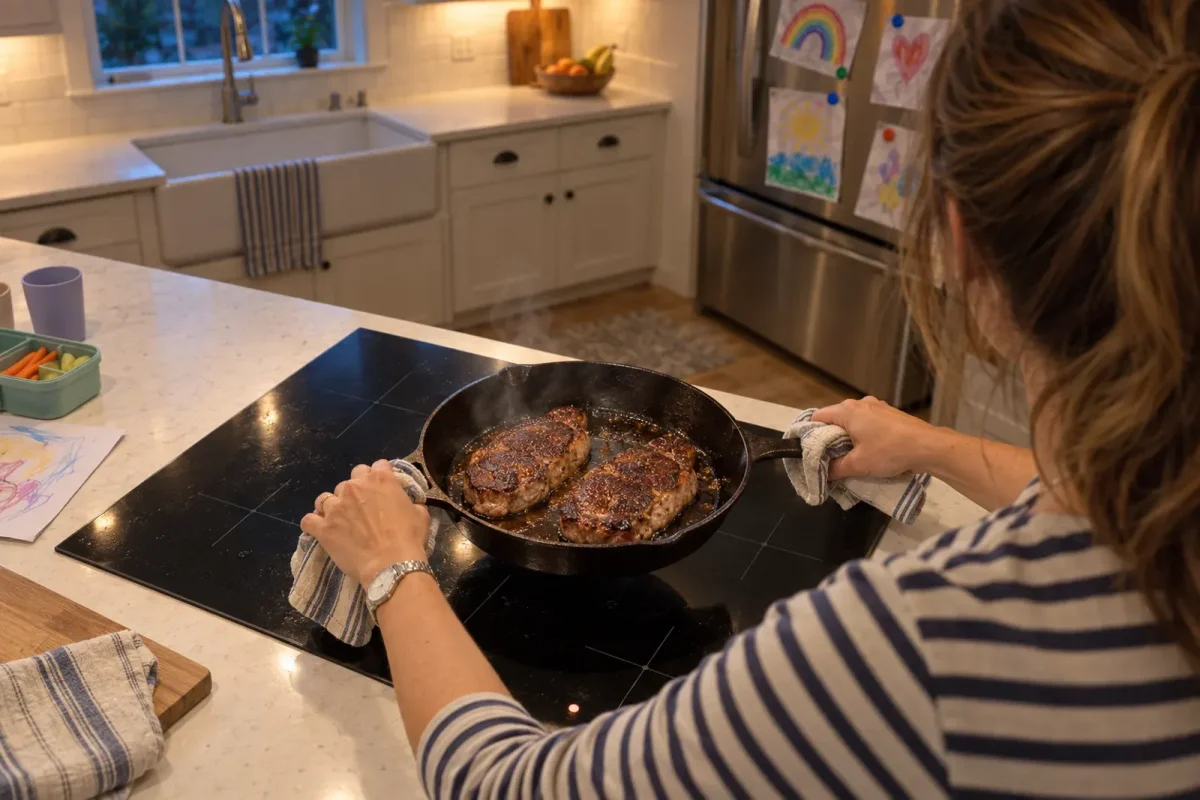
Yes, cast iron works on induction, and it works very well. Cast iron is made mostly of iron, which is strongly magnetic, so an induction cooktop heats it directly. Enameled cast iron (like Le Creuset or Staub) works too. The two rules: preheat on medium rather than blasting it on high, and lift the pan instead of sliding it so you don’t scratch the glass.
My 12-inch Lodge skillet is the pan I use most on induction, almost every day for nine years. For this guide I tested five cast-iron pans, bare and enameled, on my induction cooktop for heat-up time, hot spots and scratching. Here’s what I learned.
Cast iron on induction: quick rules
- It works: bare and enameled cast iron are both magnetic.
- Preheat on medium for 3 to 5 minutes, not on boost, because cast iron spreads heat slowly.
- Lift the pan to move it instead of sliding it, because a rough base can scratch the glass.
- Use the zone closest in size to the pan’s base.
- Keep the base clean, because burnt oil or grit on the bottom can mark the glass.
Why cast iron works on induction
An induction cooktop makes a changing magnetic field that heats only magnetic (ferromagnetic) metal. Cast iron is iron, so it reacts strongly and heats fast and efficiently. Lodge confirms its cast iron is safe to use on induction cooktops. If a magnet sticks firmly to your pan, and on cast iron it always will, the pan works. For more, read What Cookware Works on Induction?
My cast-iron tests
I tested each pan on the same 11-inch zone of my Bosch 800 Series, with a thin layer of flour to show hot spots and an infrared thermometer to read the cooking surface.
| Pan | Medium (level 6) to 400°F | Boost to 400°F | Hot-spot check (center vs edge) | Glass after 30 days |
|---|---|---|---|---|
| Lodge 12-inch skillet | 4 min 30 sec | 1 min 50 sec | Center 60°F hotter on boost; even after 4 min on medium | No marks |
| Lodge 10.25-inch skillet | 3 min 40 sec | 1 min 35 sec | Even within 20°F | No marks |
| Vintage smooth-bottom 10-inch skillet | 3 min 20 sec | 1 min 25 sec | Even within 20°F | No marks |
| Enameled 5.5-quart Dutch oven | 5 min 10 sec | 2 min 10 sec | Even within 25°F | No marks |
| Cast-iron reversible griddle (2 zones) | 6 min 30 sec | Not tested | Cooler strip between zones | One faint mark where I slid it |
Temperatures in degrees Fahrenheit (°F), read with an infrared thermometer.
The lesson: on boost, my 12-inch skillet got a ring of very hot metal over the coil while the edges lagged. On medium for four minutes, the whole pan evened out and my steak browned edge to edge.
How to preheat cast iron on induction
- Put the pan on the zone that best matches its base. A pan much bigger than the zone heats mostly in the middle.
- Add a thin film of oil. Lodge suggests preheating with oil and watching for it to shimmer.
- Set medium (around 5–6 of 9, or 6–7 of 10) for 3–5 minutes. Cast iron spreads heat slowly, so give it time.
- Turn up to high only once the pan is evenly hot, then add the food.
- If the oil smokes, lift the pan off for a minute; on induction the heat stops right away.
Lodge also recommends heating gradually to avoid thermal shock. That matters more on induction because boost can heat the center of the pan very quickly. For more cooking tips, read How to Use an Induction Cooktop.
Will cast iron scratch an induction cooktop?
It can, but only if you slide it or if there’s grit under it. Cast iron itself is not harder than the glass-ceramic top; scratches usually come from sand-like grit, burnt-on bits or a rough casting edge being dragged across the surface. Lodge says the bottoms of its pans are smooth enough not to scratch glass tops and recommends lifting the pan to move it.
- Lift pans instead of sliding them.
- Wipe the bottom of the pan before you cook, especially after camping or the oven.
- Check for rough spots; a vintage or worn pan may need its base smoothed.
- If you use a protector mat or a sheet of parchment under the pan, check your cooktop manual first. For more, read Best Induction Cooktop Protector Mats.
After 30 days of daily use, my glass had no new scratches from the skillets, and one faint mark from sliding the griddle, which buffed out with cooktop cleaner. For cleaning tips, read How to Clean an Induction Cooktop.
Enameled cast iron on induction
Enameled cast iron works on induction because there’s iron under the enamel. The smooth glassy base is gentle on the cooktop. Two cautions: don’t heat an empty enameled pot on high, and don’t let it boil dry, because enamel can crack from extreme heat. My enameled Dutch oven makes a slight hum on high, which is normal.
Cast-iron griddles and grill pans
A long cast-iron griddle works best on a cooktop with a bridge or flex zone that links two elements. On two separate zones, I got a cooler strip down the middle. For more, read Best Flex-Zone Induction Cooktops.
Mistakes to avoid
- Don’t preheat an empty pan on boost.
- Don’t slide the pan across the glass.
- Don’t expect even heat from a pan much larger than the zone.
- Don’t leave burnt oil on the bottom of the pan.
- Don’t drop a heavy pan onto the glass.
FAQ
Does cast iron work on induction?
Yes. Cast iron is strongly magnetic, so induction heats it directly and efficiently. Lodge confirms its cast iron is safe on induction cooktops.
Can cast iron crack on an induction cooktop?
It’s rare, but very fast heating of an empty pan can stress cast iron. Preheat on medium with a little oil instead of using boost on a cold, empty pan.
Does enameled cast iron work on induction?
Yes. There’s iron under the enamel, so it’s magnetic. Avoid heating it empty on high or letting it boil dry.
Will cast iron scratch my induction cooktop?
Only if you slide it or there’s grit under it. Lift the pan to move it and keep the base clean.
Why does my cast-iron pan heat unevenly on induction?
Induction heats the part of the pan above the coil, and cast iron spreads heat slowly. Preheat on medium for a few minutes and use the zone closest to the pan’s size.
Is cast iron good for induction cooking?
Yes, it’s one of the best. It heats efficiently, holds heat well for searing, and lasts for generations.