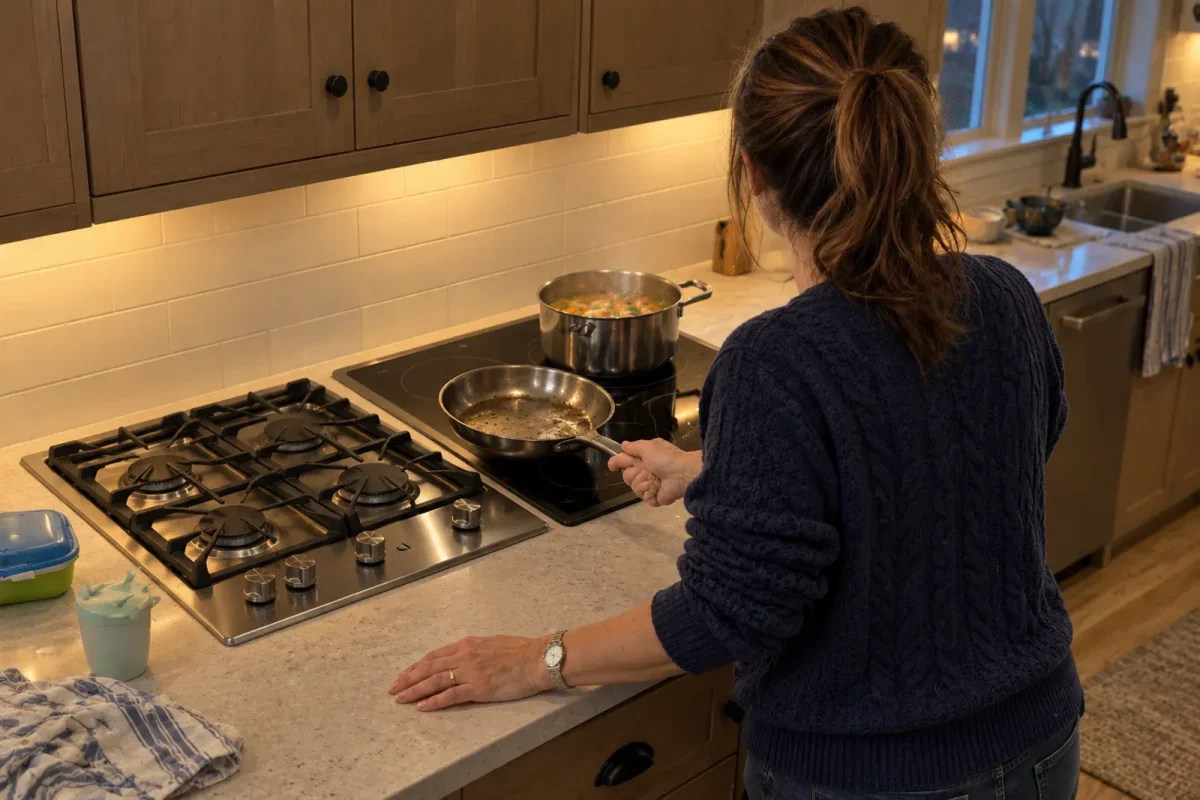
Induction is better than gas for most home cooks: it boils faster, gives the same instant control, keeps combustion fumes out of your kitchen and is far easier to clean. Gas still wins for round-bottomed wok cooking, charring over an open flame, cooking through a power outage and working with any pan you own.
I grew up cooking on gas, and my mother still does. When we replaced our cooktop nine years ago, I chose induction. For this guide I ran the same tests on my induction cooktop and a 30-inch gas cooktop at my sister’s house, before she switched to induction herself. Here is how induction vs gas really compares.
Induction vs gas at a glance
- Induction boiled a quart in 2 minutes and 41 seconds; gas took 4 minutes and 58 seconds on its biggest burner.
- About 85% of induction’s heat reaches the pan, compared with about one-third for gas, according to ENERGY STAR.
- Gas burns fuel indoors and releases nitrogen dioxide (NO2); induction burns nothing.
- Both respond to changes almost instantly.
- Induction is a flat sheet of glass to wipe; gas has grates and burner caps to scrub.
- Gas still wins for round-bottom woks, charring peppers or tortillas over a flame, cooking during power outages, and using any cookware.
My side-by-side tests: induction vs gas
Same 3-quart tri-ply pan, same 12-inch cast-iron skillet, same 70°F tap water, three runs each. Gas tests used the largest burner on a 30-inch GE gas cooktop; induction tests used my Bosch 800 Series on its largest zone.
| Test | Induction | Gas | Winner |
|---|---|---|---|
| Boil 1 quart, highest setting | 2 min 41 sec | 4 min 58 sec | Induction |
| Boil 6 quarts of pasta water | 14 min 5 sec | 19 min 40 sec | Induction |
| Time for a boil to calm after turning to low | about 2 seconds | about 2 seconds | Tie |
| Lowest steady simmer (degrees up/down over 30 min) | about 4°F | about 7°F | Induction |
| Kitchen air temperature rise after 30 minutes of boiling | +2°F | +7°F | Induction |
| Charring a bell pepper | Not possible | Easy | Gas |
| Round-bottom wok stir-fry | Flat-bottom wok only | Works well | Gas |
Temperatures in degrees Fahrenheit (°F).
Speed and control
Induction is faster than gas because the heat starts inside the pan instead of escaping around its sides. ENERGY STAR says induction can boil water in nearly half the time of gas, and my quart boiled almost twice as fast.
For control, the two are close: both change heat as soon as you turn the knob or tap the control. Induction is better at the very low end. On my sister’s gas cooktop the smallest flame still made my tomato sauce spit; on induction it held a lazy simmer. Many induction cooktops also let you set a pan temperature, which gas can’t do.
Indoor air and health
Gas stoves burn fuel in your kitchen, which releases pollutants including nitrogen dioxide (NO2). Induction burns nothing, so the only fumes come from the food itself.
A 2024 Stanford University study published in Science Advances estimated that typical gas and propane stove use raises average yearly NO2 exposure by about 4 parts per billion (ppb), which is roughly 75% of the World Health Organization’s outdoor exposure guideline, before counting outdoor sources. The researchers linked long-term exposure to as many as 200,000 current childhood asthma cases and found that people in homes under 800 square feet had about twice the national average exposure.
If you keep gas, use a range hood that vents outside every time you cook. With induction you still need a hood for smoke and grease from the food. For more, read Is Induction Cooking Safe?
Safety
- There’s no open flame, so induction can’t light a dish towel or a sleeve.
- The glass only warms from the pan. Next to my boiling pot it read 118°F, while the gas grate read over 500°F.
- Induction zones stop heating when you lift the pan, and most switch off automatically after a set time.
- There’s no gas to leak and no burner to leave on unlit.
Energy efficiency and running cost
Induction is about two and a half times as efficient as gas at getting heat into the pan: ENERGY STAR puts it at about 85% for induction and about one-third for gas. Whether induction is cheaper to run depends on your local electricity and gas prices. At my rates, cooking costs about the same either way, within a few dollars a month. For more, read How Much Electricity Does an Induction Cooktop Use?
Cooking feel: woks, searing and charring
Gas is better for round-bottomed wok cooking and anything you want to char over a flame. Induction only heats the part of the pan touching the glass, so a round-bottom wok barely heats, and there’s no flame to blister a pepper or warm a tortilla.
- Induction sears as well as gas once the pan is preheated; my cast-iron steak crust was the same on both.
- For stir-fries, use a flat-bottom carbon-steel wok on induction, or a dedicated induction wok burner.
- Lifting a pan off induction to toss food pauses the heat, so keep it on the glass and stir instead.
Cleaning
Induction is much easier to clean: wipe a flat sheet of glass. Gas means lifting grates, scrubbing burner caps and clearing ports. Cleaning my sister’s gas cooktop after one week of testing took me 25 minutes; my induction took 3. For more, read How to Clean an Induction Cooktop.
Cost of switching from gas to induction
Switching from gas usually means four costs: the induction cooktop itself, a new 240-volt circuit run by an electrician, capping the old gas line, and replacing any non-magnetic pans. My electrician charged $650 for the circuit and permit. Some states and utilities offer rebates for switching to electric cooking; check what’s available now before you buy. For more, read Induction Stove Rebates and Tax Credits, How Much Does an Induction Cooktop Cost in 2026? and Induction Cooktop Electrical Requirements.
Is induction better than gas for you?
- Choose induction if you want faster cooking, cleaner indoor air, easier cleaning, or a safer cooktop around kids.
- Keep gas if you cook with a round-bottom wok, char food over flame often, lose power often, or can’t add a 240-volt circuit.
- Not sure? Try a portable induction burner next to your gas stove for a few weeks.
When you’re ready to shop, read Best Induction Cooktops and Induction vs Electric Cooktop.
FAQ
Is induction better than gas?
For most home cooks, yes. In my tests induction boiled water almost twice as fast, held a steadier simmer and kept the kitchen cooler, and it doesn’t burn gas indoors. Gas is still better for round-bottom woks and charring over flame.
Do chefs prefer gas or induction?
Many professional kitchens still use gas, but more chefs now use induction for its speed, precision and cooler, cleaner kitchens. Wok-focused cooks tend to stay with gas.
Is induction cheaper to run than gas?
It depends on your local energy prices. Induction is far more efficient (about 85% vs about one-third, per ENERGY STAR), but electricity usually costs more per unit of energy than gas, so running costs often end up similar.
Are gas stoves bad for your health?
Gas stoves release nitrogen dioxide and other pollutants indoors. A 2024 Stanford study estimated typical use raises average yearly NO2 exposure by about 4 parts per billion (ppb). Venting a hood outdoors helps; induction removes the combustion source.
Can you use a wok on induction?
Yes, with a flat-bottom wok. A round-bottom wok needs an induction wok burner with a curved surface, or gas.
What do I need to switch from gas to induction?
An induction cooktop, a dedicated 240-volt circuit installed by an electrician, the gas line capped, and magnetic cookware. Check for local rebates first.