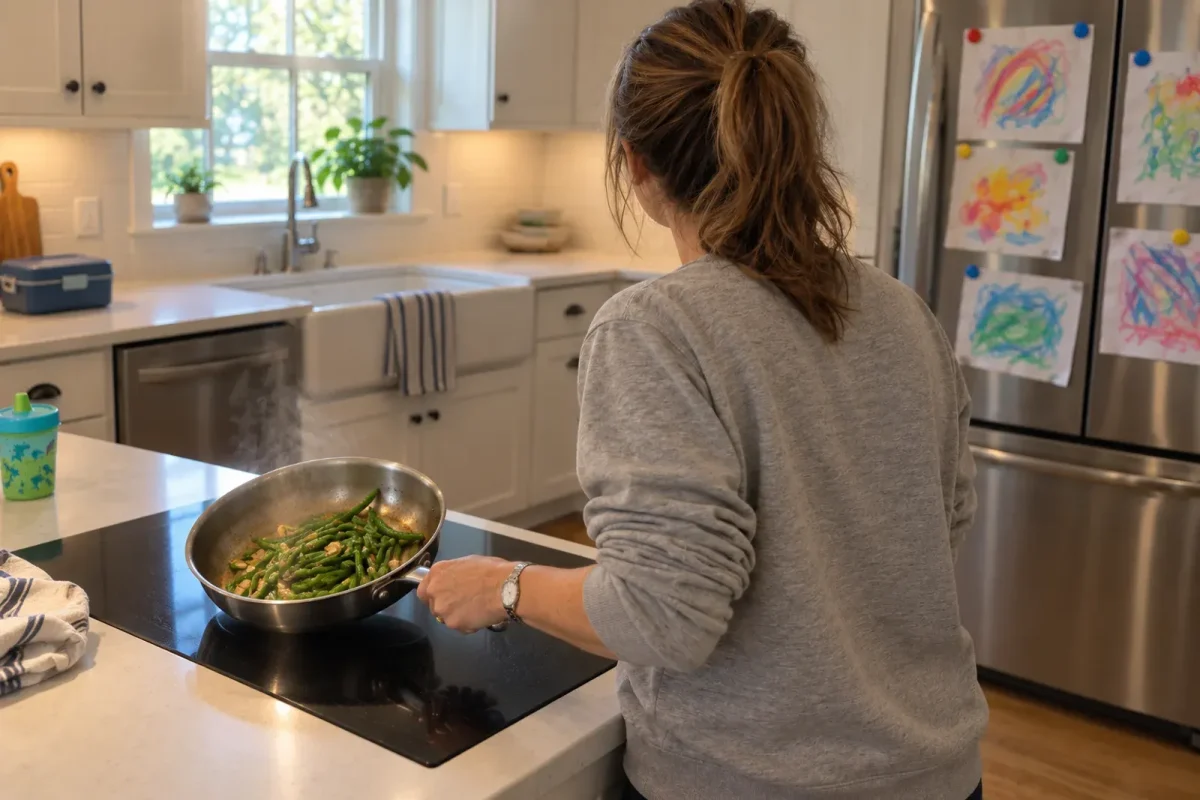
Most stainless steel cookware works on induction, but not all of it. It works if the base is made of a magnetic grade of stainless steel, so the quick test is to hold a fridge magnet to the bottom of the pan: if it sticks firmly, the pan will work. Clad (tri-ply or 5-ply) pans and disc-bottom pans usually have a magnetic outer layer or base plate. Pans made entirely of non-magnetic 18/10 or 18/8 stainless steel won’t heat on induction.
Stainless steel is most of what I cook with. When I switched to induction nine years ago, I magnet-tested every pan I owned, and for this guide I tested 14 stainless pans from my kitchen and my friends’ kitchens on the same induction zone. Here’s which stainless steel works, which doesn’t, and why.
Stainless steel on induction: quick answer
- Clad stainless (tri-ply or 5-ply) usually works, because its outside layer is magnetic stainless.
- Disc-bottom (encapsulated base) stainless usually works if the disc is magnetic.
- 18/0 stainless, also called 430, is magnetic and works.
- Pans that are 18/10 or 18/8 stainless all the way through aren’t magnetic and won’t work.
- The test is simple: if a magnet sticks firmly to the flat base, the pan works.
Why some stainless steel works on induction and some doesn’t
An induction cooktop heats with a changing magnetic field. That field only creates useful heat in metals that react strongly to a magnet, called ferromagnetic metals, such as iron and some types of steel. “Stainless steel” isn’t one metal; it’s a family of iron alloys. Some are magnetic and some aren’t, depending on how much nickel and chromium they contain and how their crystals are arranged. For the science, read How Does an Induction Stove Work?
18/10 vs 18/8 vs 18/0 stainless steel
The numbers describe the alloy: the first is the approximate percentage of chromium, the second is nickel.
| Grade | Also called | Magnetic? | Works on induction? | Where you’ll find it |
|---|---|---|---|---|
| 18/10 | 304 (with about 10% nickel) | No (or very weakly) | Not on its own | Cooking surface inside most quality pans |
| 18/8 | 304 | No (or very weakly) | Not on its own | Pots, utensils, cheaper cookware |
| 18/0 | 430 (almost no nickel) | Yes | Yes | Outer layer of clad pans, disc bases, induction-ready pans |
Nickel makes 18/10 and 18/8 stainless resistant to rust and gives it its shine, but it also makes the steel non-magnetic. That’s why makers put a layer of magnetic 18/0 stainless on the outside of the pan: you get a nickel-rich cooking surface inside and a magnetic base outside.
Clad vs disc-bottom construction
Fully clad (tri-ply, 5-ply)
Layers of metal are bonded all the way up the sides: usually 18/10 stainless inside, an aluminum or copper core for even heat, and magnetic stainless outside. On induction, the whole base heats and the core spreads it up the sides. My tri-ply pans boil the most evenly of anything I own.
Disc-bottom (encapsulated base)
The body is thin stainless, with a thick disc of aluminum sealed under a magnetic stainless plate on the base only. These usually work well and cost less. Watch for discs that are smaller than the base: only the disc area heats. On my disc-bottom stockpot I saw a ring of slower bubbles around the edge.
Single-layer stainless
Thin, single-layer pans work only if the steel itself is a magnetic grade. They heat fast but scorch easily and can warp, which hurts contact with the glass.
My magnet and boil tests on 14 stainless pans
Each pan sat on the same 8-inch zone of my Bosch 800 Series at power level 9 with 2 cups of 70°F water. Times are the middle of three runs.
| Pan | Construction | Magnet | 2 cups to a boil | Notes |
|---|---|---|---|---|
| All-Clad D3 3-quart saucepan | Tri-ply clad | Strong | 1 min 58 sec | Even, quiet |
| Tramontina tri-ply 10-inch skillet | Tri-ply clad | Strong | 2 min 2 sec | Even |
| Made In 5-ply sauté pan | 5-ply clad | Strong | 2 min 8 sec | Very even; heavier |
| Cuisinart Chef’s Classic saucepan | Disc bottom | Strong | 2 min 6 sec | Slight hum on 9 |
| IKEA 365+ pot | Disc bottom | Medium | 2 min 20 sec | Disc smaller than base |
| Old department-store stockpot | Single-layer 18/10 | None | — | Not detected; pan symbol flashed |
| Vintage Revere Ware saucepan | Stainless with copper bottom | None | — | Not detected |
| Budget stainless steamer pot | Single-layer | Weak | 4 min 35 sec | Buzzed loudly, heated unevenly |
8 of 14 pans shown. Temperatures in degrees Fahrenheit (°F). Brand names describe the pans I used, not current product lines; check the maker’s site for today’s version.
The pattern: every pan with a strong magnet result worked well; the weak-magnet pan worked badly; no-magnet pans didn’t work at all.
How to check if your stainless steel pans work on induction
- Do the magnet test: hold a fridge magnet to the center of the flat base. A strong grip means it works well, a weak grip means it may work slowly or buzz, and no grip means it won’t work.
- Check the edge too. On disc-bottom pans, move the magnet toward the rim to see how big the magnetic plate is.
- Look for the coil-shaped induction symbol or the words “induction ready” on the base or box.
- Try it with 1 cup of water on your cooktop. If the zone shows a “no pan” symbol, the pan isn’t magnetic enough.
For every cookware material, read What Cookware Works on Induction?
Cooking tips for stainless steel on induction
- Preheat on medium, not boost. Induction heats stainless very fast; my empty skillet hit 450°F in under a minute on boost, which is hot enough to burn oil.
- Use the water-drop test: when a few drops of water bead up and skate across the pan, it’s ready for oil.
- Match pan and zone size so the whole base heats.
- Keep the base flat. Don’t plunge a hot pan into cold water; that’s how thin stainless warps.
- Clean the base. Burnt oil on the bottom can mark the glass. For more, read How to Clean an Induction Cooktop.
- Buzzing is normal on high with some clad pans; it usually quiets at lower settings.
What to look for when buying stainless steel for induction
- The words “induction compatible” or the induction symbol on the box.
- Full cladding, or a thick disc base that covers almost the whole bottom.
- A flat, heavy base that won’t warp.
- 18/10 stainless on the cooking surface for rust resistance, with magnetic stainless on the outside.
- And take a magnet to the store.
For other pans that work, read Can You Use Cast Iron on Induction? For pans that don’t work, read Induction Converter Discs.
FAQ
Does stainless steel work on induction?
Most stainless steel cookware works if its base is a magnetic grade, as in most clad and disc-bottom pans. Pans made entirely of non-magnetic 18/10 or 18/8 stainless don’t work. A magnet sticking firmly to the base means it will work.
Is 18/10 stainless steel induction compatible?
Not on its own, because 18/10 stainless is non-magnetic. Many 18/10 pans still work because they have a magnetic stainless outer layer or base plate.
Is 18/0 stainless steel magnetic?
Yes. 18/0 (430) stainless has almost no nickel, which makes it magnetic, so it works on induction. It’s often used as the outer layer of induction-ready pans.
Why is my stainless steel pan not working on induction?
The base probably isn’t magnetic, the magnetic disc is too small for the zone, or the base is warped. Try the magnet test and a smaller zone.
Why does my stainless steel pan buzz on induction?
The layers in clad or disc-bottom pans vibrate slightly in the magnetic field at high power. It’s normal and usually stops at lower settings.
Is tri-ply stainless good for induction?
Yes. Tri-ply has a magnetic outer layer for induction and an aluminum core that spreads heat evenly, which makes it one of the best choices.