An induction stove works by turning your pan into the heater. A copper coil under the glass carries alternating current, which creates a rapidly changing magnetic field. That field induces small electric currents (eddy currents) in the base of a magnetic pan, and the pan’s resistance to those currents makes it hot. The glass isn’t heated directly; it only warms from the pan sitting on it.
I’m a home cook, not an engineer, so I explain this the way I’d explain it to my kids, and I checked the technical parts against cooktop makers’ manuals. I’ve also run a few simple experiments in my kitchen so you can see each step happen.
How an induction stove works, step by step
- Household electricity enters the cooktop’s electronics: 240 volts for a built-in cooktop and 120 volts for a portable burner.
- The electronics switch the current back and forth very fast, roughly 20,000 to 100,000 times a second, depending on the design. This is called high-frequency alternating current.
- That current flows through a flat copper coil under each zone and creates a magnetic field that rises through the glass.
- The changing field induces swirling electric currents, called eddy currents, in the base of a magnetic pan.
- The metal resists those currents, and its magnetism keeps flipping, which turns electrical energy into heat right inside the pan.
- The hot pan base heats the food. The glass warms only because the hot pan is sitting on it.
That’s why induction feels so responsive: change the power and the heat in the pan changes almost at once, because nothing in between has to warm up or cool down. More background: what is an induction cooktop?
Why the pan has to be magnetic
Induction only makes useful heat in ferromagnetic metals, such as iron and magnetic stainless steel. In aluminum, copper or glass the field passes through with little effect, so the cooktop either doesn’t detect the pan or barely heats it. If a magnet sticks firmly to the base, the pan works. For more, read What Cookware Works on Induction? and Can You Use Cast Iron on Induction?
Three kitchen experiments that show it
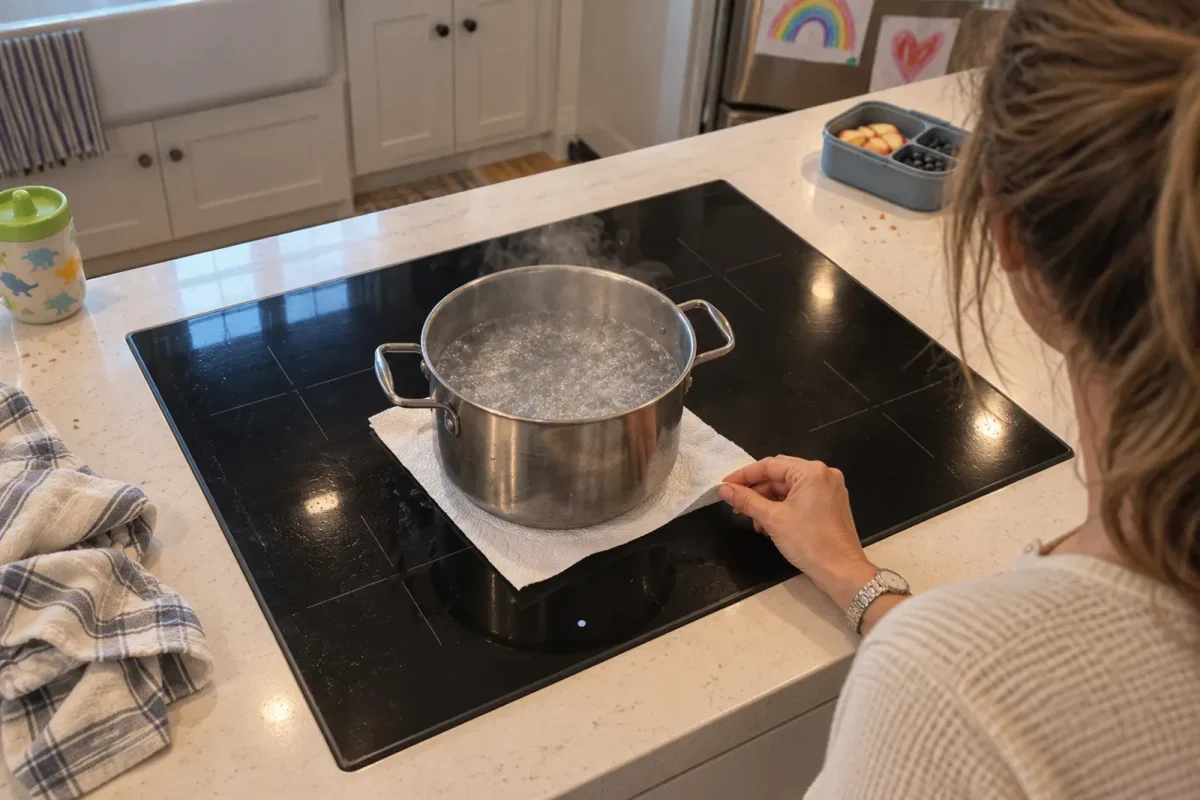
1. The paper towel test
I put a paper towel between the glass and a pot of water, then boiled it. The water boiled in 3 minutes and 5 seconds and the paper towel didn’t scorch. The heat is in the pan, not the glass.
2. The no-pan test
I turned a zone on with nothing on it. It stayed dark, flashed the “no pan” symbol, and switched itself off after about a minute. No pan, no heat.
3. The aluminum pan test
I set my aluminum sauté pan on a zone. The cooktop didn’t recognize it at all; when I put a magnetic steel converter disc underneath, the pan heated, but slowly.
How the cooktop controls the heat
- Power levels tell the electronics how much power to send to the coil. Higher numbers mean more power.
- At low settings, some cooktops can’t run the coil gently enough for a very low simmer, so they switch it on and off in cycles. On my test cooktops you could hear a soft click and see the simmer rise and fall every few seconds.
- Power boost lets a zone borrow extra power for a few minutes to boil water fast.
- Neighboring zones often share one power supply, so boosting one can turn down its neighbor. Portable double burners share their 1,800 watts the same way.
- The cooktop senses whether a suitable pan is present, and temperature sensors under the glass cut the power if anything overheats.
Why induction cooktops hum, click and buzz
- A cooling fan protects the electronics and keeps running for a minute or two after you switch off.
- A hum or buzz at high power comes from the magnetic field making the layers of a pan vibrate slightly. Heavier, single-piece pans are usually quieter.
- Clicking is the electronics switching the coil on and off at low settings.
All of these are normal. For more, read Induction Cooktop Not Working?
Why induction is so efficient
Because the heat is made inside the pan, very little escapes into the room. ENERGY STAR says about 85% of an induction cooktop’s heating energy reaches the food, compared with about a third for gas, and that induction can boil water in nearly half the time of gas, radiant or coil electric. For more, read Induction vs Electric Cooktop and Induction vs Gas.
How do I know if my stove is induction?
- Look for “induction” on the glass or the model label.
- Turn on a zone with no pan: induction stays dark, while radiant electric glows red.
- Try a magnet on your favorite pan. If your stove only heats pans a magnet sticks to, it’s induction.
How induction ranges and ovens work
An induction range has an induction cooktop on top and a normal electric oven underneath. The oven doesn’t use induction; it bakes with electric heating elements, often with a convection fan. “Induction oven” usually means an induction range.
FAQ
How does an induction stove work?
A copper coil under the glass creates a changing magnetic field. That field induces electric currents in the base of a magnetic pan, and the pan heats up. The glass only warms from the hot pan.
Does an induction cooktop use magnets?
It uses electromagnetism, not permanent magnets. The coil creates a magnetic field only while it’s on and only heats magnetic cookware.
Why doesn’t the glass get hot on induction?
The heat is made inside the pan, not the glass. The glass gets warm only from the hot pan touching it, so it can still be hot right after cooking.
Is the magnetic field from an induction cooktop safe?
Cooktops sold in the US must meet safety and emissions limits, and the field drops off quickly with distance. People with pacemakers or other implants should follow their device maker’s guidance. For more, read Is Induction Cooking Safe?
Why does my induction cooktop click on low?
On low settings many cooktops switch the coil on and off in short cycles to hold a gentle heat. The click is the electronics switching; it’s normal.
Do induction cooktops work without a pan?
No. Without a magnetic pan, the zone won’t heat and usually switches itself off after a short time.