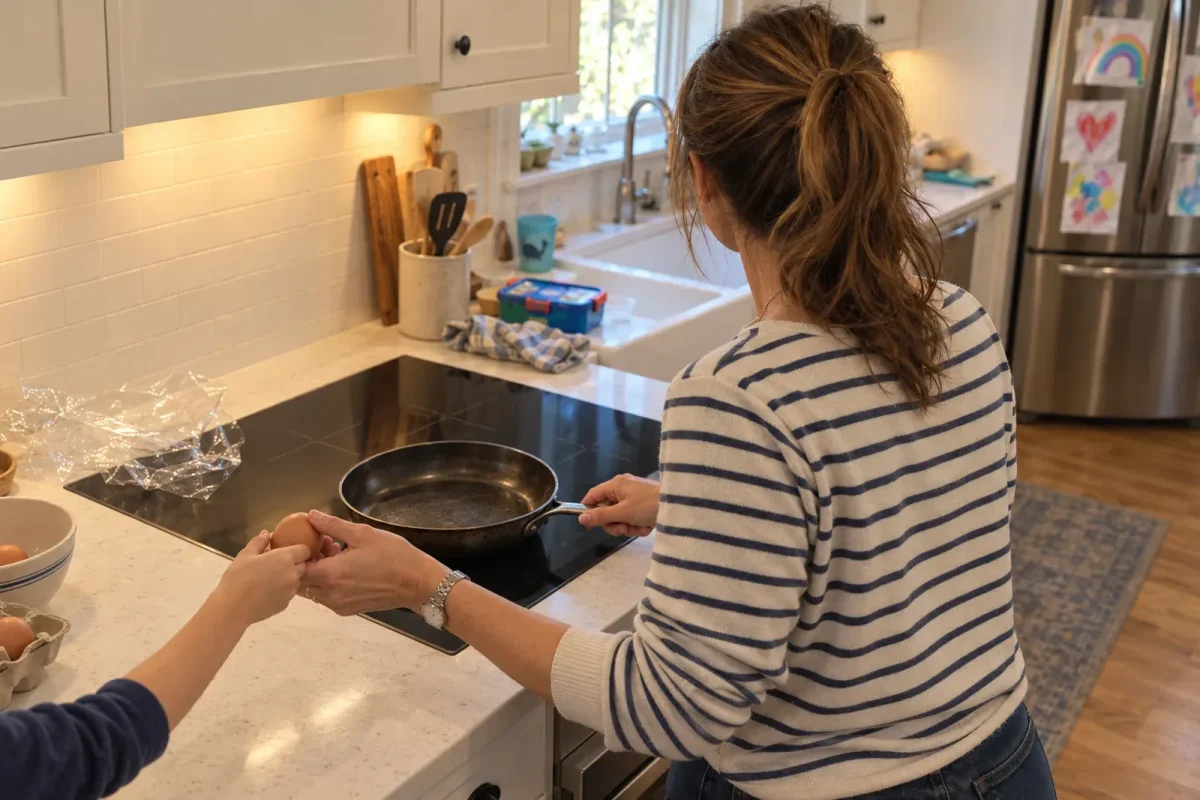
To use an induction cooktop, put a magnetic pan on a cooking zone, turn the cooktop on, select the zone, and choose a power level. The pan starts heating within seconds. Use medium (about 5–6 out of 9) for most cooking, high (8–9) or boost for boiling, and low (1–3) for simmering and melting. Lift the pan and the heat stops; put it back and the heat resumes. The main adjustment is speed: induction heats faster than gas or electric, so preheat on medium and have your ingredients ready.
I’ve cooked three meals a day on induction for nine years, and I helped my sister make the switch this year. This is the guide I wish I’d had in my first week, with the settings I actually use for everyday food and the mistakes I made so you don’t have to.
Quick start: your first meal on induction
- Check your pan: a fridge magnet should stick firmly to its base.
- Place the pan in the center of a zone that matches its size.
- Press power, select the zone and set the level.
- Preheat on medium for 1–2 minutes before adding oil or food.
- Turn down sooner than you would on gas or electric.
- When done, turn the zone off and watch for the “H” hot-surface light.
Step 1: Use the right pans
Induction only heats magnetic cookware: cast iron, enameled cast iron, carbon steel and most clad or disc-bottom stainless steel. Pans should have a flat base about the same size as the zone. If the cooktop shows a flashing pan symbol or “U,” it can’t detect a suitable pan. Seven of my ten pans worked when I switched. To check your own pans, read What Cookware Works on Induction?, Does Stainless Steel Work on Induction? and Can You Use Cast Iron on Induction?
Step 2: Learn the controls
Most induction cooktops use touch controls. Layouts differ, but the sequence is similar:
- To switch on, press and hold the power key until the display lights up.
- To choose a zone, tap its symbol or its slider.
- To set the level, tap plus or minus, slide, or tap a number. Most cooktops use 1 to 9; some use 1 to 10 or 1 to 17.
- To turn a zone off, set it to 0 or press its off key. Press the main power key to turn everything off.
- To lock the controls for cleaning or around kids, hold the lock key, which usually shows a key or padlock symbol.
Keep the control area dry and clear. Water, a pan handle or a wet cloth on the controls can make them beep or switch off. On my Bosch, a pot lid resting on the slider turned the zone off twice in my first month.
Step 3: Induction power level guide
Power levels aren’t temperatures; they’re how much energy goes into the pan. The same level gets a small pan hotter than a big pot. Use this as a starting point and adjust by watching the food.
| Level (of 9) | What it’s for | My examples |
|---|---|---|
| Boost / P | Fastest boiling | Pasta water, blanching vegetables |
| 8–9 (high) | Boiling, searing in a preheated pan | Steak crust, stir-fry |
| 6–7 (medium-high) | Sautéing, frying, pancakes | Onions, chicken thighs, eggs in a big pan |
| 4–5 (medium) | Gentle frying, cooking rice, sauces | Scrambled eggs, rice after it boils |
| 2–3 (low) | Simmering soups, stews | Chili, tomato sauce, oatmeal |
| 1 (lowest) | Melting, keeping warm | Butter, chocolate, keeping gravy warm |
If your cooktop uses a 1–10 or 1–17 scale, the same proportions apply: about two-thirds of the way up is medium-high. Your manual has a recommended-settings chart, so check it once and keep a photo of it on your phone.
Boost, temperature mode, timers and bridge zones
- Boost (also called power boost, PowerBoost or “P”) gives a zone extra power for a few minutes, usually for boiling. Some cooktops borrow that power from the neighboring zone, so that zone may drop while boost is on.
- Temperature mode, on some models, lets you set a target pan temperature instead of a power level, and the cooktop holds it using a sensor. It’s great for frying and searing.
- A kitchen timer just beeps, while a zone timer switches that zone off when it ends. I use zone timers for rice every night.
- Bridge or flex zones link two zones into one for a griddle or long pan. For more, read Best Flex-Zone Induction Cooktops.
- Keep warm holds food at a low setting, and pause stops all zones for a moment.
First meals: what to cook and how
Boiling pasta
Fill the pot, cover it, and use boost. My 6 quarts boil in about 14 minutes. When you add the pasta, drop to 7–8 to keep a rolling boil without boiling over.
Eggs
Preheat a nonstick or stainless pan on 4 for one minute, add butter, then cook on 3–4. Induction gets hot fast; on gas I used to start on high.
Searing steak or chicken
Preheat cast iron on 6 for 3–4 minutes so the heat spreads evenly, then turn up to 8 just before adding the meat. Don’t start cast iron on boost; the center gets much hotter than the edges.
Simmering soup or sauce
Bring it to a boil on high, then drop straight to 2–3. If it stops bubbling, go up one level. On some cooktops low settings pulse on and off; a heavier pot evens this out.
Rice
Bring to a boil on 8, cover, drop to 2, and set a 15-minute zone timer.
Beginner mistakes (I made most of these)
- Using high heat out of habit. I burned garlic twice in my first week. Start a level or two lower than you think.
- Preheating an empty pan on boost. It can overheat in under a minute and damage nonstick coatings.
- Tossing food by lifting the pan. The heat pauses when the pan leaves the glass; stir instead, or work quickly.
- Using a pan much bigger than the zone. Only the middle heats.
- Sliding pans. It scratches the glass; lift them.
- Leaving utensils on the cooktop. A metal spoon on an active zone can get hot.
- Letting a pan boil dry. Overheat protection helps, but it can still damage the pan.
Noises, beeps and blinking
- A running fan is normal. It cools the electronics and may run for a few minutes after you switch off.
- Humming or buzzing is normal at high power with some pans, especially multi-ply or lightweight ones.
- Clicking on low is the cooktop switching power on and off to hold a low setting.
- A flashing pan symbol means no suitable pan was detected, or the pan is off-center.
- Beeping and shutting off usually means the controls are wet or covered, or there’s an error code.
Something not right? Read Induction Cooktop Not Working? or look up your code in Induction Cooktop Error Codes by Brand.
Everyday care
Wipe spills once the glass is cool enough to touch, use a ceramic cooktop cleaner weekly, and keep pan bottoms clean. For more, read How to Clean an Induction Cooktop. Safety habits for families: is induction cooking safe?
FAQ
How do you use an induction cooktop for the first time?
Wipe the glass with a cooktop cleaner, place a magnetic pan on a zone, turn the cooktop on, select the zone and set a power level. Start a level or two lower than you would on gas or electric.
What number is medium heat on an induction cooktop?
On a 1–9 scale, medium is about 5–6. On a 1–10 scale, about 5–6, and on a 1–17 scale, about 9–10. Check your manual’s settings chart.
What number should I simmer on induction?
Usually 2–3 on a 1–9 scale. Bring the food to a boil first, then turn down and adjust by one level until it holds a gentle simmer.
Why does my induction cooktop turn off when I lift the pan?
Induction only heats when it detects a magnetic pan. Lifting the pan pauses heating, and most cooktops switch the zone off if the pan isn’t returned within a short time.
Do you need to preheat a pan on induction?
Briefly, yes. Preheat on medium for one to two minutes, or three to five for cast iron. Avoid preheating an empty pan on boost.
Can you use oil on an induction cooktop?
Yes, in the pan as usual. Oil heats fast on induction, so watch it closely and lower the heat if it starts to smoke.