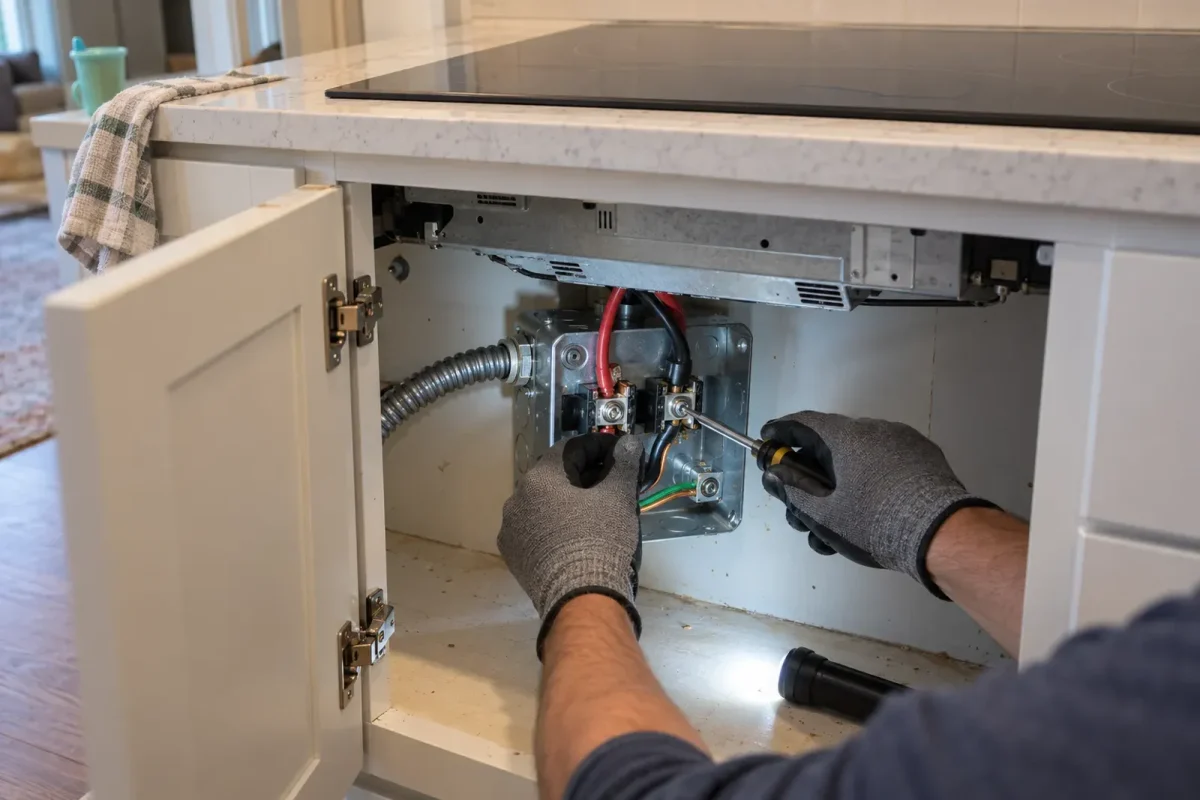
A built-in induction cooktop needs its own dedicated 208/240-volt circuit, usually 30 to 50 amps depending on the size and model. A portable induction burner needs only a standard 120-volt kitchen outlet. The exact breaker size is printed in your cooktop’s installation guide, and a licensed electrician should confirm the wire size and connection for your home and local code.
When I switched to induction, our old cooktop was gas, so we needed a brand-new 240-volt circuit. For this site, my electrician has since wired a temporary plywood counter in my kitchen for every built-in cooktop I test. Here is what each type needs, what I learned, and the questions to ask before you buy.
Induction electrical requirements at a glance
- A 24-inch to 30-inch built-in cooktop needs a dedicated 208/240-volt circuit, usually 30 to 40 amps; some need 50 amps.
- A 36-inch built-in cooktop needs a dedicated 208/240-volt circuit, usually 40 to 50 amps.
- An induction range needs a dedicated 240-volt circuit, commonly 40 to 50 amps.
- A portable induction burner uses a standard 120-volt outlet and draws up to about 1,800 watts.
- Always follow the installation guide for your exact model and your local electrical code.
Electrical requirements for the cooktops I tested
Here’s what the installation documents list for models from my best induction cooktops tests. Even cooktops of the same size need different breakers.
| Cooktop | Size | Voltage | Breaker | Source |
|---|---|---|---|---|
| Frigidaire Gallery GCCI3067AB | 30 inches | 240 volts | 30 amps minimum | Spec sheet |
| Samsung NZ30A3060UK (older model) | 30 inches | 240 volts | 30 amps | AJ Madison |
| KitchenAid KCIT730SBL | 30 inches | 240 volts | 50 amps | AJ Madison |
| Bosch 800 Series NIT8661UC | 36 inches | 208/240 volts | 40 amps | AJ Madison |
| GE Profile PHP9036DTBB | 36 inches | 208/240 volts | 50 amps (max draw 48.3 amps at 240 volts) | AJ Madison |
Retail listings checked October 2026. The installation guide that ships with your cooktop is the final word.
The biggest surprise in my testing: two 30-inch cooktops that look almost identical needed 30 amps and 50 amps. If we’d assumed, the 50-amp model would have tripped our breaker on the first pasta night.
Volts, amps and watts in plain English
- Volts (V) are the “pressure” of the electricity. U.S. homes have 120 volts at normal outlets and 240-volt circuits for big appliances.
- Amps (A) measure how much current flows. Breakers are rated in amps.
- Watts and kilowatts measure power. Watts equal volts multiplied by amps, and 1 kilowatt is 1,000 watts.
A normal 120-volt, 15-amp outlet can supply about 1,800 watts (120 × 15), which is why portable induction burners top out there. A 240-volt, 40-amp circuit can supply about 9,600 watts, which is what lets a built-in cooktop run four or five zones and boost.
208 volts vs 240 volts
Most houses have 240-volt service; many apartments and condos get 208-volt service. Most built-in induction cooktops are rated for “208/240 volts,” meaning they work on either, but with a little less maximum power on 208-volt service. For example, the PHP9036DTBB’s published specs list its maximum connected load as 11.6 kilowatts at 240 volts and 10.1 kilowatts at 208-volt service. You may notice slightly slower boiling on 208 volts; nothing else changes.
Breaker and wire size
The breaker size comes from the cooktop’s installation guide; the wire size must match the breaker under your local code. As a general guide, copper wire is commonly sized like this, but your electrician decides based on wire type, distance and local rules:
| Breaker | Typical copper wire |
|---|---|
| 30 amps | 10 AWG |
| 40 amps | 8 AWG |
| 50 amps | 6 AWG |
AWG = American Wire Gauge; a smaller number means thicker wire. Never put a bigger breaker on existing thinner wire to “make it work.”
Hardwired or plug-in?
Most built-in induction cooktops are hardwired: a flexible metal conduit (whip) from the cooktop connects to a junction box in the cabinet below. Some models come with a cord or a cord kit for a 240-volt outlet. Check the installation guide, and make sure the junction box is reachable once the cooktop is in. For more, read How to Install an Induction Cooktop.
Replacing an electric cooktop, a gas cooktop or a range
- Coming from a radiant electric cooktop, you may be able to reuse the circuit if its breaker and wire match the new cooktop’s requirement. Many older electric cooktops ran on 30 or 40 amps, so a 50-amp induction model may need new wire.
- Coming from gas, you’ll need a new 240-volt circuit from the panel, plus the gas line capped by a qualified pro. Ours cost $650 including the permit.
- Going from an electric range to an induction range, the same 240-volt range circuit usually works, but check the amps.
Related reading: Induction vs Gas, How Much Does an Induction Cooktop Cost in 2026? and Induction Stove Rebates and Tax Credits.
Is my electrical panel big enough?
Look at the main breaker at the top of your panel (often 100, 150 or 200 amps) and count free breaker spaces. A cooktop needs a double-pole breaker, which takes two spaces. Homes with 100-amp service and electric heat, a dryer and an electric vehicle (EV) charger may not have room; an electrician can do a load calculation. If the panel is full, options include a panel upgrade, a load-management device, or a lower-amp cooktop like the 30-amp Frigidaire Gallery.
120-volt and portable options
If you can’t add a 240-volt circuit, you still have options:
- Portable induction burners plug into a regular outlet. Use a circuit with nothing else running. See my best portable induction cooktops.
- 120-volt two-burner plug-in cooktops drop into a small cutout but share about 1,800 watts between both zones. See best 120-volt induction cooktops.
- Battery-assisted cooktops and ranges use a built-in battery to deliver more power from a 120-volt outlet.
Checklist before you buy
- Find the voltage and breaker size in the installation guide for the exact model.
- Check your existing circuit’s breaker and wire size, or plan a new circuit.
- Check your panel’s capacity and whether it has free spaces.
- Confirm whether the cooktop is hardwired or uses a cord, and where the junction box goes.
- Ask about a permit; many areas require one for a new circuit.
- Hire a licensed electrician and keep the paperwork for warranty claims.
FAQ
Do induction cooktops need 220 or 240 volts?
Built-in induction cooktops need a 208/240-volt circuit (often called “220 volts” in everyday speech). Portable induction burners run on a normal 120-volt outlet.
How many amps does an induction cooktop need?
Most built-in induction cooktops need a dedicated 30 to 50 amp circuit. In my tests, 30-inch models ranged from 30 to 50 amps and 36-inch models from 40 to 50 amps. Check your model’s installation guide.
Can I plug an induction cooktop into a regular outlet?
Only a portable induction burner or a small 120-volt plug-in cooktop. Full-size built-in cooktops need a dedicated 240-volt circuit.
Can I use my old electric cooktop’s circuit for induction?
Often yes, if the breaker and wire size match the new cooktop’s requirement. If the new model needs more amps, the wire and breaker must be upgraded by an electrician.
Will an induction cooktop work on 208 volts?
Most models rated 208/240 volts work on 208 volts with slightly less maximum power, so boiling may be a little slower.
Do I need an electrician to install an induction cooktop?
For the electrical connection, yes. A licensed electrician should confirm or install the circuit, and many areas require a permit.