Friday is fried rice night in our house, and it was the one dinner I never got right after switching to induction. My round-bottomed wok rocked on the flat glass, and the moment I lifted it to toss, the heat cut out. My kids were polite about the soggy rice, but I wasn’t fooled.
So in October I tested six induction wok burners, the kind with a curved glass top that cradles the wok, on our kitchen counter. Each one got the same 14-inch carbon-steel wok and the same 3-cup fried rice recipe three times, plus a beef stir-fry and a pot of hot-pot broth. My kids judged the rice, and an infrared thermometer told me how hot the bowl and sides of the wok really got.
The NuWave Induction Wok made the best fried rice of the six. It comes with its own 14-inch carbon-steel wok that sits close to a curved coil, and it got the wok to 450°F in 2 minutes and 5 seconds. If you already own a round-bottomed wok, the 1700W concave induction wok cooktop is the best bare burner. If you want a dial, the VEXMAECY 1800W has one.
Cooking on a flat cooktop instead? A flat-bottomed carbon-steel wok works on any induction zone; see what cookware works on induction. For restaurant-level power you’ll need a 240-volt unit from my commercial picks. If you want real stir-fry at home, keep reading.
My rankings at a glance
| Rank | Cooktop | Best for | Power (watts) | Wok to 450°F in | Fried rice | My rating |
|---|---|---|---|---|---|---|
| 1 | NuWave Induction Wok | Best overall | 1,500 watts | 2 min 5 sec | Best: dry, separate grains | 8.5 |
| 2 | 1700W Concave Induction Wok Cooktop | Best bare burner for your own wok | 1,700 watts | 1 min 55 sec | Very good | 8.3 |
| 3 | VEXMAECY 1800W Concave Wok Burner | Best with a dial | 1,800 watts | 1 min 50 sec | Very good | 8.0 |
| 4 | 1700W Induction Wok with Stainless Wok | Best set with steady low heat | 1,700 watts | 2 min 10 sec | Good (stainless wok sticks) | 7.7 |
| 5 | NuWave Mosaic Induction Wok | Best for RVs and small circuits | 1,500 watts | 2 min 25 sec | Good | 7.3 |
| Skip | No-name 1700W concave | Not recommended | 1,700 watts | 3 min 40 sec | Steamed, not fried | 5.2 |
Wok temperatures were read with an infrared thermometer at the center of the same 14-inch carbon-steel wok on the highest setting, middle of three runs. Ratings are out of 10.
Induction wok burner reviews
Here’s how each wok burner did in my kitchen, best first.
1. Best overall: NuWave Induction Wok

Quick facts: Power: 600, 900 or 1,500 watts settings · Temperature: 100–575°F in 5°F steps · Wok: 14-inch heavy-gauge carbon steel, included · Weight: 14.4 pounds with wok · Controls: Digital touch; change time or temperature while cooking
My results: 450°F in 2 minutes and 5 seconds; fried rice best. My rating: 8.5 out of 10.
The NuWave pairs a curved base with its own 14-inch carbon-steel wok, so the fit is right out of the box. Setting a temperature instead of a power level is surprisingly useful in a wok: I set 450°F for fried rice and 325°F for the garlic and ginger, and nothing burned.
At 1,500 watts it isn’t the most powerful, but the close fit made up for it. Owners mention limited capacity, and I could only stir-fry about 4 cups of food at a time before it steamed instead of seared.
What I liked
- Its wok is included and fits perfectly.
- It sets temperatures in 5-degree steps.
- Its low-wattage settings suit weak circuits.
What I didn’t like
- It tops out at 1,500 watts.
- It handles only small batches.
My verdict: Buy it if you want a complete wok setup that makes real fried rice at home. Skip it if you cook big batches for a crowd.
2. Best bare burner for your own wok: 1700W Concave Induction Wok Cooktop

Quick facts: Power: 1,700 watts at 120 volts; 16 power levels · Coil: 9.25-inch concave coil · Low heat: Non-pulse continuous heating, per the maker · Controls: Rotary knob plus push buttons; timer · Fits: Round-bottom woks; flat pans up to 9.25 inches
My results: 450°F in 1 minute and 55 seconds; fried rice very good. My rating: 8.3 out of 10.
This no-frills burner is for people who already own a round-bottomed wok. The 9.25-inch coil is the largest here, and it heated the sides of my wok better than any other model. The maker says it heats continuously at low power rather than pulsing, and my hot-pot broth held a gentle simmer.
It has no wok included and the brand is little known, so check the return window.
What I liked
- It has the largest coil and the best heat up the sides.
- It holds a steady low simmer.
- It has knob control.
What I didn’t like
- No wok is included.
- It’s a little-known brand with a shorter track record.
My verdict: Buy it if you already own a round-bottomed wok and want the best heat up its sides. Skip it if you want a wok in the box.
3. Best with a dial: VEXMAECY 1800W Concave Wok Burner
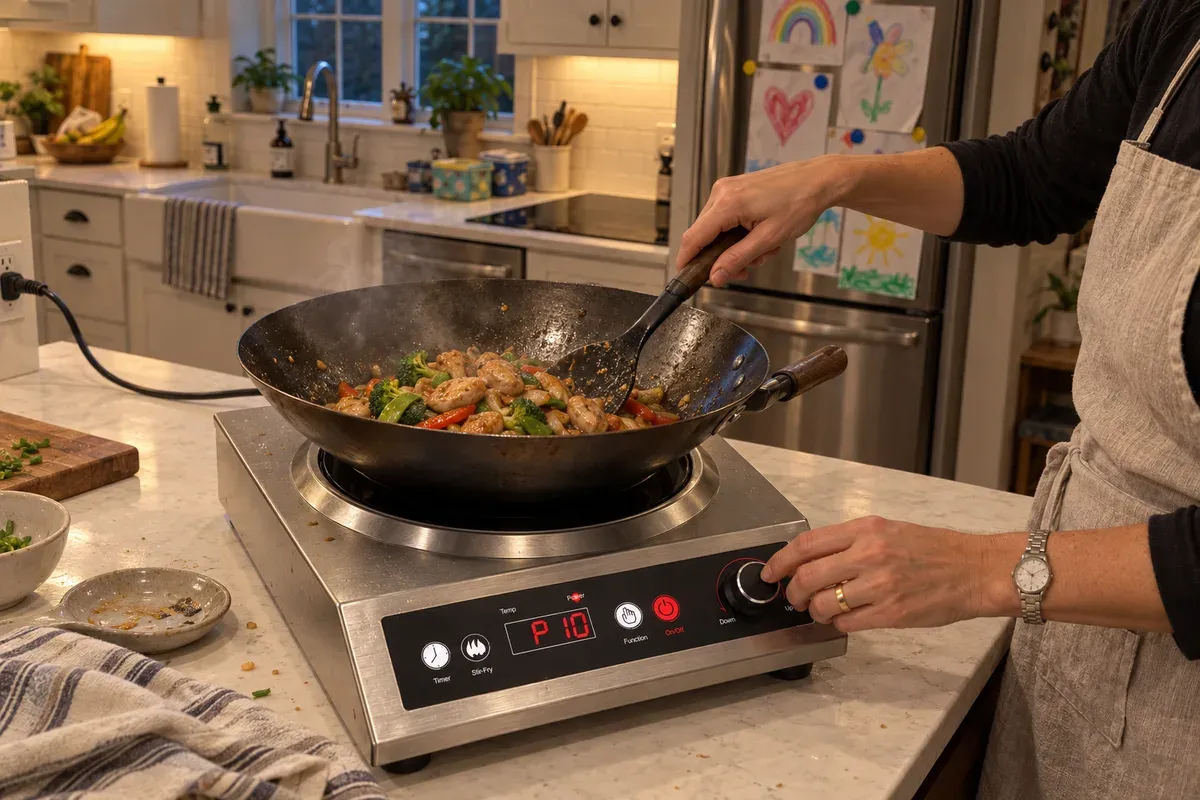
Quick facts: Power: 1,800 watts at 110–120 volts; 10 power levels (P1–P10) · Temperature: 10 settings, 140–460°F · Concave surface: 9.84 inches across, 1.8 inches deep · Controls: Touch plus knob; “Stir fry” mode; 24-hour timer · Warranty: 12 months, per the listing
My results: 450°F in 1 minute and 50 seconds; fried rice very good. My rating: 8.0 out of 10.
The most powerful burner here, with a knob you can spin quickly mid-stir-fry. The “stir fry” button jumps straight to high heat. It reached 450°F fastest of all. The maker notes that flat pans heat more slowly on its curved surface, and my flat skillet was noticeably slower.
Some owners say the displayed setting doesn’t always match the heat; on mine, P7 and P8 felt almost the same.
What I liked
- It heated up the fastest.
- Its knob makes quick changes easy.
- It comes with a 12-month warranty.
What I didn’t like
- It has only 10 settings.
- It works poorly with flat pans.
My verdict: Buy it if you want the fastest heat-up and a dial for quick changes. Skip it if you also cook in flat pans.
4. Best set with steady low heat: 1700W Induction Wok with Stainless Wok
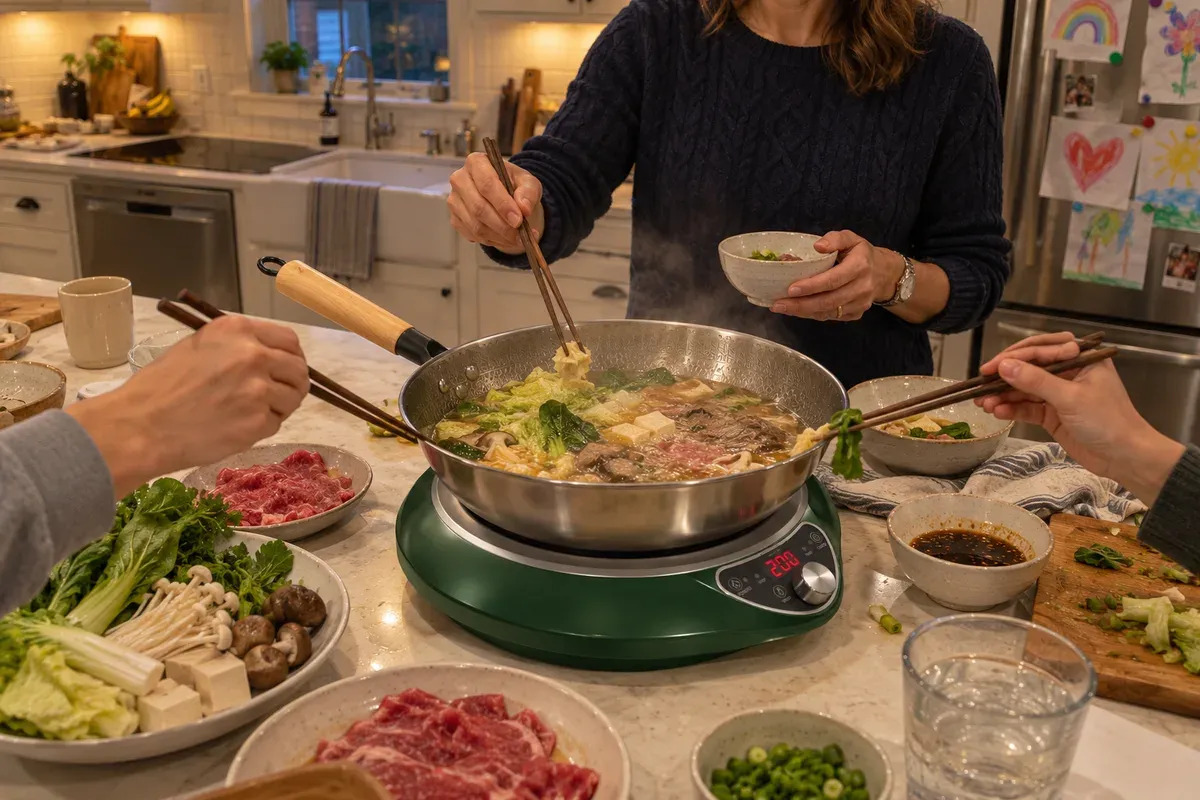
Quick facts: Power: 1,700 watts at 120 volts; 16 power levels · Coil: 9.25-inch double-layer copper coil, concave · Low heat: Non-pulse continuous heating, per the maker · Wok: Stainless steel wok included · Weight: 6.9 pounds
My results: 450°F in 2 minutes and 10 seconds; fried rice good. My rating: 7.7 out of 10.
This looks like the same burner as #2 sold with a stainless wok. The burner is great; the wok is the weak link. Rice stuck to the stainless wok until I swapped in my carbon-steel one. It’s the best pick here for hot pot nights thanks to its steady low heat.
What I liked
- Its steady low heat suits hot pot and soups.
- A wok is included.
What I didn’t like
- The stainless wok sticks; carbon steel works better.
My verdict: Buy it if you make hot pot and soups as often as stir-fries. Skip it if you want the stainless wok to fry without sticking.
5. Best for RVs and small circuits: NuWave Mosaic Induction Wok

Quick facts: Power: 600, 900 or 1,500 watts · Temperature: 100–575°F in 5°F steps; 6 presets · Wok: 14-inch carbon steel with tempered-glass lid · Weight: 15 pounds · Safety: Shuts off when the timer ends; won’t start without the wok
My results: 450°F in 2 minutes and 25 seconds; fried rice good. My rating: 7.3 out of 10.
The Mosaic is NuWave’s older wok burner. Its 600-watt setting is the reason to buy it: it runs on small recreational vehicle (RV) inverters and campground hookups. It was slower than the newer NuWave and its sides stayed cooler. Some owners report cracks or melting near the base after heavy use, so avoid running it empty on high.
For more, see my guide to the best induction cooktops for RVs and camping.
What I liked
- Its 600-watt setting works on weak power.
- A lid is included.
What I didn’t like
- It’s slower than the newer model.
- Some owners report cracking.
My verdict: Buy it if you need a wok burner that runs on 600 watts in an RV or on a weak circuit. Skip it if you have full power available.
The one I’d skip
This generic burner looked identical to my #2 pick but behaved very differently: it took almost twice as long to heat the wok, the sides stayed cool, and my fried rice steamed instead of fried. It also had very few owner ratings when I checked. Spend a little more on one of the picks above.
Why a wok burner beats a flat induction cooktop for stir-frying
Induction heats only the metal close to the coil. On a flat cooktop, a flat-bottomed wok heats well across its base but the curved sides stay cooler, and a round-bottomed wok barely heats at all. A concave wok burner wraps the coil around the bowl, so heat climbs higher up the sides, which is what lets you push food up the wall while cooking the next ingredient. On my flat Bosch zone, the wok sides reached only about 280°F when the base hit 450°F; on the concave burners they reached 350–400°F.
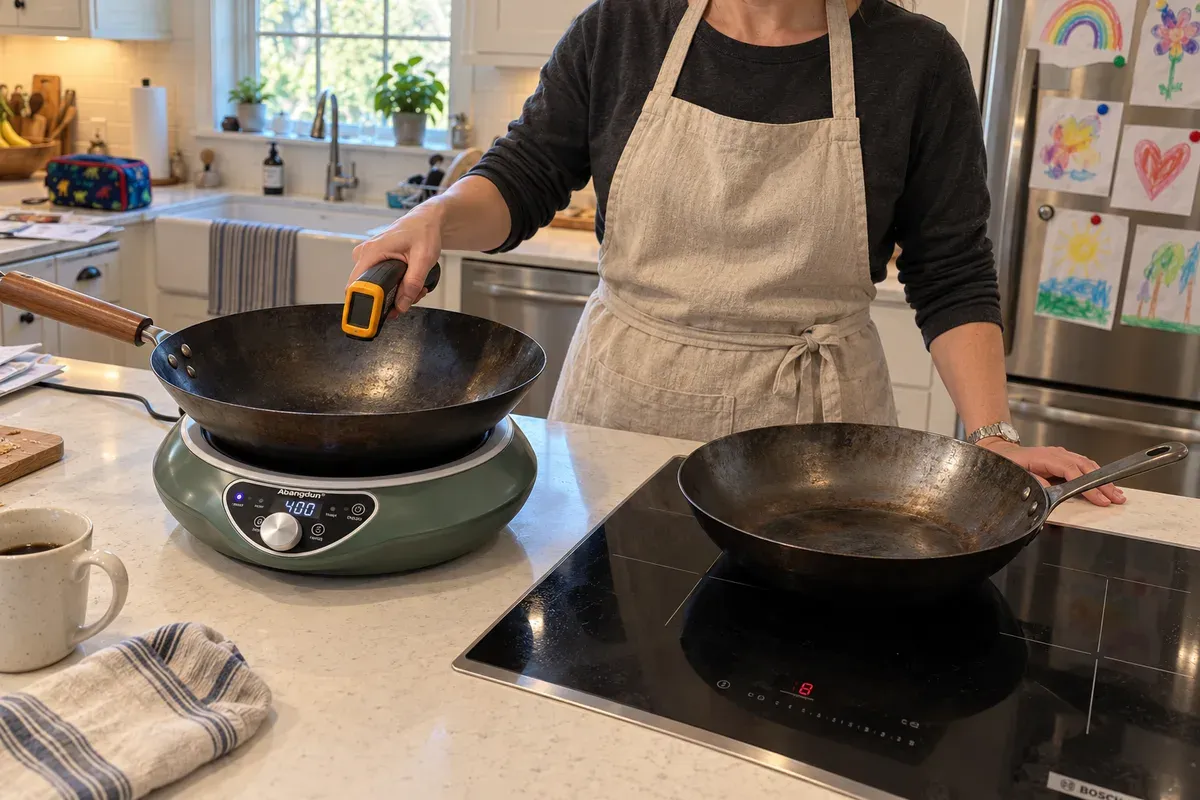
Two honest limits: a 120-volt wok burner tops out around 1,500 to 1,800 watts, far less than a restaurant wok range, and you still can’t toss the wok high in the air without pausing the heat. For true restaurant power you need a 240-volt commercial unit: see best commercial induction cooktops.
How to choose an induction wok burner
Concave vs flat
A concave burner suits a round-bottomed wok. If you’d rather use one flat burner for everything, buy a flat-bottomed carbon-steel wok and a regular portable induction cooktop instead.
Coil size and wattage
A bigger coil heats more of the wok. On 120 volts, 1,500 to 1,800 watts is the ceiling; 240-volt commercial wok ranges go much higher.
Wok material
Carbon steel is the classic: light, magnetic and nonstick once seasoned. It must be magnetic; aluminum woks won’t heat. For more, see my guide to what cookware works on induction.
Controls
Knobs are faster mid-cook; temperature settings are easier to repeat.
Power
Use a dedicated kitchen outlet. Running a wok burner and a kettle on the same 15-amp circuit can trip the breaker. For more, see my guide to electrical requirements.
Wok cooking tips on induction
- Preheat the empty wok for a minute, then add oil.
- Cook in small batches; overloading drops the temperature and steams the food.
- Keep the wok on the burner and toss with a spatula instead of lifting.
- Season carbon steel well, and dry it on the burner after washing.
Induction wastes far less heat than a gas wok burner: ENERGY STAR says about 85% of induction’s energy reaches the pan. Want more control tips? How to use an induction cooktop.
FAQ
Can you use a wok on an induction cooktop?
Yes. A flat-bottomed magnetic wok, such as carbon steel, works on any induction zone. A round-bottomed wok needs a concave induction wok burner.
Are induction wok burners worth it?
Yes, if you stir-fry often. The curved top heats the wok’s sides as well as its base, which gives better stir-fries than a flat cooktop.
Can induction get hot enough for wok hei?
A 120-volt induction wok burner gets a carbon-steel wok well above 450°F, which is enough for very good stir-fries, but it has less power than a restaurant gas wok burner.
What wok works on induction?
A magnetic wok: carbon steel, cast iron or magnetic stainless steel. Flat-bottomed for flat cooktops, round-bottomed for concave wok burners.
How many watts is an induction wok burner?
Home 120-volt models are usually 1,500 to 1,800 watts. Commercial 240-volt units go much higher.
Can you use a round-bottom wok on a flat induction cooktop?
Not well. It only touches the glass at one point, so it heats slowly and unevenly. Use a flat-bottomed wok or a concave wok burner.