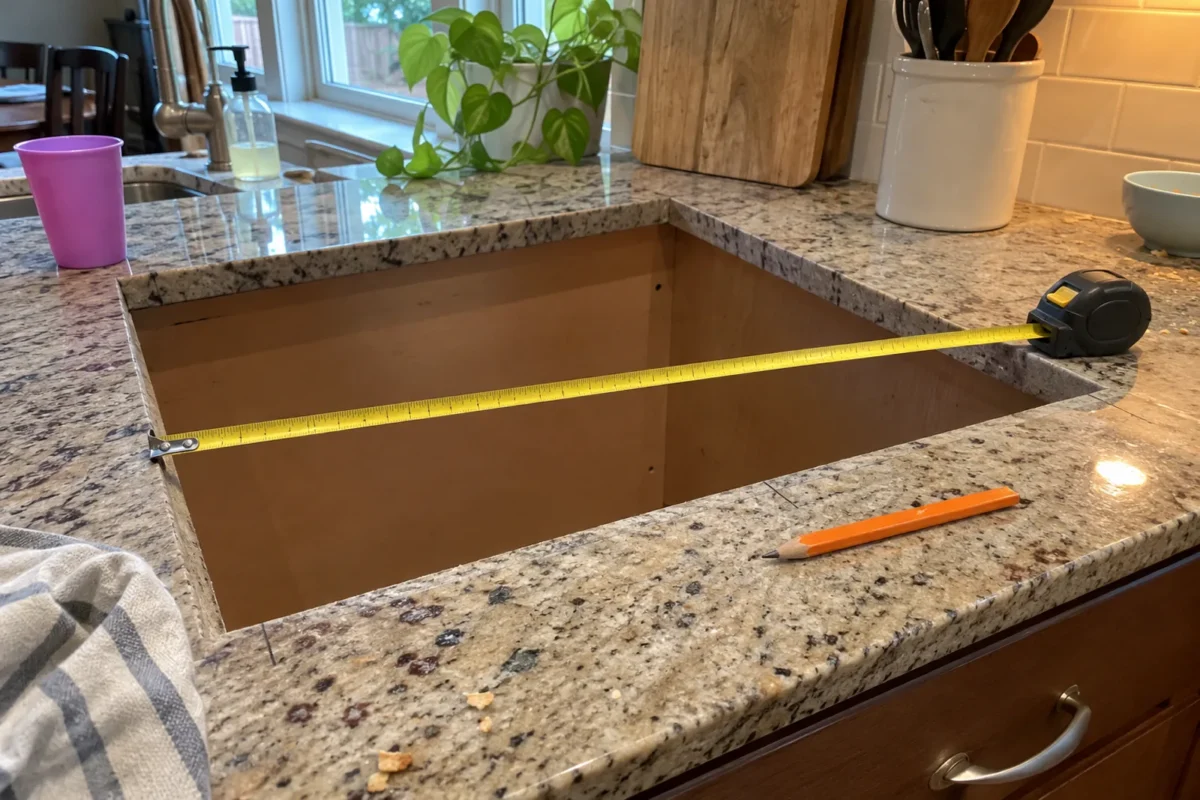
Built-in induction cooktops come in three standard widths: 24, 30 and 36 inches. The counter cutout is always smaller than the cooktop: about 22 inches wide for a 24-inch model, 28 1/2 to 29 7/8 inches for a 30-inch, and 33 7/8 to 36 1/8 inches for a 36-inch, with a depth of 19 to 20 1/2 inches. Cooktops of the same width don’t share one cutout size, so always check the exact cutout range for the model you’re buying against the hole in your counter.
Our own kitchen is a good example of why this matters. When we switched from gas, our granite installer had to widen the hole by half an inch for the Frigidaire Gallery. When I swapped that Frigidaire for a Bosch 800 Series years later, the Bosch dropped straight into the same hole. That was luck as much as planning, and while researching this guide I found pairs of same-size cooktops that won’t swap at all.
Induction cooktop sizes at a glance
- 24-inch cooktops have 3 or 4 zones and need a cutout about 22 inches wide.
- 30-inch cooktops have 4 or 5 zones and need a cutout about 28 1/2 to 29 7/8 inches wide.
- 36-inch cooktops have 5 zones and need a cutout about 33 7/8 to 36 1/8 inches wide.
- Most cutouts are 19 to 20 1/2 inches deep, front to back.
- The box below the glass hangs about 3 5/8 to 4 1/8 inches under the counter.
- The cooktop’s installation guide is the only measurement to trust.
The standard widths
- 24 inches is the compact size for condos, small kitchens and accessory units. Most have three or four zones. See the best 24-inch induction cooktops.
- 30 inches is the standard American size and the easiest to find. Four zones is typical; a few fit five. See the best 30-inch induction cooktops.
- 36 inches gives you five zones with real space between big pans. See the best 36-inch induction cooktops.
Some premium brands also sell narrow two-zone induction modules, around 15 inches wide, that you combine with other modules. And if you can’t cut a counter at all, a portable induction burner just sits on top.
Real cutout sizes, model by model
These figures come from each maker’s specification sheet. A range, like 28 1/2 to 28 5/8 inches, means any hole between those two numbers works.
| Cooktop | Width | Cutout width | Cutout depth | Breaker |
|---|---|---|---|---|
| Bosch 500 Series NIT5469UC | 24 inches | 22 inches | 19 1/4 inches | 30 amps |
| Bosch 800 Series NIT8061UC | 30 inches | 28 7/8 inches | 20 inches | 30 amps |
| GE Profile PHP9030DTBB | 30 inches | 28 1/2 to 28 5/8 inches | 19 5/8 to 19 3/4 inches | 40 amps |
| Frigidaire Gallery GCCI3067AB | 30 inches | 28 1/2 to 29 7/8 inches | 19 5/8 to 20 1/2 inches | 30 amps |
| Bosch 800 Series NIT8660UC | 36 inches | 34 3/4 to 34 7/8 inches | 19 7/8 to 20 inches | 40 amps |
| GE Profile PHP9036DTBB | 36 inches | 33 7/8 to 34 inches | 19 1/8 to 19 1/4 inches | 50 amps |
| Frigidaire Gallery GCCI3670BM | 36 inches | 33 7/8 to 36 1/8 inches | 19 1/8 to 20 1/2 inches | Check the guide |
Sources: Bosch NIT8061UC specification sheet, GE Profile PHP9030 quick specs, GE Profile PHP9036 quick specs and Bosch NIT8660UC specification sheet. Checked November 2026; models get updated, so confirm against the guide that ships with yours.
Why same-size cooktops don’t always swap
Look at the table again. A hole cut for a 30-inch GE Profile is 28 1/2 to 28 5/8 inches wide. A 30-inch Bosch 800 Series needs exactly 28 7/8 inches. That’s only a quarter to three-eighths of an inch, but on a granite or quartz counter it means calling a fabricator to recut the stone in place.
The 36-inch sizes are even further apart. A GE Profile 36-inch needs a hole about 34 inches wide, and a Bosch 800 Series 36-inch needs 34 3/4 to 34 7/8 inches. Going the other way, from Bosch to GE, the hole would be wider than GE’s range allows, and you can’t make a stone hole smaller.
The Frigidaire Gallery 30-inch is the most forgiving model in my table. It accepts anything from 28 1/2 to 29 7/8 inches wide, which is why it’s a common pick for straight replacements. Frigidaire and GE also run fit programs aimed at replacements: Frigidaire’s Fit Promise and GE’s Fit Guarantee. Read their terms, because they cover specific models and situations.
Depth, setbacks and counter space
Most cutouts are 19 to 20 1/2 inches deep. The cutout also has to sit a minimum distance from the front edge of the counter and from the wall behind it:
- Bosch asks for at least 2 1/4 inches from the front edge of the counter and 2 inches from the back wall.
- GE asks for at least 2 1/2 inches at the front, 1 3/4 inches at the back, and 2 inches to a side wall or tall cabinet. GE also wants a counter at least 25 inches deep, with at least 23 1/2 inches of flat surface.
Standard counters are about 25 inches deep, so this usually works. Where it gets tight is a counter with a raised backsplash ledge, a deep window sill, or a thick front edge profile. Measure the flat, usable depth, not the full slab.
Leave room beside the cooktop, too. Kitchen designers following National Kitchen and Bath Association planning guidelines plan at least 12 inches of counter on one side of a cooktop and 15 inches on the other, so you have somewhere to set a hot pan down.
How deep it goes below the counter
An induction cooktop isn’t just a sheet of glass. Underneath is a metal box with the electronics and a cooling fan. On the Frigidaire Gallery it’s 3 5/8 inches deep, and on the Bosch 800 Series it’s 4 1/8 inches, plus the air gap the maker asks for. Bosch includes a 1-inch ventilation gap in its installed depth, and GE asks for 3 inches of free space between the cooktop and anything combustible below it.
In a standard base cabinet, that often means the top drawer has to be shortened or removed. If you want a wall oven underneath, the numbers get stricter, and some ovens aren’t approved at all. I cover that in Can You Put an Induction Cooktop Over a Wall Oven?
How to measure your existing cutout
Measure the hole, not the old cooktop. The glass overhangs the cutout by an inch or more on every side, so measuring the glass tells you nothing useful.
- Turn off the breaker for the cooktop.
- Look from below first. Open the cabinet under the cooktop. You can often see the edges of the cutout and measure the width from underneath.
- If you can’t see it, lift the old cooktop. Most are held by clips or brackets from below. Have a second person help, and don’t strain the cable.
- Measure the width at the front and at the back, and the depth at the left and at the right. Cutouts are rarely perfectly square, and the smallest number is the one that counts.
- Note the corners. Some cutouts have rounded corners, and a few cooktops list a maximum corner radius.
- Measure the counter thickness and the distance from the cutout to the front edge and to the wall.
- Find the junction box and measure how far it is from the cutout. Bosch’s cable is 37 inches long and GE’s is 48 inches.
Then compare your numbers with the cutout range in the installation guide for each model you’re considering. The guides are free to download from the maker’s site or the retailer’s product page.
If the cutout is too small or too big
- Too small: the hole can usually be enlarged. On laminate it’s a quick job with a jigsaw. On granite or quartz, a fabricator cuts it in place with a wet saw. Ours cost $150 for half an inch. Ask about dust protection and whether the cut weakens a narrow strip of stone at the front or back.
- Too big: this is the hard one, because you can’t add stone back. Look for a model with a larger cutout range, or one with a stainless frame that covers more of the edge. If nothing fits, the counter section may need replacing.
- Too shallow or too deep: treat it the same way. Depth is easier to get wrong because people only measure width.
The full installation process, from the breaker to the final test, is in How to Install an Induction Cooktop.
Framed, frameless and flush-mount
- Framed cooktops have a stainless steel edge. It protects the glass edge from chips and can hide a slightly rough cutout.
- Frameless cooktops show only beveled glass. They look cleaner and are easier to wipe, but the exposed edge is more vulnerable, so lift heavy pots rather than sliding them off the side.
- Flush-mount cooktops sit level with the counter. The fabricator routes a ledge around the cutout so the glass drops in, and it has to be planned before the counter is made. It’s mainly a premium-brand option.
Which size should you choose?
If you’re replacing a cooktop, the counter usually decides for you. If you’re designing a kitchen:
- Choose 24 inches for a small kitchen or a household of one or two.
- Choose 30 inches for most families. Four well-spaced zones handle everyday dinners, and it’s the size with the most models to pick from.
- Choose 36 inches if you regularly cook with three or four pans at once or use big stockpots and griddles. Check that your circuit can handle 40 or 50 amps; see induction cooktop electrical requirements.
Still deciding between models? My guide to choosing an induction cooktop covers the other things to check before you buy.
FAQ
What are the standard induction cooktop sizes?
The standard widths are 24, 30 and 36 inches. Some premium brands also make narrow two-zone modules around 15 inches wide.
What is the cutout size for a 30-inch induction cooktop?
Usually 28 1/2 to 29 7/8 inches wide and 19 5/8 to 20 1/2 inches deep, but it varies by model. For example, the Bosch 800 Series needs 28 7/8 by 20 inches, and the GE Profile needs 28 1/2 to 28 5/8 by 19 5/8 to 19 3/4 inches.
What is the cutout size for a 36-inch induction cooktop?
Usually about 33 7/8 to 34 7/8 inches wide and 19 to 20 inches deep. The GE Profile 36-inch needs about 34 inches and the Bosch 800 Series 36-inch needs 34 3/4 to 34 7/8 inches.
Will a new induction cooktop fit my old cutout?
Only if your hole falls inside the new model’s cutout range. Measure the cutout itself in two places each way and compare it with the installation guide.
Can I put a 30-inch induction cooktop in a 36-inch cutout?
No. The 30-inch glass won’t cover the larger hole. You’d need a new counter section or a 36-inch cooktop.
How deep is an induction cooktop below the counter?
About 3 5/8 to 4 1/8 inches for the models I checked, plus an air gap. That’s why the top drawer below a cooktop often has to be shortened or removed.